
The exhibition by Jan Hendrix takes me back almost thirty-five years. His first shows remain indelible in my memory like the notes that I have taken of past exhibitions before deciding what to write. The young artist, who chose serigraphy as his expressive medium, exhibited his work at the same gallery—GAM—which back then was located on the outskirts of the Zona Rosa neighborhood. An earlier exhibition by Jan Hendrix was also presented at the GAM—already located in its current address in San Miguel Chapultepec—during the last months of 2015. I cannot erase the parameters that lead me to that place. Since the Dutch citizen settled in Mexico in the late 1970s, the delicacy of his works focused on nature, its foliage, and sections of landscapes offered the audience a subtle experience. Back then, it was rare that this first-rate gallery devoted its exhibition space to prints, as it used to favor paintings, sculptures, and some drawings by renowned artists. However, Jan Hendrix’s consistent body of work was charged with subtle aesthetic messages. And this is the reason why the gallery has been exhibiting his works for decades. Through the years he has also incorporated bridges of expanding dimensions and luminosities, inhabited by differentiated, multi-matteric, and multi-resolutive creations.
In the new century Jan Hendrix has been creating monumental projects associated with architecture and integrated into the urban landscape, the outdoors, as well as in public and private spaces. Two-dimensionality has not disappeared from his language; it has been incorporated into the three-dimensional works—as circular, labyrinthine, and layered facets—that play with the interaction between translucencies and drafts. Although paper and silkscreen continue to be an important part of his work, other materials like bronze, Mylar, porcelain, glass, steel, Corian, epoxy resin and bright-mirrored finishes construct a universe in which we recognize Hendrix’s continuing artistic evolution, even when his career seemed stable and “satisfied.” Watching his works is immensely measurable. Viewers may decide to “see figurative works again,” “different leaves,” “analyses of plant structures,” “signals that the artist discovered for us.” Gradually, the delicacy of the frames and the grace of irregularities generate a different view about things that we thought we knew and had observed on other occasions, either in parks or museums. We cannot approach the work of Jan Hendrix with a system, with the déjà vu system. He presents it that way but also conveys infinite dimensions, various states of “being,” sensuality, and suspended materials.
Jan Hendrix is a serious and unassuming artist. He is a tireless traveler who has learned to prefer works that can be rolled and travel unframed, like the leaves carried by the wind in autumn. The geographies in which he presents his several exhibitions each year continue to grow in number. Official invitations, commissions, and the pleasure of working in his workshop keep Hendrix in a constant creative state. Leaves, those beautiful vestiges bitten by birds and pounded by storms—these fossilized leaves comparable to textured volcanic rocks, some of an infinite lightness, others solid presences on earth—are never repeated. Whether they are algae, constellations, allusions to clouds, vegetation fragments, perforations on acrylic, steel, or other materials, in the exhibition titled The We of Me Hendrix offers an induction of post-conceptual art into transmodernity.
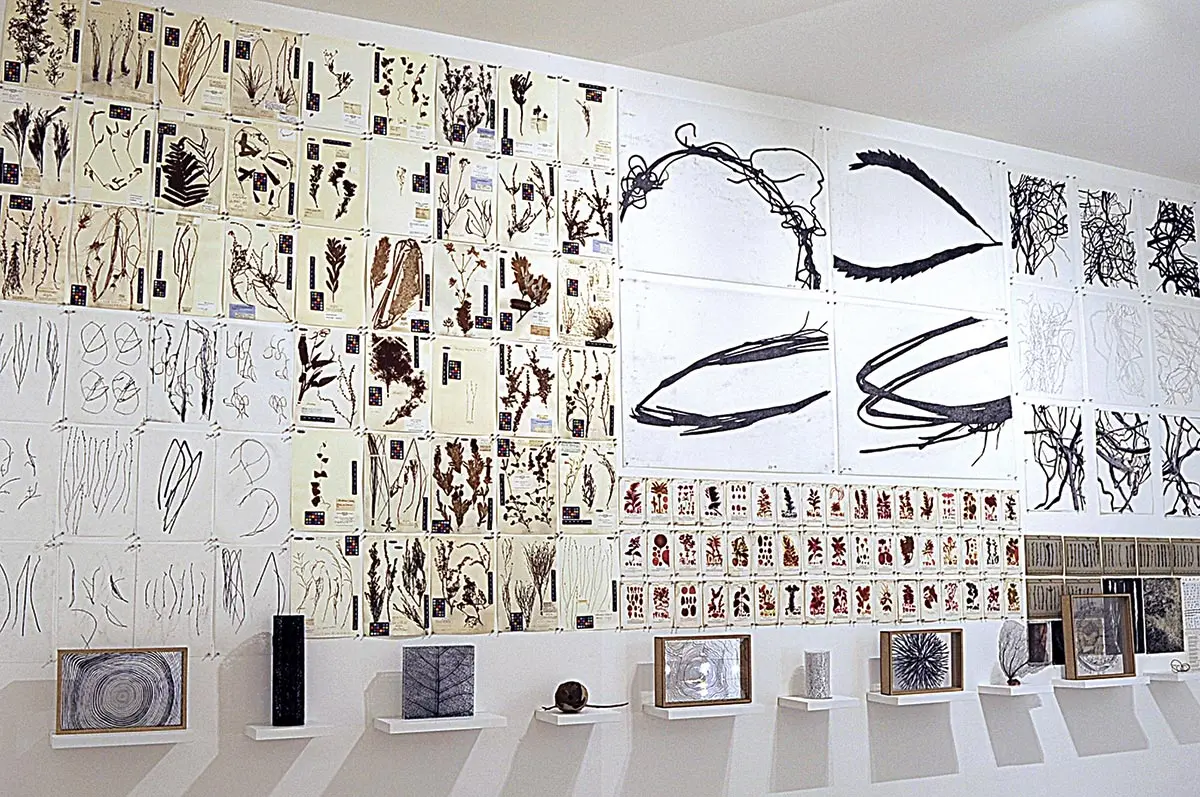
Medium size works (40 by 80 cm), cut out acrylics measuring 320 by 370 cm like La Tour Blanche 3 and 4; bronze sculptures—which are more reliefs than sculptures—that measure 120 by 150 cm and other works of similar dimensions, have achieved diverse impressions in the gallery. Always loyal to his roots, Hendrix’s innovative designs are not limited to a single material or technique. Through the exploration of different experiences, he finds a contemporary vocabulary that incorporates even shiny or reflective elements. A visit to his workshop a few months before the opening of The We of Me offered me a glimpse of what I would later encounter in the gallery. Several works, sections and expanded sketches exhibited on a large wall of the gallery were also present in his studio across from his large desk. “I always wanted to have a big table,” he said to me as we both visually considered it in silence, comparing his desk and the large wall with objects that were to be included in the exhibition, considering the great change in scale that his work has experienced during this century in which we live.
GRACIELA KARTOFEL