
We could find in the retrospective by Johanna Calle a series of works that suggest meticulous, deep-rooted, expectant, and, suddenly, anxious elements. We could also find a clean and neatly arranged space where painful questions about our present are gradually formulated through several projects. But no matter the meaning we draw from the exhibition, we will likely find some of those elements troubling and hurting viewers as they get closer to the delicate lines rendered with thread, pencil, fine point pen, or typewriter. We walk through an exhibition with subtle surprises, given that many of the projects presented there are unknown to those of us who have been following Calle’s artistic trajectory for several years. But whether the works were created two decades ago or are recent inquiries, we are nevertheless surprised by the aggressive beauty that her drawings contain.
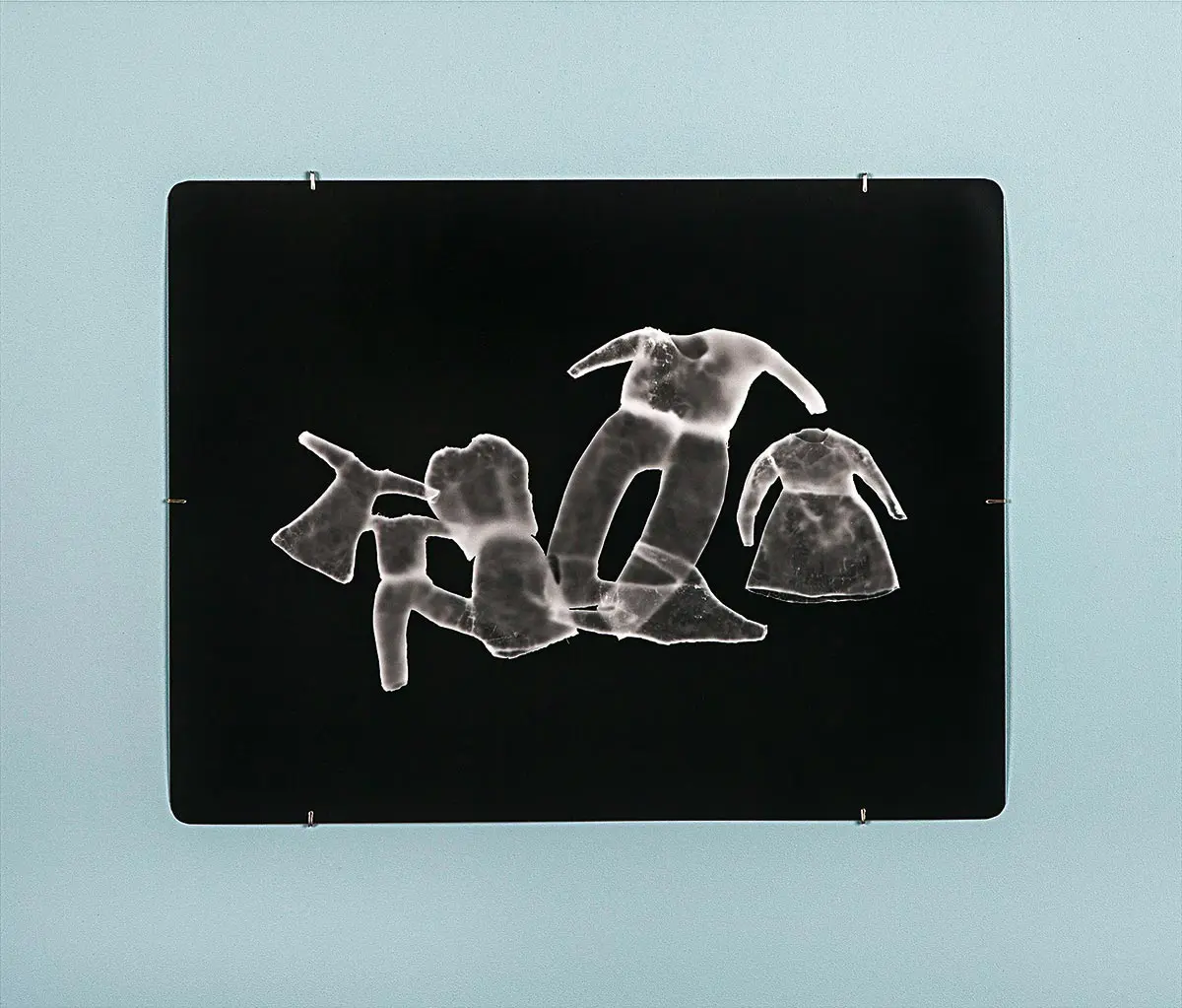
Even so, it is necessary to carefully look for each of the aspects previously mentioned. Calle’s projects are born from previous ones like a weave without beginning or end, playing with us as if we were inside a Borgean labyrinth. Her works intertwine in such a manner that her inquiries open endless paths to new forms of making things visible. Newspaper reports about the daily disappearance of children in Colombia gradually make way for a series of portraits anchored on canvases that attempt to thread something extremely mundane and absurd at the same time. And even when, like in this instance, it is one of her works from almost twenty years ago, we cannot but be surprised and sorry about the terrible currency of such subject matter. They are not situations that achieve a calm state through time. On the contrary, they have multiplied with the passing of time. Thus, the prophetic nature of Calle’s affirmation that “[…] works are never finished, they are part of a continuous process.” Stories are repeated, problems never go away, and Calle, like Sisyphus, continues to roll the stone uphill in an attempt to understand the cracks that open in human nature. And if this work, titled Nombre Propio (Proper Noun), found a way of materializing on the raw canvas and the thread, the next one, titled Adiós a Bogotá (Goodbye to Bogota), achieves its visual power with steel needles on cardboard, generating musical writings on invisible pentagrams. Further ahead, the piece Perímetros (Perimeters), describes large trees on notary papers created with a typewriter, perhaps to indicate the holes and incongruences in the laws enacted from the center of a country that has turned its back to its other regions. While some works, like Progenie (Lineage), resort to photography as evidence, as negative; others like Colombianismos, use it as support to scratch some of its parts to enunciate the voids in the image. In any of them, Calle demonstrates the same insistence with which she created an alphabet—Prelude (Preludio)—in order to “play with those signs” and be able “to translate words that are not part of a more familiar language.”
All of which involves a process, a careful selection of materials, a precision in the manner in which each material must be expressed; but, most importantly, a rigorous approach to the research and time that the work needs to become visible. Calle makes this clear when she insists that her project requires a process designed to evolve rather than to seek results. Her drawings “[…] are not strokes of luck.” On the contrary, they are testimonies that affect us because of their visual maturity. It is clear that each project in the exhibition stems from the construction of an archive rich in images, readings, and experimentations with materials. At a time when we search for expediency and immediacy in each aspect of life, the exhibition reminds us that life itself is a process. That what we today see in the newspapers with astonishment is nothing more than a series of historic events that have been forged through time by us, in the same manner, that language, nature, and child abuse have. Thus, her works must answer to that process, to that insistence; patiently waiting for those who know that historic references are not created instantly, but require a lot of respect for the process and its avatars.
Motivated for how little she knew about Calle’s work, Helena Tatay spent nearly four years developing a relationship with the artist to build the exhibition now presented at the Museo del Banco de la República. In a collaborative effort, both artist and curator have spent that time cultivating a project that is the result of silent, but terribly compelling, work.
ANDRÉS GAITÁN T.