
The Galería Nueveochenta presented in Bogota the exhibition titled Between the Floor and the Wall by Colombian sculptor John Castles. Curated by Osbel Suárez, the exhibition provided a comprehensive look at the sculptor’s production created between 1970 and 1985. It consisted of about fifty works including drawings, sculptures, and public sculptural projects that show Castles’ interest in exploring the relationship between volume and space through the use of industrial materials whose properties are an essential part of the work.
This survey of his work reveals that much of his artistic production was influenced by his training as an architect in Medellin during the 1970s—the reason for being regarded by critics like Luis Fernando Valencia as an urban artist. His drawings, oxidized papers or ferrographies, and the sculptural language with which he displays a special mastery over public spaces are characterized by the precision of the lines and the compelling force of the volumes.
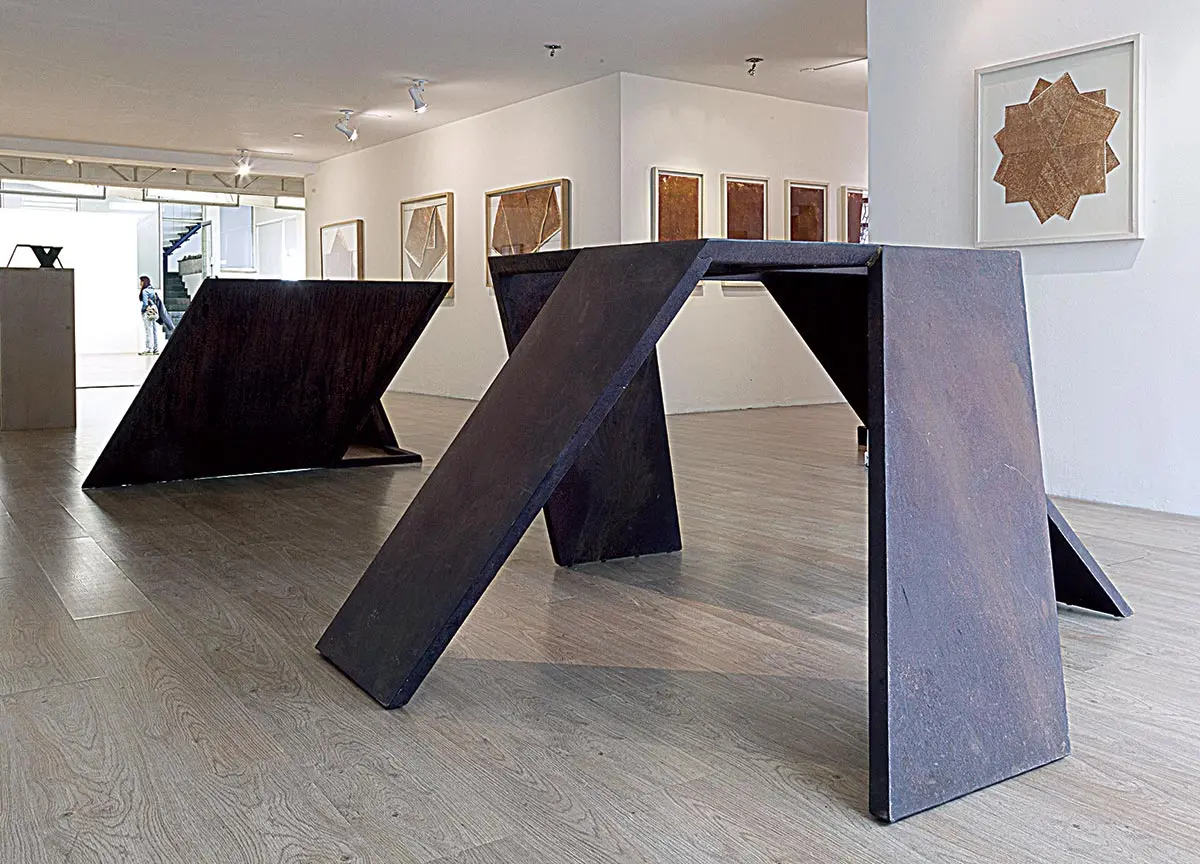
The exhibition at the Galería Nueveochenta was particularly significant because it included the reconstruction of works never before seen by the public of Bogota, like Sin Título (Untitled, 1981), the piece with which Castles participated in the Fourth Biennial of Medellin—which consists of four loose sheets of steel held solely by their opposing weights—or Pórtico (1972), made with PVC pipes and the work with which he participated in the Third Coltejer Art Biennial in Medellin. The exhibition also included works in aluminum produced between 1972 and 1975, which are rarely displayed nowadays and whose spatial, structural, and technical approach was influenced by one of his mentors, sculptor Edgar Negret.
More than a mere chronological survey, curator Osbel Suárez offered a panoramic view that allowed us to evaluate Castles’ oeuvre through the years and to identify the recurrent elements in his explorations.
One such element is his exploration of the support, referenced in the title of the show. Castles not only demonstrates an obsession with observing the behavior of the materials in the space, or establishing a dialogue between volume and emptiness, but also with exploring the manners in which the works relate to their supports, whether on the wall or on the floor. One of the emblematic works associated with this concern, and perhaps one of the most impressive of the exhibition, is Esquina No. 8, Center’s Piece, originally created in 1983 for the exhibition New Spaces—curated by US critic John Stringer in the exhibition hall of the Center for Inter-American Relations in New York—and recreated for this exhibition at the Galería Nueveochenta. With this piece—which consists of metal rods and rods painted on the wall— Castles clearly shows his interest in the supports. He opted to do without pedestals as traditional supports and use the floor instead as active support; without any tricks, gimmicks, frameworks, or levers; the rods rest on each other and project their shadow onto the wall. The shadows are complemented by painting to emphasize the three-dimensional projection on the plane and to create the illusion of multiplication that affirms the presence of the piece in space.
This play with perception was already present in sculptures like the Del Suelo a la Pared 3 (From the Floor to the Wall 3, 1981), and continued to persist throughout the 1980s. In these sculptures, which use vinyl to enhance the shade, the artist covers a height of 1.60 meters—the average height of the eyes and the place where we locate the horizon—making the depth of field disappear. Subtly, Castles gives his works the ability to challenge the viewers’ own perceptions.
On the other hand, the exploration of the language of the materials proposed by Castles, takes advantage not only of the malleability of metal, but also of its natural, uncovered, color, in order to approach the life of the material, its interaction with space, reaction to gravity, and transformation over time.
Perhaps one of the most striking aspects of the exhibition is the review of works by an artist who since the mid-seventies has been thinking about and producing works that have an installation nature. Despite their heavy appearance, Castles’ sculptures are not total or definitive, they do not exist without the place in which they were located; on the contrary, they are modular sculptures that only make sense when assembled in the space.
The exhibition was accompanied by the release of the book John Castles, Entre el Suelo y la Pared (John Castles, Between the Floor and the Wall), with an introduction by Carlos Hurtado, a comprehensive essay by the curator of the exhibition titled John Castles y la Escultura Colombiana del Último Medio Siglo (John Castles and Colombian sculpture from the Last Half Century), and a complete chronology of the artist.
MARIA CLARA BERNAL