
No matter how much it wants to appear otherwise, Colombia—like a large section of Latin America—will remain marked by painting as a medium and by the narrative as a strategy. This statement may rub some people the wrong way, which should not surprise us in the least, especially considering that in the face of prevalent uncertainties about what we are and what we have, the unceasing quest for novelty has resulted in a journey back in time: the design of a strategy that pushes academic, financial, and social attention in the direction of the past in order to discern what in its time wasn’t discerned and, in a way, rectify the course and find the lost path.
To that we must add some utterances often repeated in recent years, such as “painting is exhausted”; “the form of art is and must be different”; “this is the moment of drawing, which is not mediated by the aspiration of being art”; “society needs artists committed with working with the community.” Such views have appeared continuously since 1984 when Arthur C. Danto’s The End of Art shook our paradigms. Yet, each of these utterances can be countervailed by its opposite, returning our gaze to the producers, to what is made, and especially to what is legitimized as language.
The debate around the validity of art, and particularly of painting—something that flares up in cycles, following the rhythms of the market—comes undone when the art system confronts us with artists who, in spite of all that and perhaps focused on their own stubbornness or enraptured in their labor, remind us that painting is, was, and will always be the medium through which humanity recreates its myths, exorcises its fears, and projects its experience in almost shamanic ways.
Certainly, the art system recognizes that persistence is the most expeditious way to reach one’s goals. Stubbornness becomes, thus, an ingredient of the creative operation. Insisting on a way of seeing the world, which is nothing but the principle of creating new worlds as Nelson Goodman pointed out in 1984,1 is an unstated goal of the arts. In consequence, encountering a painter is a transcendent relief, a comfort, and a joy even for the most aseptic of critics—one of those moments that give us all a Mona Lisa smile.
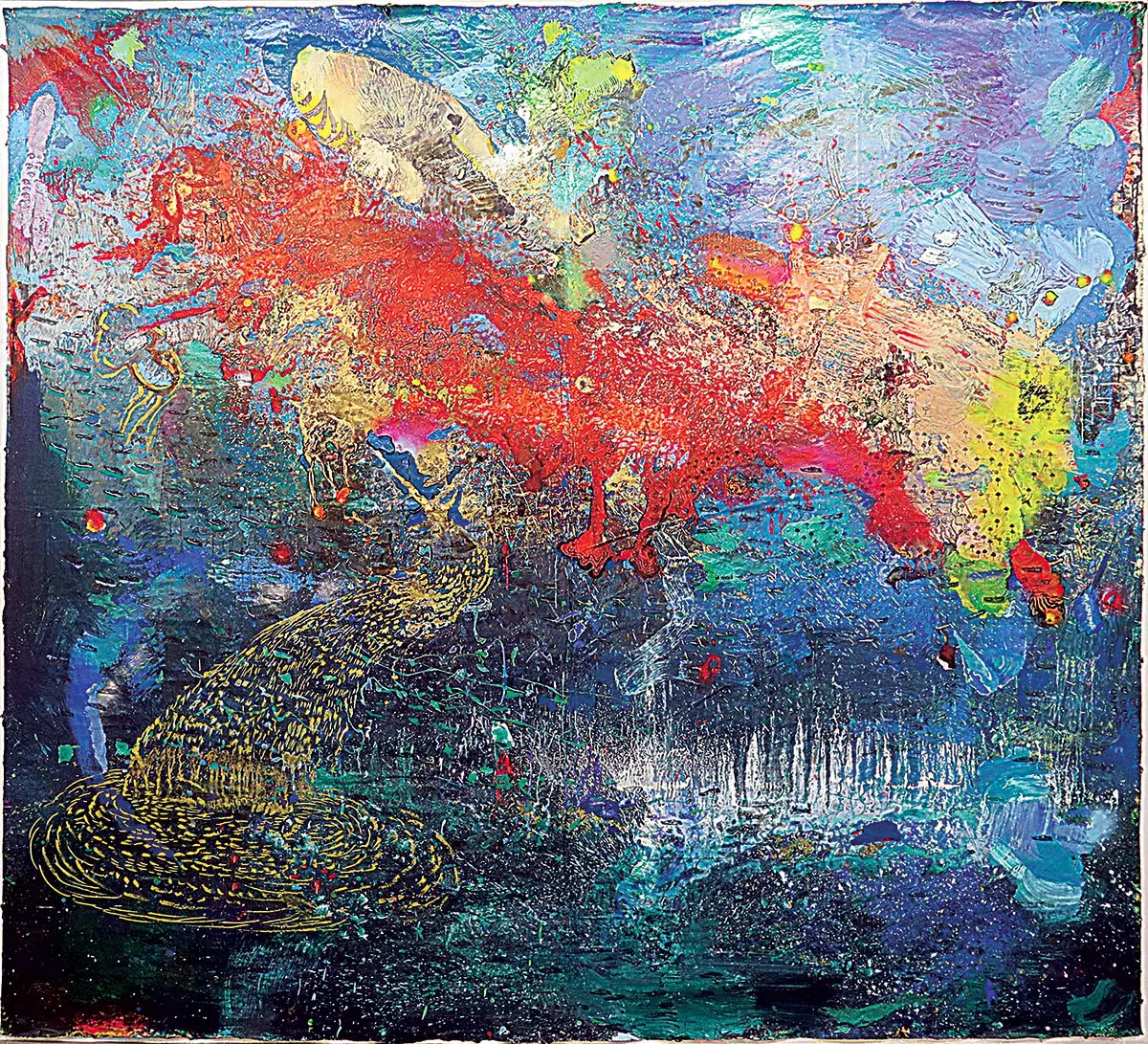
Last year, El Museo Gallery in Bogotá presented the most recent fruits of José Horacio Martínez’s pictorial investigations. Martínez is a Painter with a capital “P”, one who reminds of what we mentioned before and is capable of updating the validity of this medium. Recognized already at the now-mythic National Artists Salon in 1994, Martínez surprised us now with his Travesías (Journeys), the title of his show, part of the end-of-year programming in the Colombian capital. Like navigation charts for a journey about to set sail, promising to take us to unsuspected domains, his paintings are loaded with a unique power to involve us in their spatiality, so prematurely that it is hard not to look at and inhabit them. A single look and we are in; getting out, however, is a different matter.
Continents, islands, oceans, sierras, deserts, forests, hills, rivers, lakes, waterfalls, canyons, plateaus, ice-capped mountains, beaches, coastlines, and isthmuses all appear and fade out so fast that we are not even certain of their presence. A blink and the focus of the narrative we thought we had in front of us dissolve. We struggle to sustain our attention in order to follow the prescribed course if any exists.
Among those shapes, routes, pathways, and journeys are drawn to guide a gaze that becomes shifting. In vain we search for a resting point: once we have entered this space, these maps begin to inhabit us, taking possession of our senses and altering our way of thinking, with a logic intent on deciphering the mysteries that hide within. After a while, we finally understand that this is a different time, a different space, and find comfort in that knowledge.
These paintings bring forth new elements, perhaps because they have been conceived on the basis of the most excellent pictorial tradition and combined with a divergent and propositive logic. Their greatest virtue is that they aspire to nothing other than the dynamic interplay of form and chromatic communication. None of the formats presented in the gallery ceases to be in construction. They seem to lack a layer of sealant to stop their continued flow: that is their secret. Similarly, the references that emerge and allow themselves to be captured by our gaze incessantly recreate the relationship between logos and mythos. The apparitions speak from a place of symbolic integrity and continue to connect randomly with the geography they populate and with other accidents or figures that emerge from below, above, or behind. In the same way, the surface is an organic band and recreates a fractal system that in no way clarifies the coordinates used for its design. In sum, this is a journey on a Möbius strip that ensnares us with the force of its color, the plot of a possible drawing, and the soundness of a different, yet necessary kind of painting.
Pure and random splotches, an effective graphic intervention, imprints, and chromatic juxtapositions between ink and colors all challenge the canonical postulates of painting in order to arrive at forms and concepts united in a single front: the sublime timeless manifestation of the notion of the journey.
Each canvas in the gallery is a world, a sum total, and a universe. A little skill and imagination suffice for us to enter into any one of them or exit any other, and in that way, we jump between them with the certainty that something from each is staying with us. One will hardly remain unchanged after traveling in this cosmos.
As we pointed out before, we live in a land of painters, of chroniclers of the blotch and the drip. It is gratifying to encounter journeys of this kind, documents that tear apart certitudes with skilled hands-on arguments, which are indeed more potent than reason. Any censure of the medium serves only to demonstrate its good health; it emerged with the earliest human societies and will remain us as long as we continue in the mysterious journey of existence.
NOTE
1. Nelson Goodman, Of Mind and Other Matters. Cambridge: Harvard University Press, 1984.
OSCAR ROLDÁN-ALZATE