
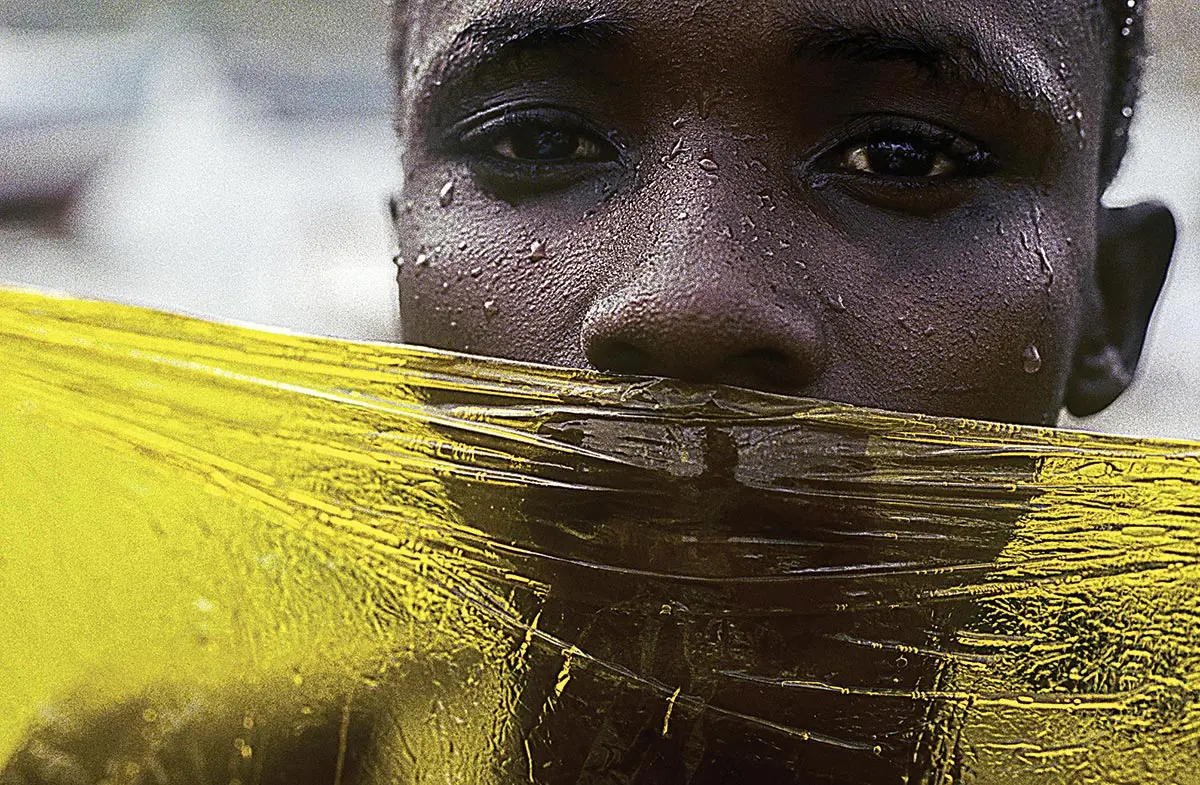
A group of three dozen images offers a glimpse into the work by the late Brazilian photographer Mario Cravo-Neto (1947-2009), who died at the age of 62. One-half of these works consist of black and white photographs, each measuring nearly one square meter (printer with selenium toner on fiber base Ilford paper), from The Eternal Now series, created in the late 1980s and further developed during the 1990s; while the other half consists of digital color photographs—70 by 100 cm each, digital prints Harman Gloss Baryta 320 gsm paper.—from the Laroye series that Cravo-Neto created after 2000.
Salvador de Bahía, Mario Cravo-Neto’s hometown and the place where he lived most of his life, was also the territory in which he created his work. From a young age, he became familiar with the Candomblé Afro-Brazilian religion, a syncretic belief system rooted in the Yoruba culture of West Africa. More than two million enslaved Africans were taken to Brazil by boat until the mid-nineteenth century. Many of them arrived at the northeastern port city of Salvador de Bahía. The town continues to be a center for Brazilian Candomblé to this day. His contact with Pierre Verger (1902-1996) was very important to Cravo-Neto. Verger was a French photographer and anthropologist who traveled the world, until settling down in Salvador de Bahía in 1946, and was eventually initiated as “Babalawo” (a Yoruba priest), with the name of Fatumbi.
Mario Cravo-Neto got close to Candomblé like no other photographer. The religion was reflected in his artistic production (consisting of several hundreds of thousands of photographs). The work by Nigerian photographer Rotimi Fani- Kayode (1955-1989) and Cravo-Neto’s contemporary colleague, Miguel Rio-Branco, are based on a similar iconography; however, they do not have the same sublime spirituality contained in the black and white images by Cravo-Neto, which are very close in their sensitivity to Robert Mapplethorpe’s work—although Cravo-Neto’s are more sensual than erotic in nature. His images convey incredible tranquility and absolute timelessness. They have become a symbol of the culture and religious heritage of which he was a part.
Although the images are ichnographically overt, they are never a mere description of the rituals and completely elude casual and anecdotal elements. Mario Cravo-Neto brings viewers close to the subjects portrayed, which he captured in his studio in staged photographic scenes. Bodies, faces, and objects are born from darkness. Proper framing, precise and sophisticated lighting, and the frontal poses confer an incredible and immediate presence to the subjects. In addition, Cravo-Neto has the ability to render the haptic and tactile qualities of the surfaces and structures of skin, hair, scales, or feathers in such a sensorial manner that one can almost feel them. They rise from their two-dimensionality to a statuesque plane in space. His highly poetic black and white photographs are not solely symbols of life and death, strength and physicality and magical lighting, but also of innocence and vulnerability.
These powerful visual metaphors are still lifes that are nonetheless animated by a spiritual foundation. In this sense, Mario Cravo-Neto liked to refer to his photography as a search for the found object (objet trouvé) and its inner poetic strength.
Curated by Gabriela Salgado and Mark Sealy, the photographs in the exhibition titled A Serene Expectation of Light at Autograph ABP, in London, have been arranged so the older black and white photographs are intercalated with the more recent color images. This generates a fascinating and revealing dialogue between the color photographs—most of them snapshot taken in public spaces—that depict situations of high exaltation and strength, sometimes faded and, on the other hand, black and white photographs with sublime and universal validity that transcend colorful realities to become calm, intense images, charged with inner greatness. These subtly calculated, great aesthetic and sensual compositions, exude a sense of eternity (The Eternal Now) that contrasts the bustling, dynamic, colorful, and pulsating world. The world of black and white images becomes a stylized and aesthetically distant substrate unrestrained by the world of color images that depict ecstasy, greed, lust, and carnal bliss.
This first solo exhibition by Mario Cravo-Neto in the UK could have also been titled The Aesthetic Improvement of Earthly Existence. The exhibition’s only flaws are that the photos are not well lit and the extreme reflections from the glass.
HANS-MICHAEL HERZOG