
In his most recent exhibition, Mateo López turned space upside down, creating a captivating, enigmatic, and rigorous experience. His works on paper, sculptures, and animations sustained a skillful dialog from beginning to end, in that each item expanded the boundaries of the artist’s global work.
The tools of the craft were brilliantly imitated and appropriated. The artist’s study and its equipment acquired a new meaning as paper, pencils, measuring tape, desks, drawers, a chair, and a window were confronted and transformed.
Originally educated as an architect in his native Colombia, López has incorporated elements of that profession into his works. In his drawings, he prefers neat lines and the symbolic code of the cyanotype. His sculptures mine the essence of everyday structures while reinventing their possibilities. The familiar and the useful are reused, repurposed, and presented in a lyrical, unexpected way. For example, a pedestal was set to lean on a birch tree trunk.
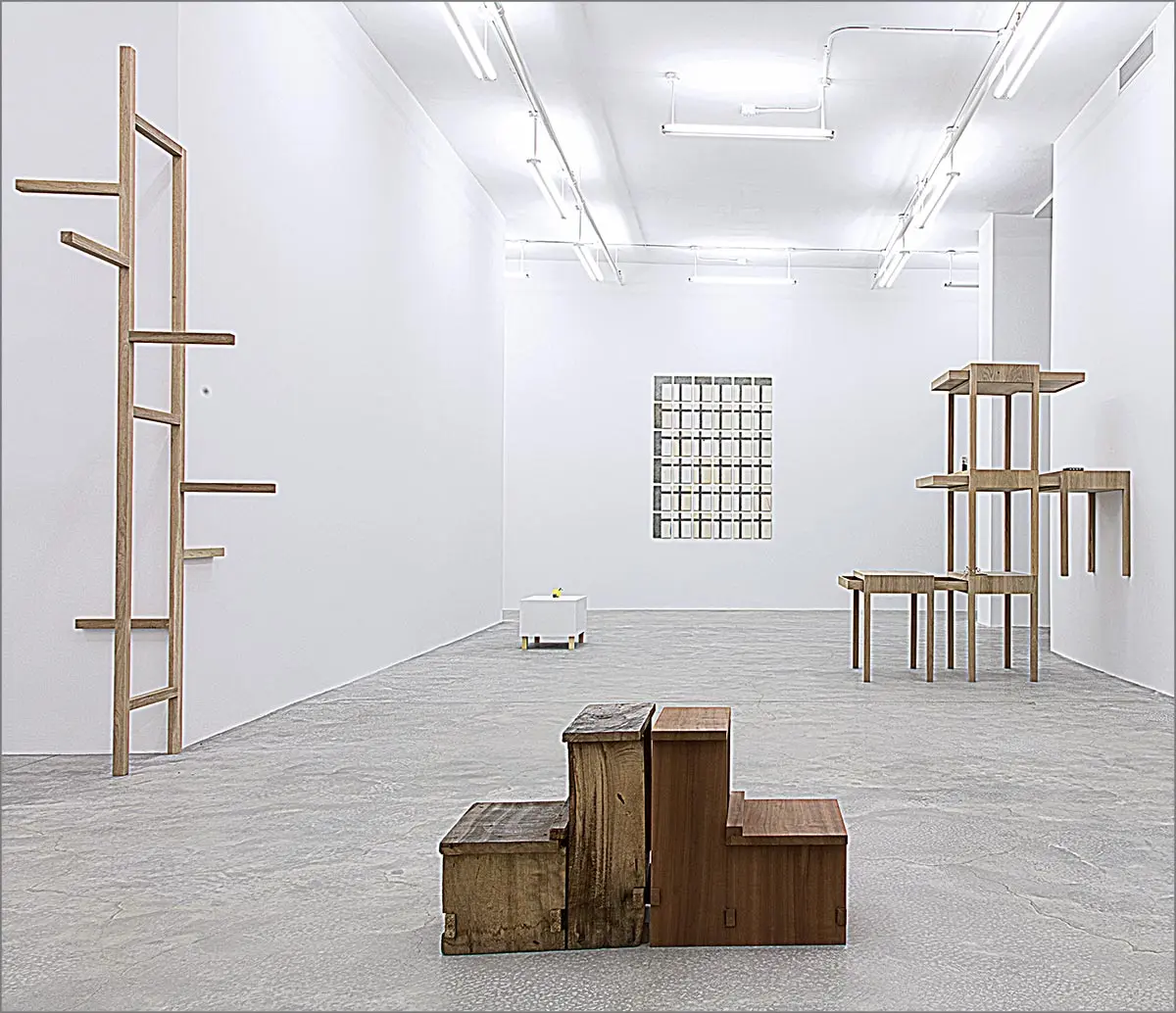
As the title of the exhibition indicated, López created A Room Inside a Room, fluidly transforming elements of the work area and the objects found there. The parallel reality presented in the gallery was exemplified by a sculpture depicting two similar armchairs López had nailed together. On the one hand, in The Meeting (Bogotá-New York) the wood was worn out and stained, communicating a personal history. On the other, the second chair was made of new wood, with an immaculate veneer.
These two coexisting states suggested a past and a future, one looking backward and the other forwards. One could even deduce that the two and a half centimeters between the two chairs were the thin line of the present. López’s manipulation of such dualities was evident throughout the exhibition, enhancing the coherence of the works as a unitary collection.
The theme of duality (in tandem with the relationship between art and handicraft) was also explored in a group of 13 books, apparently blank, that was cut into different shapes and presented in diverse positions. As architectural elements or as supports for objects, these beautifully put together books, cut in unusual ways, alluded to alternative purposes while decidedly preserving the features that allowed us to recognize them as “books”.
This work was titled R/e/a/d/i/n/g Positions (After Bruno Munari). Munari, a graphic designer, wrote the influential classic Design as Art; he defended the democratization of the arts and the joining of romanticism with utility, two concerns that are equally present in López’s work.
The title of the work and the disposition of the books suggested the many physical positions adopted by readers, as though the books were actually being read. Ironically, these reconfigurations posited many narratives, while the books appeared, as we said, blank.
In one group, four books were placed vertically, with their edges touching to form a tower. A mustard-color book laid on top of the other two, like a refuge. Triangular books suggested plazas, staircases, or public spaces. There was a mango on top of a book, with yet another book on top of the mango. All these arrangements recontextualized, in a humorous way, the idea of a book as a medium to communicate information or to entertain.
Drawers are also metaphors for the transmission of information, as well as a recurrent symbol for López. In Poeta Writing Desk, an inciting-looking drawer was missing its knob. The round hole where the knob should have been intensified the mystery, exploring the concepts of warehousing and memory. To one side of the desk was a box, perhaps for the poet’s papers. Inside the box, however, there was a paper shirt.
Ladder for a Corner confounded our expectations in a different way. The steps of a ladder had been separated to the sides with anthropomorphic exuberance.
Time as Activity was a text-based projection. Its three-minute loop alternated images (including that of an insisting alarm clock) with verses from a poem by Yanina Valdivieso, the artist’s wife. Situated in a lateral gallery, this entertaining interlude was filled with quotations referring to the larger exhibit. Hand Shapes Thought flashed onto a screen with the slight flickers of manuscript inscriptions. There was also a reemergence of architectural motifs, for instance in The Floor is Addressed and Form Resumes Composition. The action of drawing was also invoked in works like A Series of Acts are Traced and The Line Encloses a Momento.
In a room specially built with mobile projection screens, a series of elegant drawings echoed M.C. Escher in the way in which dimensional suspension was presented. Other works were like vistas dislodged from thoughts or mechanical diagrams. The configuration of this gallery inside the gallery changed during the exhibition period, and the drawings were also reorganized, all to suggest the evolving environment of creativity.
More than most artists, López fulfills one of critic Donald Kuspit’s essential dictates: “An artist keeps one foot on every day through his subject matter, but transcends it by re-creating it in aesthetic terms.”
López is an artist who expands our analysis of dimensionality, function, and purpose. Beyond their mischievousness and ironic sense of humor, these oeuvres were innovative.
JEFFREY CYPHERS WRIGHT