
Venezuelan artist Nela Ochoa recently presented an important anthology exhibition titled Postpretérito (Postpreterite), featuring a selection of works from different periods in her prolific career and allowing us to review the conceptual density that is it's characteristic. The exhibition was in view at La Caja, occupying the two levels of the Fundación Cultural Chacao exhibition space.
The show was organized in four “zones”, each bringing together works in a variety of media and from different periods in the artist’s evolution. These works were grouped as follows: Zone 1: Archaeologies of the probable; Zone 2: Unearthings; Zone 3: Potential cartographies; and Zone 4: Sediments. The arrangement is not intended to signal a chronology; works from different moments are exhibited together to highlight the connecting threads coursing through expressive means and themes (or, more precisely, subthemes) of a diverse nature. A heterogeneity of media is, indeed, a distinguishing characteristic in Nela Ochoa’s career, since, as she has noted, the content she engages in is approached from a variety of angles: performance, video, installation, sculpture, painting, and more.
The body is central to Nela Ochoa’s art—starting with her own, having trained since childhood and worked as a professional dancer in the 1980s. This practice gave her a clear understanding of the importance of gesture as a language. Already with his earlier gestografías (gesturegraphs), as she called the choreographies and videos she created between 1985 and 1999, she has been deeply aware of the fact that it is on the body where our entire history—present, past, and future—comes to be summarized and recorded. And the body becomes social in its interaction with others, which in turn modifies its gestures. Many of the latter are explained by the genetics of living beings, whether human, animals, or plants. The artist is intent on unveiling the causes behind the actions or behaviors of organisms, a research project she has carried forward for a number of years. With her knowledge of this intangible interiority of the body’s genetic component, she is able to explain—and, hypothetically, modify—behavioral alterations such as for example (and among humans) aggression, gluttony, fear, among other attitudes and tendencies.
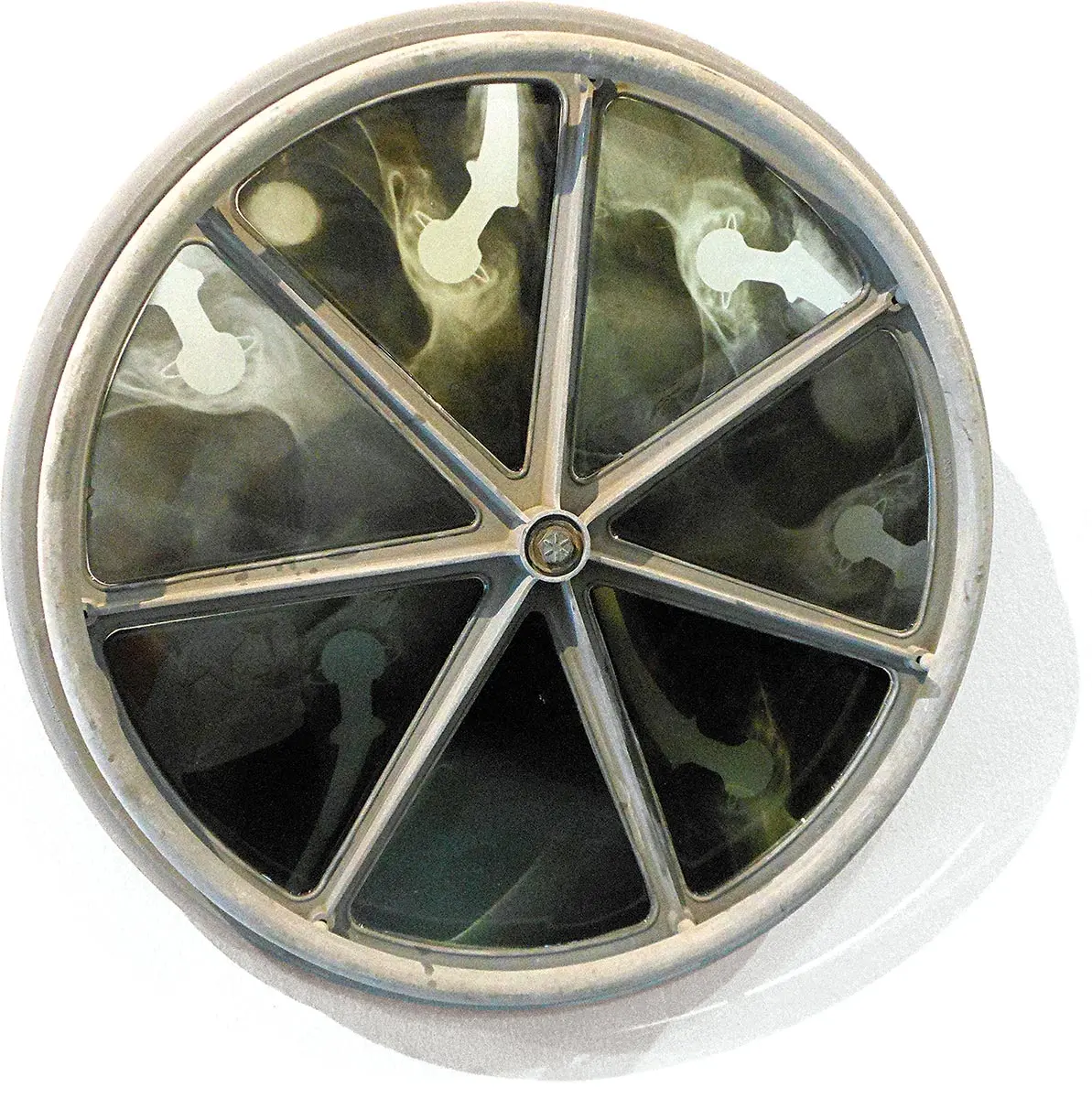
These reflections have important precedents in her oeuvre. The theme of human attitudes, both individual and collective, was present already in videos like Topos (Moles, 1987) and Mendiga (Beggar Woman, 1999), all the way through Eco genético (Genetic Echo), which describes in a graphic language the genetic sequence that determines “the memory of fear” (giclée print, 2004/video version, 2006). On the other hand, violence as a behavioral characteristic of certain individuals is highlighted with images of the bone structures of bullet-riddled bodies, the x-ray plates of which are intervened in works like Vitral (Stained-Glass Window), Intervenciones (Interventions), and Rueda (Wheel), from 2015. Similarly, Ochoa transfers images from brain CAT scans onto canvases, which allows her to critique the elements of cruelty that define certain aspects of our social reality. In the series Carne de cañón (Cannon Fodder, 2015), for instance, bodies made from acrylic-painted, sprayed, and latex-intervened tarp hangs like they would in a slaughterhouse. These bodies explicitly denote the evidence of a continued, lacerating social transgression. In Experimento Pez Beta (Beta Fish Experiment, 2015), Ochoa analyzes the “sociability” capabilities of two live beta fishes, one of them accompanied by its own image reflected on a mirror, while explaining their aggressiveness via a printout of their genetic map.
All of this helps us understand Ochoa’s art—and this exhibition—as a “scientific laboratory.” Nela Ochoa reinterprets genetic sequences, chromosomes, embryos that she draws, encapsulates, sews, or assembles. The results are works like Bandejas retrogénicas (Retrogenetic Trays, 2010, made in resin and diverse materials), Banco de genes (Gene Bank, 2015, with latex cells), and others.
Postpretérito, the title for this exhibition, refers to a hypothetical or conditional action that could have taken place in the past or could take place in the future. It expresses the time of the probable, or, as exhibition curator Lorena González points out, “what could happen if something else happened before.” Interestingly, something of grave import did occur that almost caused the show to be suspended: Ochoa’s Desentierro (Unearthing, 2001) was stolen before it could be transported from Nueva Esparta to Caracas. This installation, composed of latex sheets imprinted with the artist’s DNA, had never before been exhibited in Venezuela. The sheets were to be placed on the gallery’s central walls. In the words of Lorena González, the absent work “has become a fundamental element in the exhibition, precisely by its not being there.” Confronted with this unexpected setback, Ochoa created a new version of Desentierro, retitled País (Country), using photographs of the original, photocopies of the latex pieces, and a variety of documents relating to the work, including the police report of its theft. With this, Ochoa turned an uncertain and conditional situation into the strange and unusual chronicle of a work of art’s stages in time, a statement that justifies the exhibition’s subtitle.
SUSANA BENKO