
One of the key objectives of Venezuelan Artist Pedro Fermín’s work in sculpture is to explore the relationship between the forms he creates and space itself. This relationship is undeniable: space is occupied by form and determines it.
Under this principle, Fermín presented two important exhibitions: El espacio como objeto (“Space as Object”), at Freites Gallery, curated by Katherine Chacón, and Diálogos (“Dialogs”), at the B.O.D. Cultural Center, curated by Gerardo Zavarce. Both featured the artist’s recent production, dated between 2004 and the present.
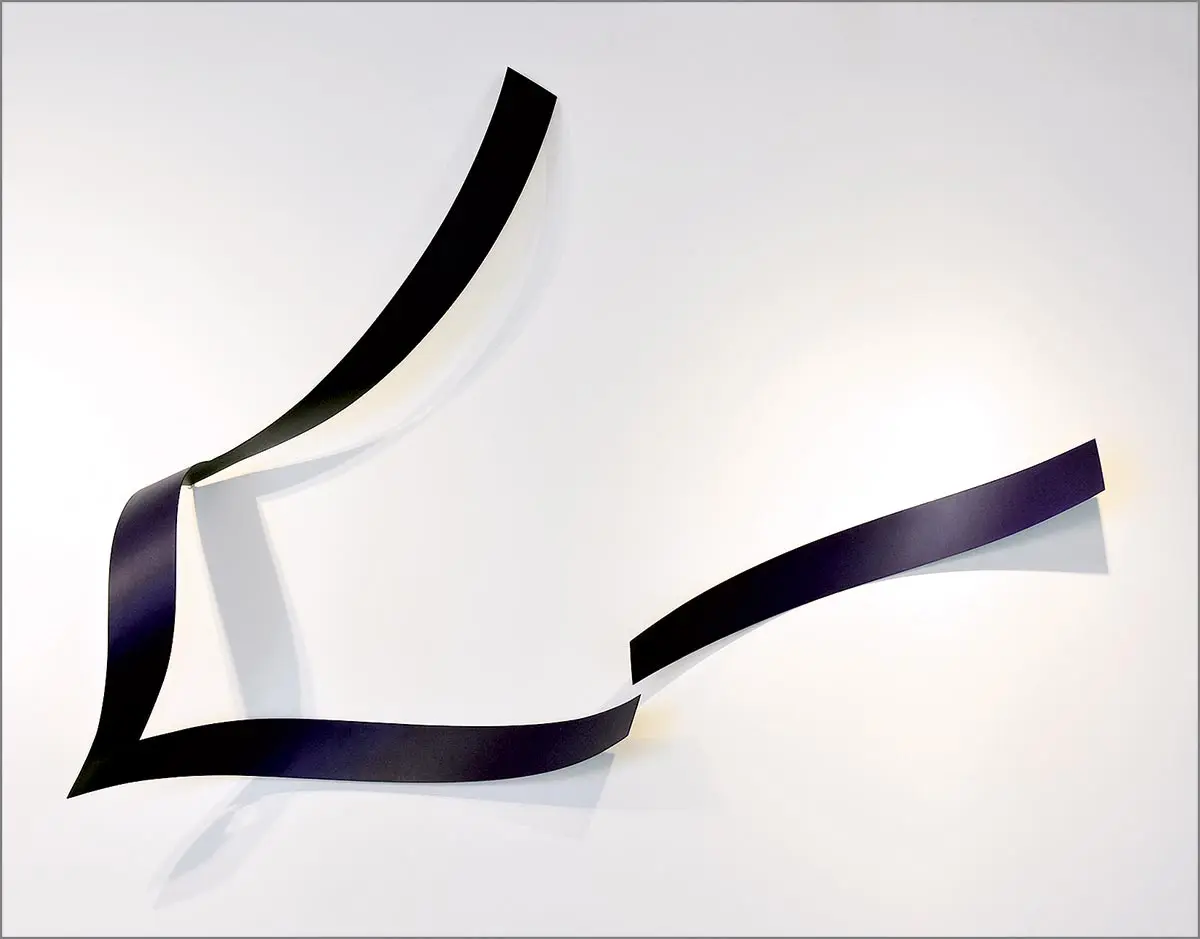
In both exhibitions, sculptures in iron or aluminum unfold on the gallery walls, or “flow” in space to create the impression of “strips” twisting on their own axis. Producing these figures requires a rigorous study of geometry, which allows Fermín to create variations of basic shapes like squares or rectangles so that a single sculpture appears to adopt different forms according to our angle of approach. In turn, their contortions suggest motion and volatility. Katherine Chacón notes in her curatorial essay that, for Fermín, shapes are understood as mobile and unstable bodies. Their ductile and flexible appearance makes it possible for them to be perceived as forms-in-process; in other words, they are lines that, according to Chacón, “bend, yet retain orthogonal echoes that activate the sensation of an ongoing process of metamorphosis, because the lines are being subjected to the moving, intangible forces of space.”
In 2013, on the occasion of Vertice (“Vertex”), an exhibition at Graphicart, Pedro Fermín declared that before creating one of his artworks he usually analyzes the space in which it is to be placed. This determines its size. This is due to the fact that Fermín’s main concern is space and how the form will interact—in terms of proportionality, we infer—with it. This consideration is particularly evident in his new exhibitions; the artist certainly observed and understood the various scales present both at Freites Gallery and at B.O.D. Cultural Center, which is characterized by their spaciousness. Equally noticeable in both locations was the importance given by the artist to the length of the walls, their heights, and the varying incidence of light on his works, all the while bolstering the expressive value of empty space and of the spatial dynamism he seeks.
Along with space, two other elements are essential to Fermín’s art: on the one hand, a constant reference to the Möbius strip; on the other, the artist’s interaction with—and admiration for, as Chacón points out—the great masters of the abstract-geometric and constructive tradition. Both elements influence the way in which Fermín conceives his sculptural shapes. In the former case, the artist takes the Möbius principle as his starting point, “extending” his linear shapes—manufactured in iron or aluminum and painted in flat, pure colors—and contorting them into a helix. Fermín says that, for him, the Möbius strip is a spiral. “My works are initially flat, but they build space in a spiral motion”, he says, and indeed that is what happens.
Fermín’s masterful execution, meanwhile, is strongly connected to a specific way of working with geometry: clean shapes and pure colors. His passion for the geometric-abstract tradition drives him to establish dialogs with such masters as Mondrian, Van Doesburg, Albers, Malevich, Max Bill, Donald Judd, and Robert Smithson. Many of Fermín’s works evoke essential aspects of the work of these artists: evident contortions that bring Max Bill to mind, or small squares in vibrant colors on undulating white strips that evoke Mondrian’s late period. Fermín is able to make geometry ductile and volatile, a unique skill expressed in the way he works with metal.
Yet Fermín’s work transcends the degree of stasis present in the geometric tradition. He takes this tradition as his starting point but differentiates his geometry with its ductility, subtleness, and mobility. This is made possible by his use of space as an object and an expressive value in itself, and his creations’ fundamental reason for being. None of these sculptural forms would be complete without a dialog with empty space, or with shadows and light as components of space. Space becomes an object and, at the same time, connecting a thread. No form exists without a space to modulate it.
SUSANA BENKO