
Canada-based Mexican artist Rafael Lozano-Hemmer relies on interaction with the public to establish a series of connections between technology, perception, the environment, and the body.
Curated by José Luis Barrios and Alejandra Labastida, the exhibition Pseudomatisms at the Museo Universitario de Arte Contemporáneo (MUAC) presents 42 works that together represent over twenty years of audiovisual production. The exhibition includes the diversity of platforms that Lozano-Hemmer has been using as artistic language and as a form of sensory experimentation. These include interactive video, robotics, computerized cameras, and surveillance sensors, photography, and sound installation, among others.
Lozano-Hemmer’s work has been presented in Sydney, Istanbul, Havana, Sevilla, New York, Valencia, Montreal, Singapore, Shanghai, and Moscow, among other places. In 2007, he represented Mexico at the Venice Biennale, and, in contrast to his international fame, this is the first monographic exhibition by Lozano-Hemmer ever presented in Mexico, in the context of the International Year of Light and Light-based Technologies.
This survey of his trajectory also includes five new works like Nanopanfletos de Babbage (Nanopamphlets by Baggage, 2015), in which two million leaflets made with elemental gold, more than 24 Karat pure, were printed at Cornell University, in New York, using nanotechnology techniques. Some 250,000 copies were released in the first exhibition room of the museum, suspended in the air so they could potentially be inhaled by the public. The rest of the leaflets were left floating in the water. The text in the gold pamphlets was also engraved in gold on the wall. It is an extract from The Ninth Bridgewater Treatise (1837). (The English scholar Charles Babbage is considered the father of computers).
Another of his recent works created between 2013 and 2015 is Empaquetamiento de Esferas (Packing of Spheres). It consists of ten spheres, each designed to concentrate the entire production of a musical composer in a single multichannel device. The spheres were modeled algorithmically so that their size was proportional to the prolificacy of each musician. This series was partly inspired by Charles Ives, who used simultaneity as a compositional tool, as well as in the proposal by John Cage to conduct Beethoven’s nine symphonies simultaneously.
In addition to the three aforementioned musicians, other spheres contain works by Górecki, Stockhausen, Nono, Wagner, Schubert, Mozart, and von Bingen.
Also, an important element in his world premieres is the huge projection, created in collaboration with Polish artist Krzysztof Wodiczko, titled Pabellón de Implicaciones (Pavilion of Implications), in which, through motion sensors, the shadow of viewers are superimposed on a projection of news content occurring in real-time.
One of Lozano-Hemmer’s emblematic works is Respiración Circular Viciosa (Vicious Circular Breathing) that is part of the Borusan Contemporary Art Collection in Istanbul. It consists of a hermetically sealed chamber in which two people are invited to breathe as the air concentrates in 61 paper bags hanging from tubes. In this piece, the visitors’ breathing circulates and becomes tangible through the inflated and deflated paper bags, which occurs about 10,000 times a day, which represents the normal breathing frequency of an adult at rest. Upon entering the air chamber, the new participants inhale the air recycled by the participants that were there before. As the breathing of different individuals converges, life is infused into a device that would otherwise be incomplete without the participation of visitors.
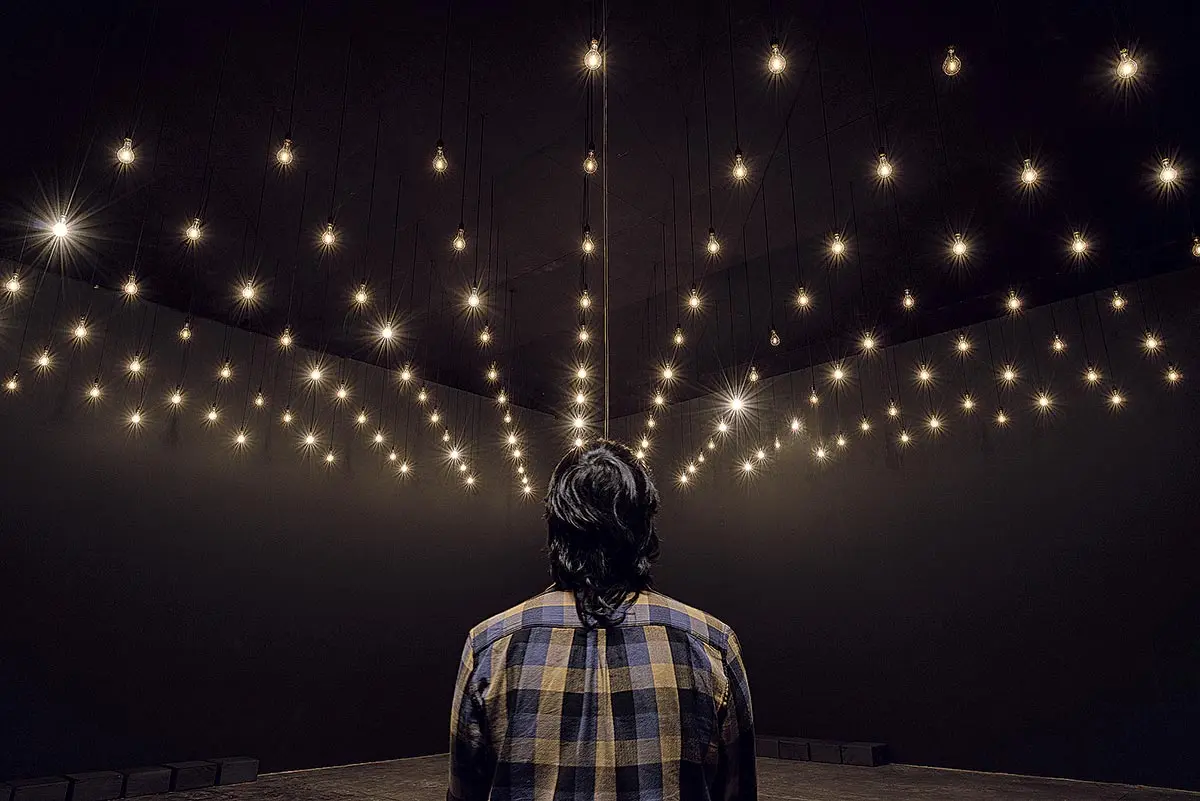
Regarded as another one of his most emblematic works, Pulse deals with the notion of presence: by means of a sensor, the viewer is invited to record his/her heart rate. The heart rate is then reflected by a suspended lightbulb whose intermittent flashing mimics the frequency of the participant’s heartbeats. As more people participate, the frequencies begin to visually overlap until forming a collective pulse.
The title of the exhibition is a reference to surrealist automatism, an artistic practice that relied on the creative power of the subconscious and the notion of value placed on accidents and randomness. In the work by this artist, a pseudomatism attempts to make tangible the predeterminations inherent in those simulations. Lozano-Hemmer’s works do not act by themselves; on the contrary, they are expressed and acquire meaning through the subject-object relationship.
This exhibition will be accompanied by a bilingual catalog with writings by curators and other texts by researchers that delve into the processes and strategies that drive Lozano-Hemmer’s artistic practice, linking them with experimental traditions found in the history of art and science.
In addition to the catalog, the exhibition will also be complemented in a novel way with the inclusion of a USB memory containing all the source codes used to program the pieces in the exhibition. This will offer access to the algorithms and methods that the engineers who collaborated with Lozano-Hemmer developed for each work, thus increasing the level of interaction with the exhibition.
ISAURA RUIZ