
“What lies beyond?—he asked pointing to the north. Forests, swamps, and an impenetrable jungle. Who knows what might be hiding there?”1
Since the invention of photography, in 1839, an intense debate has raged concerning whether it is a mirror of reality. The fidelity and the interpretive character of a created image have been questioned, as has been a photograph’s capacity to communicate, emulate, represent, or create a new reality. In recent years, Roberto Huarcaya (Lima, 1959) has experimented with the impossibility of representing the vastness of nature, of emotions, and of our environment in the broadest sense, first through his use of panoramic cameras and more recently the production of extremely long photograms. In the course of his career, the relationship Huarcaya establishes with the landscape, both natural and human has been of great importance as part of a sustained interrogation of our presence on the Earth.
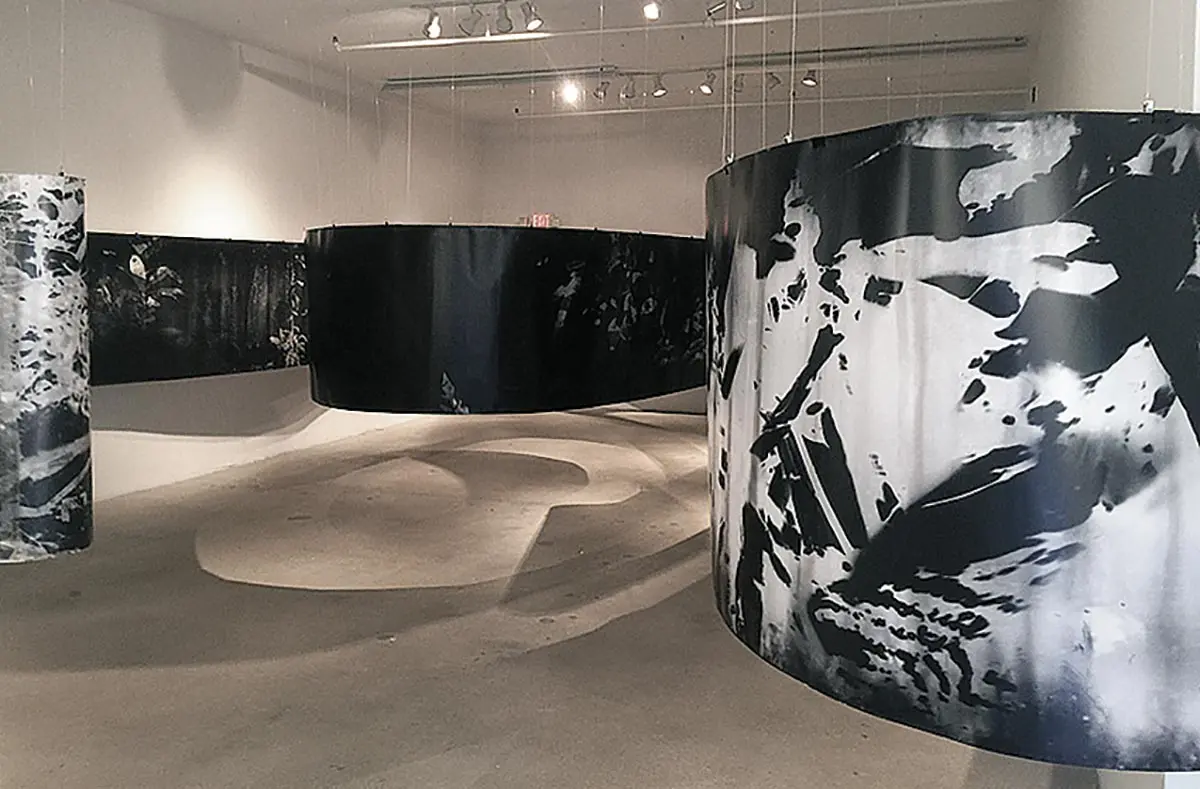
In Amazogramas, his second solo exhibition at Dina Mitrani Gallery, Huarcaya is interested in generating “something” beyond what the camera is able to capture, something that allows him to grasp the intangible: the experience of vastness and immensity; nature in its virginal state; the wilderness that is the planet’s natural lung. After a complex reproduction process, including travel and long exposures, Huarcaya creates a first large-format, a temporary installation by placing rolls of emulsion-soaked photographic paper in the depths of the rainforest, hanging from trees or leaning against them and directly exposed to natural light, day and night; he also exposes the paper to beams from flashlights for long periods, thus eschewing optical devices—the camera. Huarcaya’s actions take place in the Bahuaja Sonene region of the Peruvian Amazon-basin rainforest. Afterward, in the gallery, Huarcaya builds a second installation, a photographic labyrinth hanging from the ceiling, an organic, mobile, fragile volume that viewers must traverse with great care as if blazing a trail through the jungle. “How could I ever forget the solemn mystery of those forests? The height of the threes and the thickness of their trunks went beyond anything I, raised in the city, could possibly have imagined; they shot upwards like magnificent columns, and there, at a great distance over our heads, we were able to discern the blurry point where their lateral branches expanded into ascending gothic curves that intertwined to form a giant green dome, penetrated only by a fine, dazzling line of light cutting through the majestic darkness.”2
In this process, Huarcaya builds unique cartography, a kind of tracing of the forest on paper that’s to the passage of light through the natural canopy; in truth, it is generated to a large extent by chance, which plays as bug a role as in all of natural life. The photographer becomes not a creator as such, but a facilitator, the medium that makes it possible for the forest to paint its own portrait, for light to create an imprint of the sound, of wilderness, of humidity.
Long vertical or horizontal exposures of entire rolls of cotton fiber photographic paper, measuring 30 meters in length each, are developed right there in the forest, using circular tubs designed by Huarcaya; they return our gaze to a past that featured chemicals and sealants, attempting to “reveal” the very process of photography as it captures and blocks light and the silver halides not sealed into the paper are liberated. The resulting photograms are a return to the primitive and to the beginnings of photography; to the essential, the earth, and nature. Realizing that the extended image that hangs from the gallery ceiling is the same that rested for hours in the rainforest we are immediately transported there: “Life, which abhors darkness, struggles in those vast forests to always ascend towards the light. Each plant, even the smallest, curls up and twists itself in an attempt to reach the green canopy, climbing its larger and stronger sisters in the process. Climbing plants are naturally outsized and exuberant, but others, which in other environments are not climbers, have learned the trick here, as a way to escape the dense shadows; thus we can see jasmines, common nettles, and even jacitara palms wrapping themselves around a stout cedar tree in their struggle to reach the canopy."3
Huarcaya’s installation in the Amazon region bears witness to the way the forest acts on paper, leaving its trace of humidity and dripping layers of light and producing phantasmagoric images that seem to say, like Alexander Von Humboldt in the face of the immensity of nature: “My true and sole objective is to investigate how all-natural forces come together, the influence of inanimate nature on both animal and plant life.” Huarcaya works like a visual anthropologist, eschewing digital technology in order to bring himself closer to the most primary, the most essential meaning of photography: to draw with light.
NOTES
1. Arthur Conan Doyle, The Lost World, 1912.
2. Ibíd., p. 76.
3. Ibíd., p. 77.
AMALIA CAPUTO