
The Mercosul Biennial reached its 10th edition in 2015. Its banner title was Messages From a New America, and for the first time in its history, the Biennial had as its chief curator a critic from the Brazilian state of Rio Grande do Sul, where the event takes place: Gaudêncio Fidelis. And it was accompanied by a successful educational project, featuring a variety of actions addressed to schools and the general audiences, including informational sessions.
When the project for the 10th Biennial and its governing principles were announced, the art world was abuzz with enthusiasm, rallying behind the idea of reasserting a Latin American focus for an event that, little by little since it’s 5th edition, had seen its strategy of showcasing the productions of its own cultural region become more diffuse. With the weakening of this principle, the Biennial had ceased to be a differentiated space for reflection about Latin American art, becoming a large international exhibition in the same mold of the many similar events that punctuate the international scene.
In a press conference on the occasion of the announcement, Chief Curator Gaudêncio Fidelis said that his platform was to reengage the Biennial’s vocation as defined in its maiden edition, under curator Federico Morais. There, the premise had been to introduce the event as an exhibition that “focused the gaze on the history of Latin American art.”
Gaudêncio Fidelis further clarified his intentions in August 2014, at another press conference, as he presented the final project for the 2015 exhibition. “The intention is to promote the visibility of the country’s art via a reconstruction of the region’s most relevant production,” he said then.
Fidelis also added that the exhibition was intended to explore the “blind spots” of criticism and historiography, bringing to its audience works that have not yet received the historical consideration they deserve, and also to inaugurate a discussion of the conditions in which art is created outside the large metropolitan centers. The curator noted how, even when considering the historical substrata of artistic production, a Biennial always seeks to present a contemporary overview.
To that end, the exhibition placed at its base concepts that are relevant for the study of the region’s arts, such as the notion of antropofagia formulated by Oswald de Andrade in the 1920s, the neo-Baroque understood as a strategy for miscegenation, and the concept of post-coloniality and its unfoldings, which have marked the cultural studies of regions formerly seen as “peripheral.”
The goal was to generate in the show itself a space for the investigation of alternative meanings of artistic form as it is found in Latin American societies. In conclusion, we were informed that the 10th Mercosul Biennial was intent on “contributing to a history of the exhibition of Latin America’s art, intervening in significant ways to present new curatorial models for the promotion of artistic production and its historical legibility.”
In response to these objectives, the exhibition was organized into four sections: The Journey of Adversity; The Insurgence of The Senses; The Undeleting of the Tropics; and The Journey Continues.
The Journey of Adversity focused on art in the context of the political instability of what characterizes the history of Latin American nations, a problem that has always signified specific difficulties for the production and circulation of art. This section revisited a 1967 dictum by Hélio Oiticica, “In adversity we live,”1 in order to introduce such matters as the precariousness, difficulty, resilience, and creative generosity that permeate the artistic production of Latin America. Including in this segment were the exhibitions The Biography of Urban life (at the Rio Grande do Sul Memorial Building), which highlighted the experience of the city as expressed by artists and their works, and Modernism in Parallax (at the Rio Grande do Sul Museum of Art), which intended to rewrite the emergence of specific modernity in Latin America—or, rather, its various modernities, not always brought into relief by criticism and historiography.
In The Insurgence of The Senses, the proposal was to bring forth a “peripheral sensibility” with properties that differ from the canon established in the large centers of cultural production. This section also sought to point to the presence of senses other than gaze—smell, touch, taste, and hearing—in the works of art themselves, as factors towards the viewer’s involvement in aesthetic reception.

Three exhibitions comprised this section of the Biennial: Neobaroque Anthropophagy (at Santander Cultural); Olfactory: Smell in Art; and Body Apparatuses (the last two at Usina do Gasômetro).
A number of modes of production not yet fully assimilated by museums were brought forward in The Undeleting of the Tropics. This section was built on the argument that museums and academies are determinant for the writing of the history of art, since they make certain lines of work, groups, and artistic movements visible to the detriment of others. Featured here were the shows Dust and the World of Objects and Marginalia of Form (both also at Usina do Gasômetro).
Finally, the section titled The Journey Continues encompassed the Biennial’s pedagogical and extension activities, intended for the education of the general public.
At Santander Cultural, Neobaroque Anthropophagy included contemporary works that dialog with the Baroque tradition and confronted them with a number of period sculptures and Nineteenth-Century paintings dealing with national themes. Mainly, this exhibition sought to showcase the anthropophagical dimension of the Latin American artistic process, resting from the contact of indigenous cultures with colonizing forces, as explained in Oswald de Andrade’s 1928 Manifiesto Antropófago (Cannibal Manifesto). The show’s other supporting thesis was that the Baroque made possible a sustained operation for the cultural emancipation of Latin American societies. The curators were also intent on showing how, later, the Neobaroque movement demonstrated that the supposed principles of Western modernity are not the only ones possible, thanks to the presence of hybridization and mestizaje in other modernities.
This exhibition included works that made it possible to explore different moments of that process. Among them was Brazilian artist Wesley Duque Lee’s installation The Helicopter (1968, not at the São Paulo Museu de Arte), which presented, bricolage-like, clippings of everyday-life scenes from around the world. Also featured here was Bolivian artist Andrés Bedoya’s work built using coins, thread, and leather, and installed on a wall (2014), and a 2015 site-specific by Andrés Marroquín Winkelmann (Peru) centered on a symbolic drawing with a strong pull towards identity issues.
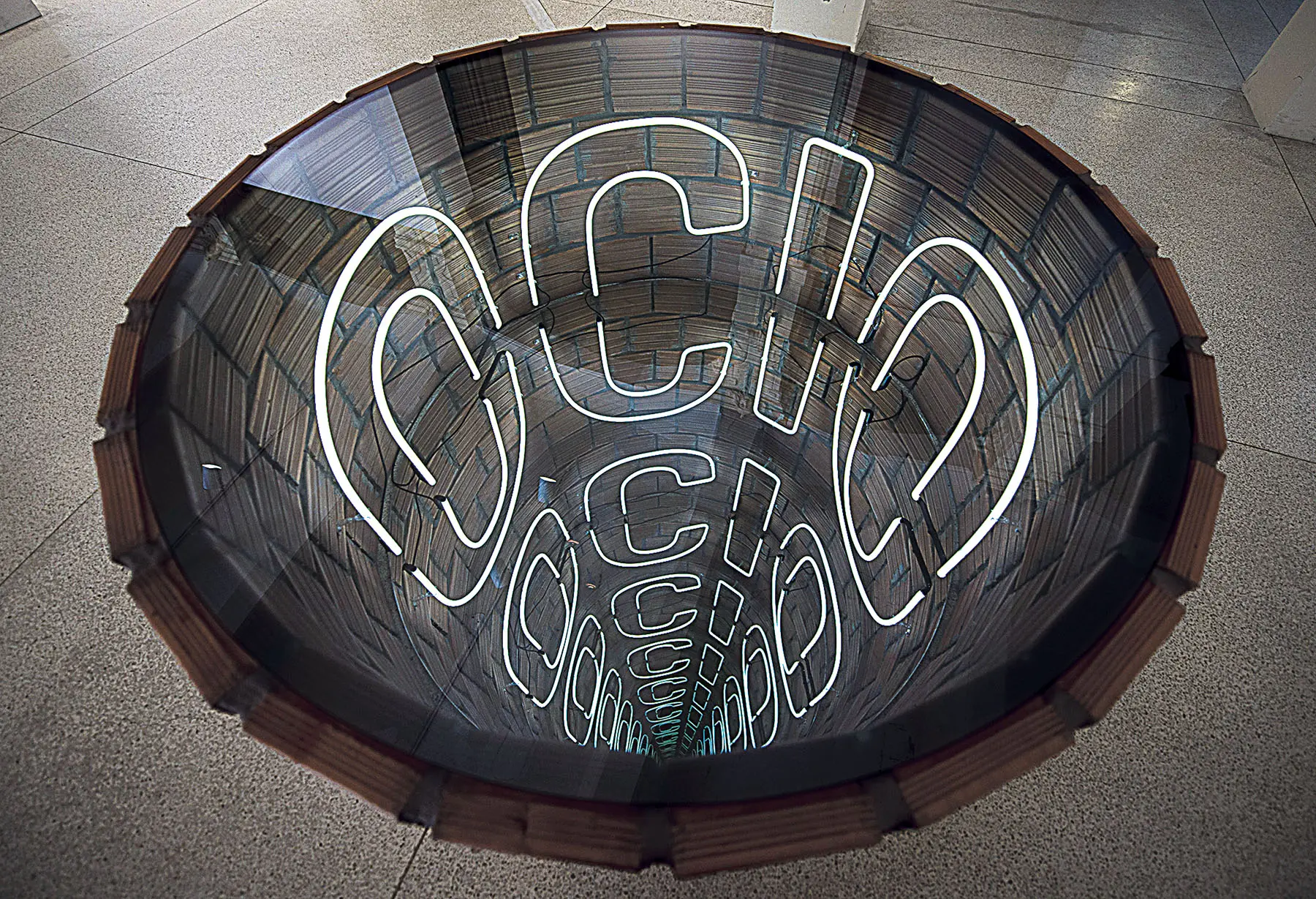
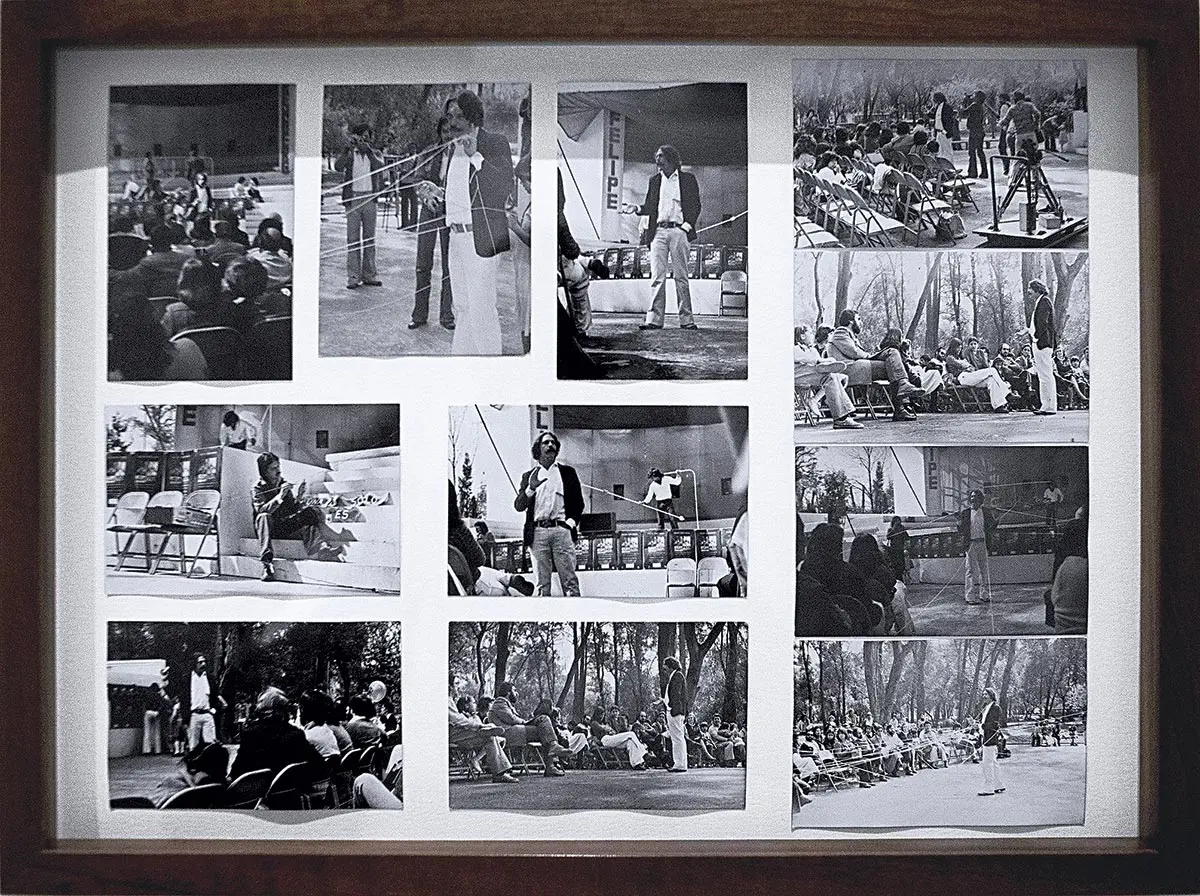
In The Biography of Urban life, presented at the Rio Grande do Sul Memorial Building, visitors encountered a view of the process of urbanization in Latin America, based on a comparison of works from different moments in the history of the region’s art. Sixty artists participated in this exhibition, including Claudio Tozzi (Brazil), with Multitud (Multitude, 1968), which depicts a protest rally using the pop-art techniques of comic-book art; Felipe Ehrenberg (Mexico), with documentation of his performance at Chapultepec Park (1972, reinterpreted in 1979); and Iván Navarro (Chile), with Ocio (Leisure, 2011), a well or pit built using brick, neon, and mirrors and displaying the word ocio for the audience to read.
Modernism in Parallax, at the Rio Grande do Sul Museum of Art, intended to present its audience with a sampler of the various modernities developed in Latin America, highlighting the fact that, concerning them, significant lapses in historiography. Paintings from different moments in the course of Latin America’s modern art were displayed in a comparative manner. For example, América del Sur I (South America I, 1927) and La Rotonde (The Rotunda, 1929) by Vicente do Rego Monteiro (Brazil); El cerdo encajonado (The Boxed-In Pig, 1967), by Nelson Leirner (Brazil), a controversial anti-establishment work that was highly influential in its moment; and Objeto emblemático (Emblematic Object, 1969) by Rubem Valentin (Brazil), at once constructive and symbolic. Also included here was a 2012 work in acrylic on 450 pieces of particle wood, by Felipe Rivas (Chile).

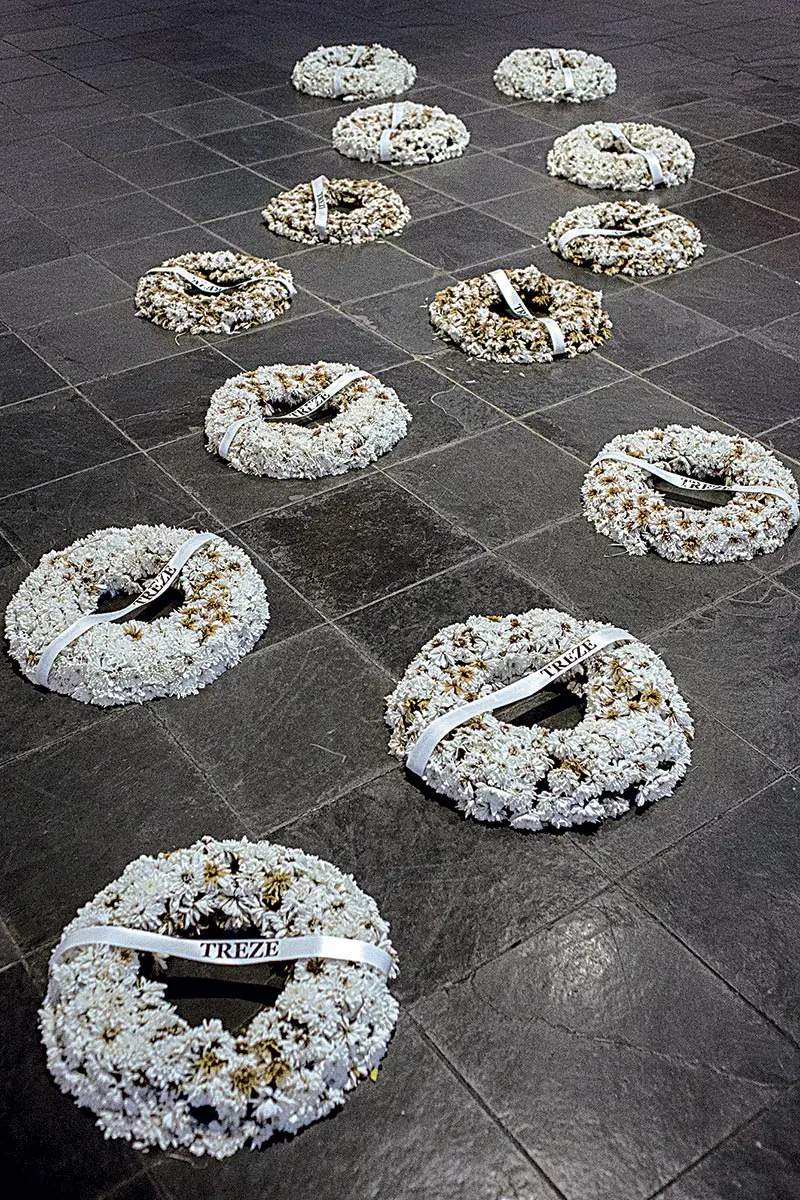
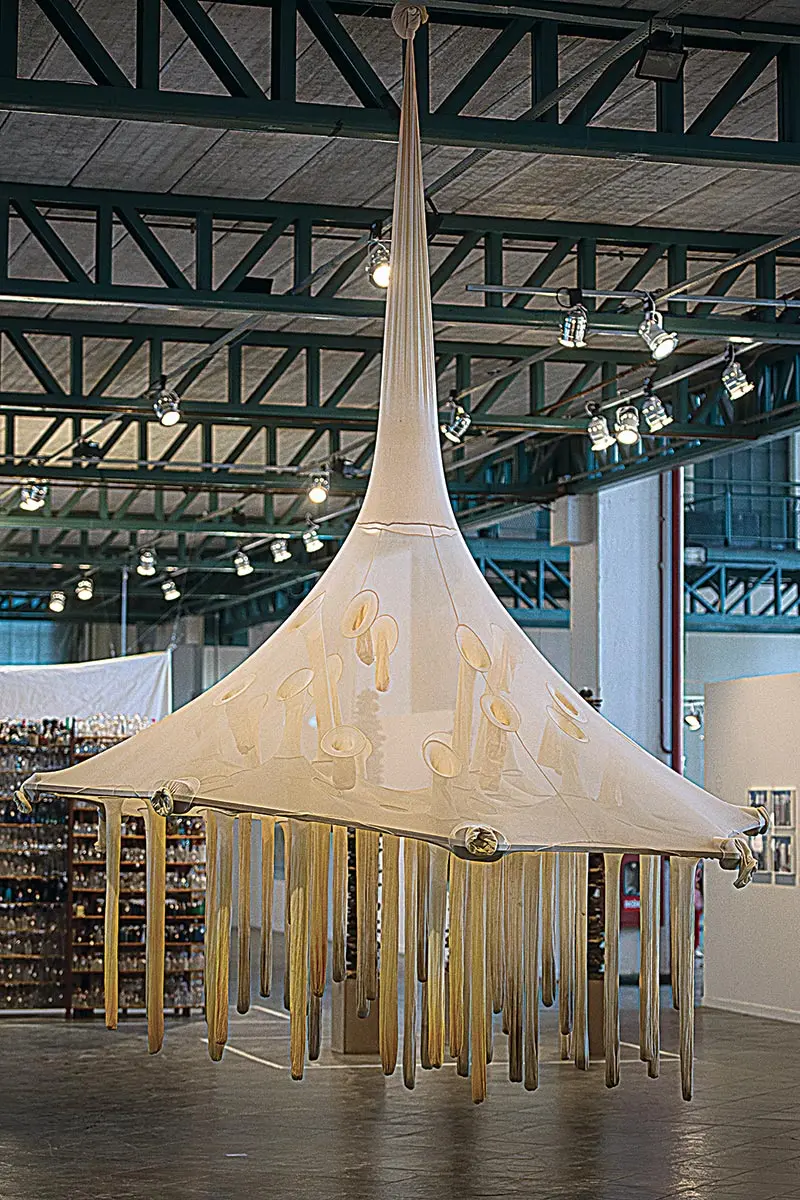
Olfactory: Smell in Art, presented at Usina do Gasômetro, was a rather original exhibition, directly connected to chief curator Gaudêncio Fidelis’ research (he is the author of the book O cheiro como critério, a title that can be translated as Smell as a criterion). This exhibition focused on artworks that engage the sense of smell, and it made it possible for visitors to interact with such works as Before I Devour You, by Brazilian artist Ernesto Neto (2007), made with tubes of flexible fabric filled with a strong saffron aroma; Quién limpia a quién - jabón de ajo (Who Cleans Who – Garlic Soap, 1994), by Oswaldo Maciá (Colombia); and Trece coronas fúnebres (Three Wreaths, 2015), an installation of flower wreaths by Saidel Brito (Cuba).
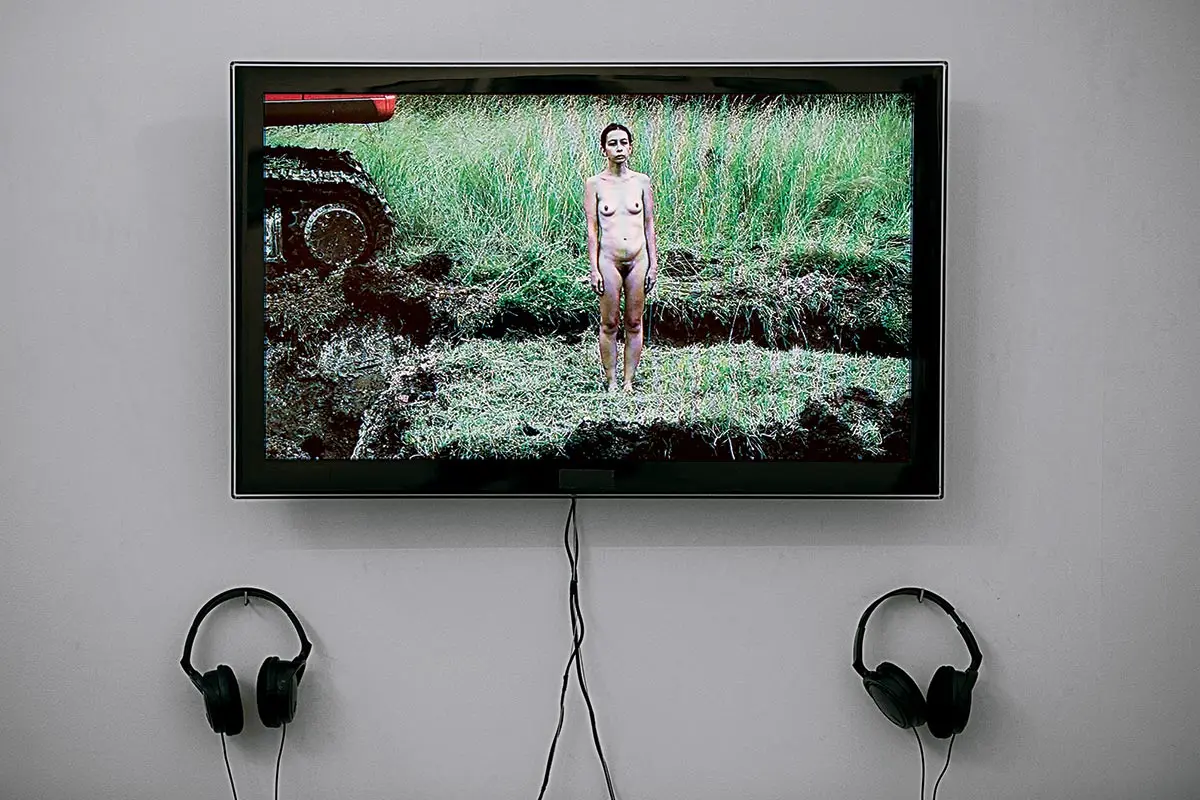
In Body Apparatuses, also at Usina do Gasômetro, the proposal was to reflect on clothing and costumes as markers of power and status, as ritual signals and social codes, and even as references to transnational, postcolonial, and exotic influences through time. O Eu e O Tu (The I and the You), from Brazilian artist Lygia Clark’s 1967 series Roupa-Corpo-Roupa (Clothes-Body-Clothes) presented us with mannequins dressed in clothes designed by the artist, with several linings and openings suggesting tactile exploration. Jac Leirner (Brazil) was present with Skin (JJ Black Magic), from 2013, built on the basis of a small register alluding to the skin, made from paper and attached in a linear sequence on the wall. Ideas of accumulation, order, and classification are a structuring strategy in this artist’s work, as made evident here. Regina José Galindo (Guatemala) presented her video Tierra (Land, 2013), which denounces violence in her country in the 1980s. Tierra makes reference to the killing and burial of victims under the dictatorial regime headed by Efraín Ríos Montt, responsible, between 1982 and 1983, of the massacre of 1,771 Maya peasants in the Ixil region, and the displacement of another 29,000. The selection of this work for the Biennial brings to our attention situations that continue to be common in all contemporary societies.
Dust and the World of Objects centered on the material realities of art objects. The curators’ intention was to show the use of dust in artistic processes. The exhibition featured the work of 39 artists, among them Gastón Ugalde (Bolivia), with New $100 Bill (2015).
As a final comment, it is worth noting that indeed, as the curatorial project intended, the 10th Mercosul Biennial was mainly historical in outlook, and it searched for connections with the origins of cultural formations and highlighted relevant artists in the history of the arts in several Latin American countries. There was a significant presence of Brazilian artists, and, in that context, a sizable number of artists whose careers took place in Rio Grande do Sul, where the event is held.
The historical overview proposed by this Biennial privileged social, political, and cultural dimensions, but it also looked intensely at Latin American Art’s constructive vocation. Not all of the “blind spots” mentioned before were illuminated; one missed, for instance, the contributions made by the 1930s and 1940s generation in Rio de Janeiro and São Paulo, the first modern artists who witnessed the city in its transformation towards modernity. The Biennial laced a strong emphasis on some artists, whose works could be seen in several sections.
The curatorial team around Gaudêncio Fidelis included Carmen Cebreros Urzaiz (Mexico), Fernando Davis (Argentina), Ramón Castillo Inistroza (Chile), Raphael Fonseca (Brazil) and Regina Teixeira de Barros (Brazil), as assistant curators. Márcio Tavares (Brazil) was the adjunct curator.
The economic crisis now underway in Brazil certainly had an impact on this international event. The number of works in the exhibition roster had to be trimmed down due to budget cuts. Even so, the Biennial was able to bring to its audience 646 works by 263 artists from 20 Latin American countries.
NOTE
1. In the catalog for the exhibition Nova objetividade brasileira (New Brazilian Objectivity), held in Rio de Janeiro.
LISBETH REBOLLO GONÇALVES
Principal professor at Universidade de São Paulo (USP), where she coordinates the Post-Graduate Latin American Studies Program.