
A fragment of solid asphalt with blotches of color scrambled on top may not mean much, until we read its title: Mariposa sobre pavimento (Butterfly on Pavement). A calligram representing a primate drawn using the names of important figures in the history of Linguistics may seem just a boutade, unless we notice it is called El mono gramático (The Monkey Grammarian). In these instances, the title neither describes nor explains the work; rather, it complements it and makes it mean. Without their titles, these works do not go far or exist in their fullness.
Yornel Martínez Elías (Manzanillo, Cuba, 1981) is the author of these works, and their associative drive can help us understand Mi mano derecha no sabe lo que escribe mi mano izquierda (Mi Right-Hand Doesn’t Know What My Left Hand Writes), his current solo exhibition at the El Reino de Este Mundo gallery of the José Martí National Library. For the first time, Martínez has been able to compile in a single location works that “illustrate” all his facets: paintings, book-objects, calligrams, and sculpture-objects. For the first time also, his tribute to Stéphane Mallarmé is tacit; before, it was intuited in their shared obsession with turning the traditional structure of the book into ashes, but now the direct debt is present in the calligram Un golpe de dados (A Throw of the Dice) and in the painting El banco de Mallarmé (Mallarmé’s White).
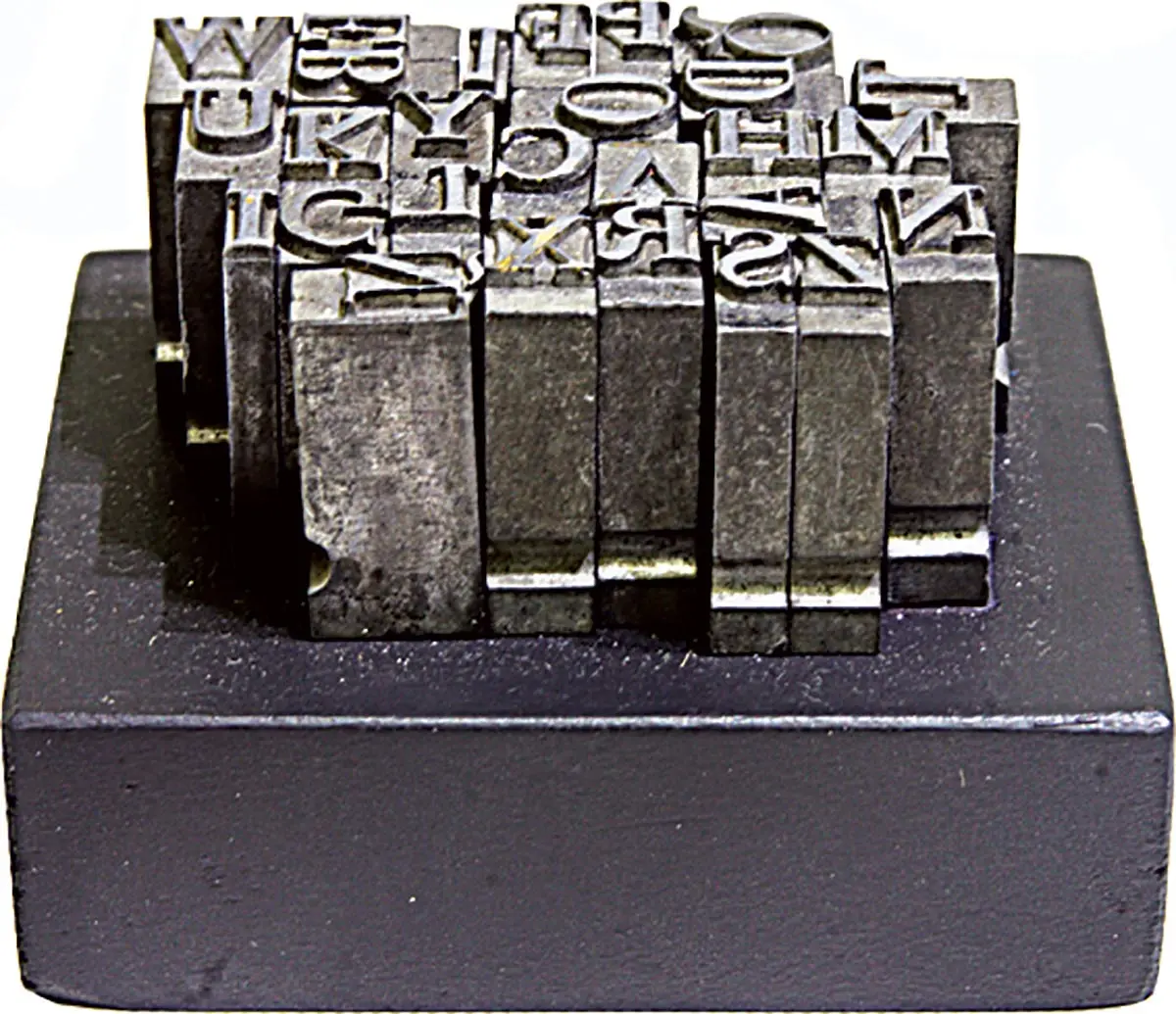
Five more pieces complete this sober, excellent exhibition situated in a perfect location for Martínez’s art (I can see the librarians in shock). Two pictorial mega-installations: El sueño de la mujer del pescador (The Fisherman’s Wife’s Dream) and Composiciones con tipos móviles (Compositions with Movable Types). From Hokusai, Yornel Martínez takes the figure of the octopus and segments it into different canvases, in different formats and colors, eccentrically arranged in the exhibition space. In some of the octopus tentacles, Martínez paints a letter, an allusion to the act of writing on a keyboard. Composiciones… is a series of linotypes painted in the foreground, devoid of narrative, which, when joined, can create sentences. In both instances, the presence of the text detours the aseptic character of the painting. Atlas is a beautiful book made from the cloth the artist uses to clean his brushes. Filled with pictorial splotches, it is an atypical atlas, highly personal and abstract. Aquí yace toda la poesía (All of Poetry Lies Here) is an objectual epitaph, a tiny mass of skyscrapers made from a print shop’s discarded types. Visually aphoristic, it may be the exhibition’s jewel; however, Colección Uróboros (Ouroboros Collection) is more seductive, because of its perversity. Following the logic of Lecturas arbitrarias (Arbitrary Readings), a minimalistic gesture that was part of Martínez’s “event” Intervención en una librería (Intervention in a Bookstore) at the 12th Havana Biennial, the artist purchases used books and combines them under what appears to be a formal mandate; when we read their titles, however, we discover interesting cross-contamination, the product of what we can call subjective chance (pace Breton).
On the wall, we read: “Beyond its materialization as a set of book-objects, the Ouroboros Collection is an editorial exercise that confronts the viewer with the search for new associative horizons. The coupling of two pre-existing books (…) creates a mutual interference—title and content—and produces a more effective alliance. A bipolar, two-faceted, two-phased reading—or, more simply, a bireading—is at the base of the principle of cultural multiplication implicit in the notion of a library. The fact that a book is composed of its perfect reverse is a reality with surprising connotations: it transforms all writing into an act of continuity, the possibility of a parody.”
Clearly, writing is for Martínez like a mineral vein, and perhaps because of that, I will not pause here to explain this terrain where the softening of the ego (image) and the robust ego (text) enter into an agonizing dialog and appear apt for any visual operation.1 “Writing must possess a tonic quality. It is behavior,” Henri Michaux said. It is in that spirit of ethical vigor and conviction that I prefer, at this point, to appreciate the work of Yornel Martínez. There is no subalternity in the use of this or that resource, but decentering of all kinds: of writing, of art, of discourse, and, of course, of power.
The art of Yornel Martínez is reversible, and his printer blog P350 is the best example: neither a magazine nor a visual-art work in the strictest sense, it nevertheless works in both directions. On that paper from bags of P350 cement, there is room for artworks, collages, and texts by a variety of guest artists and writers. Exergo (Exergue) consisted of the placement of verses of poetry on the marquees of Havana’s most popular movie theaters, a short-circuit of poetic estrangement that transformed the text, the support, and the viewer.
Yornel Martínez is a transversal artist who spends his time producing “notes on the totality,” precisely because he flees from the total. The logic of the koan fits the situation well: to be able to maneuver with the seemingly absurd. Challenging Western rationality and undermining its linearity. “Resistant to all summas and treatises (…), I have always preferred heterodox, uneven books. Perhaps this is why I spent years reading (…) fragmentary essays filled with personal allusions and fictional spaces.” By coincidence (by coincidence?), I have been reading these days this book by Gerardo Fernández Fe.2 Perhaps they want to “read each other,” because they are both great and their logics transcend this or that artistic genre (Pablo Helguera and Ernesto Leal can join in). The fact is, simply put, they are men of culture, illustrated, of interfaces.
NOTES
1 . Yornel Martínez just established Ediciones Asterisco. Their first book will be devoted to visual poetry, and several Cuban poets were invited to participate.
2. Gerardo Fernández Fe. Notas al total. Bokeh Ed., 2015.
ELVIA ROSA CASTRO