
Ariel Orozco presented Estática de gato que observa (Static of a Watchful Cat) at Licenciado Gallery, formerly Myto. In this series of works, Orozco explores the use of synthesis as an aesthetic procedure in order to reflect, subtly, about the gaze and its relation to truth, spirituality, and power. Orozco, born in Cuba, relocated to Mexico more than a decade ago. A graduate from the Instituto Superior de Arte de La Habana and a member of the Enema group, he belongs to a cohort that has eschewed the traditional subject matter of Cuban art in favor of an approximation to post-conceptualism that is indebted to action art and minimalism.
Across from the title wall, Orozco placed a white marble plank horizontally on a wooden base to resemble a table. The bas-relief inscriptions on the marble plank simulated the liquid stains left by glasses surely similar to those used on opening night. The seemingly unkempt state of the table contrasted with the neatness of the recently renovated gallery space. In this way, Río seco (Dry River) became a kind of sleight of hand alerting viewers to the need to sharpen their gaze.
In the next gallery, Cuatro verdades sobre la mesa (Four Truths on the Table) consisted of a brown wooden table placed on the wall like a painting. At first glance, it seemed like a perfectly normal table. However, the accompanying card revealed that it had been slightly altered so that all its angles were different: 86, 93, 90, and 92 degrees.
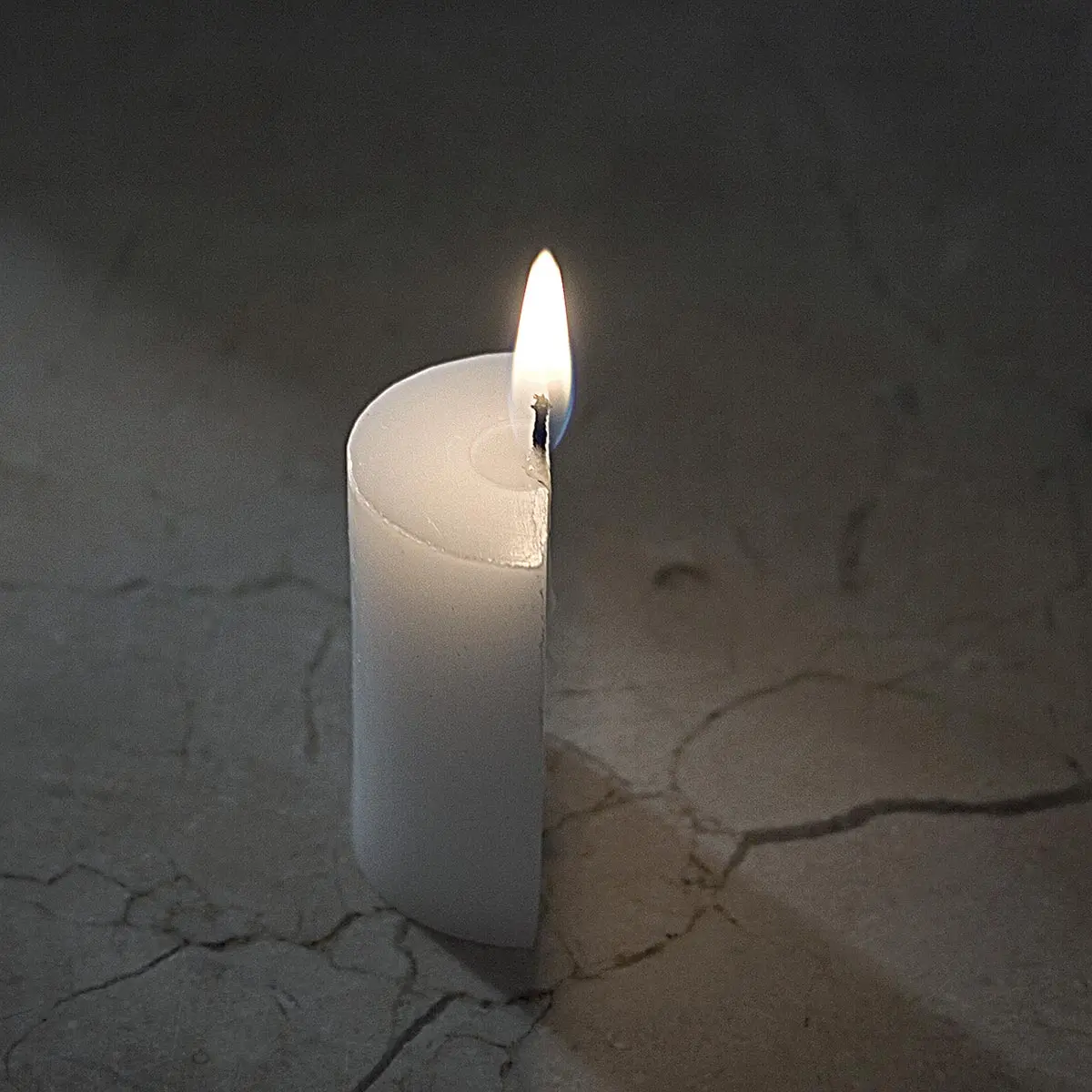
Occasionally Orozco also played with the viewer’s powers of observation and the inertia that often propels us through an art exhibition. For example, in two black-and-white confetti collages of medium and large formats, he drew small, very difficult to discern gold and silver rings, respectively titling the works Estática de triunfo (Static of Triumph) and Estática de gato que observa (Static of a Watchful Cat). In another gallery, he presented the photograph of a life-size collage in such a way that viewers thought it the same kind of object as those mentioned above. Similarly, Medium is a photograph that pretends to be a collage. The image is that of a candle sliced vertically in half and lit against a black ground. The flame was the only element joining the two sides of the image. In turn, Cruces y estrellas (Crosses and Stars) consisted of an obsessive accumulation of the motifs of the title, miniaturized to create an abstract image.
Some of Orozco’s works in marble followed a different path towards synthesis. For example, for his Aquiles (Achilles), the artist partially soaked a white marble rock in a container filled with black ink. In using these materials, he was alluding to two classical modes of legitimization: statuary and ink presented here in brute form. On the other hand, Lengua (Tongue) featured the clapper of a bronze church bell placed on a marble base. Orozco underscored the parallelism between the bell and a mouth. Placed on marble, which is symbolically associated with power, the clapper became a dysfunctional object, which is to say, a decorative, mute object.
In a sculpture on wood titled Corazón (Heart), Orozco brought his synthesis close to religious asceticism. To create this work, the artist commissioned a church cross from a team of craftsmen, to be made according to the official specifications of the Catholic Church. Once the cross was finished, Orozco cut off its arms, keeping only the intersection of the planks. In his gallery installation, Orozco lit the mutilated cross almost directly from overhead, producing a dramatic effect similar to that of religious altarpieces. On the opposite end of the spectrum, Oscuridad aumentada (Augmented Darkness) consisted of a hole in the wall above which Orozco had placed a magnifying glass that looked into nothing; meanwhile, Papeles ocultos (Hidden Papers) presented us with the whiteness of framed paper, although the card indicated the presence of blood on it, covered by other pieces of paper.
Finally, Horizonte (Horizon) was an installation occupying a small room and composed of two elements: a school desk and a blackboard set across from each other. Orozco altered the blackboard by cutting its surface horizontally to the size of a single line of chalk. On opening day, the artist did a performance that consisted of tracing the only possible line that could be traced on that blackboard: a horizon.
The final works in the exhibition were two lightboxes with abstract-looking photographs of bodily details, titled Con los ojos cerrados (With Eyes Shut) and Desnudo (Nude, which takes as its starting point the image of a geisha’s neck), and a series of ink drawings. With this exhibition, Ariel Orozco has demonstrated his conceptual maturity, as well as an apt taste for impeccable presentations, the latter being a key aspect in an artistic proposal where the gaze plays a central role.
ELVIS FUENTES