
Beatriz González is perhaps the most prolific painter in Colombia. In five decades she has covered the history of the country, inspired by that endless source of images that is the printed press. Since the beginning of her career, works like Los Suicidas del Sisga (The Sisga Suicides) drew inspiration from that source.
González’s latest solo exhibition, Reiterations, not only included a decent group of new paintings but also offered a compilation of press archives as well as some of her earlier works centered on two themes: the place and representation of indigenous peoples, and forced displacement.
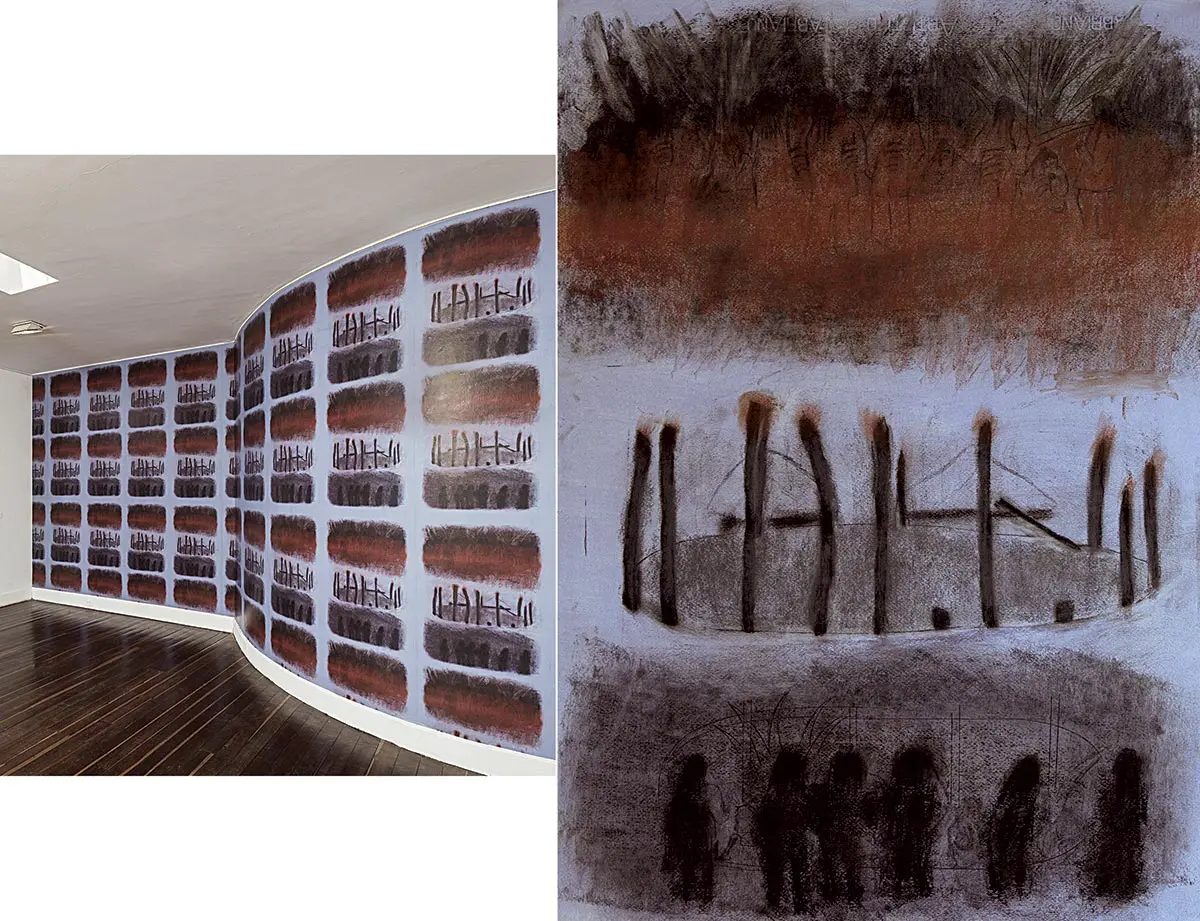
González based her narrative on tragic events. The first of which was the death, in December of 2014, of eleven people from the Wiwa community located in the Sierra Nevada de Santa Marta. The victims in question were killed by lightning that struck and completely destroyed the dwelling that they were occupying. Aside from the deaths, there were another 20 persons injured. One of the images of such tragedy was published by the Diario del Magdalena periodical, included in the show alongside a selection of press clippings collected about the event. That image was chosen by the artist as the central motif of the paintings and drawings on display. The image depicts the strange state of the burnt house, which was reduced to a few somber piles of wood darkened by the fire as a result of the electrostatic discharge.
Beatriz González created two series of small size drawings and paintings based on this image, copying the original composition as a motif subjected to several variations and modifications. Historias Wiwa 1 (Wiwa Stories 1) is a pastel and charcoal drawing where González united three images—all taken from the press, including the aforementioned photography from the Diario del Magdalena—and rearranged them vertically, one on top of the other, in the following order: on top, a nebulous an almost abstract form rendered with black charcoal and firebrick pastel; in the middle, the already mentioned remnants of the house; at the bottom, the enigmatic silhouettes of six characters in darkness, achieved through soft charcoal applications over the melancholic dark lilac predominant thorough the entire composition.
González used the image to produce one of the three types of wallpapers displayed in the exhibition; rough digital prints that replaced her memorable serigraphies. Historias Wiwa 2 (Wiwa Stories 2), an oil on paperwork from 2015—like all the “new” works appearing in the exhibition—represents an equally simple motif: the vertical ascent of eleven silhouettes of the victims from the Wiwa community—identifiable because of cotton fabric clothes, bags and long hair—through a winding road. Also extracted from a newspaper, the image is just as dark as the previous one. It was used by Beatriz González to create another wallpaper in which the predominant motif—the sinuous vertical road—acquired a coarsely ornamental quality through repetition and serialization.
Interestingly, the image is similar to others presented by Jaime Ávila in his recent exhibition titled Lost City at the Galería Nueve Ochenta during the end of 2015. Like Beatriz González, Ávila was also interested in the peoples of Sierra Nevada de Santa Marta, true survivors of all forms of violence, past and recent—at the hands of the Spanish Monarchy, the Catholic Church, the Colombian state, guerrilla and paramilitary groups, and drug cartels—implicitly painted by González as enigmatic symbols of spirituality, the respect for life and nature.
The second part of the exhibition employed the same visual strategies. It thematically centered on the Venezuelan government’s massive expulsion of Colombians in 2015. Images of exodus and exile have been frequent in the work of this artist and, on this occasion, border issues become once again present: thus, one of the paintings is called Reiteración Imposible (Impossible Reiteration). González presents four oil paintings featuring characters carrying their belongings on their shoulders as they cross a river, and a frieze taken from another work titled Zulia, Zulia, Zulia.
A third section of the exhibition consisted of archival material and works created between 1981 and 2005 selected to showcase two motifs: wallpapers from different decades, on the one hand, and the images of Colombian leaders alongside representatives from indigenous communities, on the other—a theme that also encompassed the marginalization and various forms of violence to which those peoples are subjected.
In sum, it is possible to observe his most recent artistic production a progressive simplification of form(s), it is as if she was trying to reduce figurative representation to its most minimal expression—patches that turn out to be persons, traces that represent lumber—in order to offer images that, as the formalist before Pop Art would have wanted it, work because of their expressiveness and symbolic power. Once again, one must admire the ethical nature, quality, relevance, and staying power of González’s work. She is an artist who, as we mentioned in the beginning of this review, has painted the face of a country that has been too stubborn and indifferent to avoid repeating the same mistakes and, thus, change the course of its history, at a time when the possibility of achieving lasting peace is within reach.
SANTIAGO RUEDA