
Eleven red ghosts. Eleven materializations of something that existed in the past. Eleven deformed apparitions levitating in the gallery space. Benjamín Ossa considers time: there is no way to waste it. Neither is there a way to capture it.
The series Ossa presents in the exhibition space are diverse, yet they all share a communicating thread: light and time. Hanging from the ceiling in the first gallery are eleven sculptures, the result of an action that remains documented in a photographic series. In this series, we see the artist, clad in a welder’s outfit and gear, manipulate at great cost a piece of flexible material until it takes the shape we see in the sculptures. Suspended, the sculptures produce a sensation of suspense. They are the congealed, static regression of an action registered in black and white. A colorless snapshot: it could have been taken at any point during the past century. Hence the idea of connecting those “empty garments” with a visit from the past. The proposal is titled A 250º en 1:30 segundos (To 250º in 1:30 seconds): it refers to the temperature at which Ossa molded the material and the time it took him to do it.
In the second gallery, we find several ways of engaging the same problem. In a series of Polaroid photographs, Ossa recorded light as it shifted over a 24-hour period (Monday, November 9th, 2015). The location was the Atacama desert, where light is extreme. The artist’s intervention is minimal since Polaroid images develop automatically and the camera does not allow adjustments to the diaphragm or shutter speed. Ossa applies a second operation and, in consequence, a second-time register. He photographs photography. This produces two timelines: the one captured by the camera (where we can see the color variations of the Atacama sky), and a second one resulting from shooting the Polaroids diagonally against a neutral space (which nevertheless picks up a small trace of the shadow in the original shot.) Different temporalities and different optics to confront them, all in a single day. There is no way to waste time, and neither is there a way to capture it.
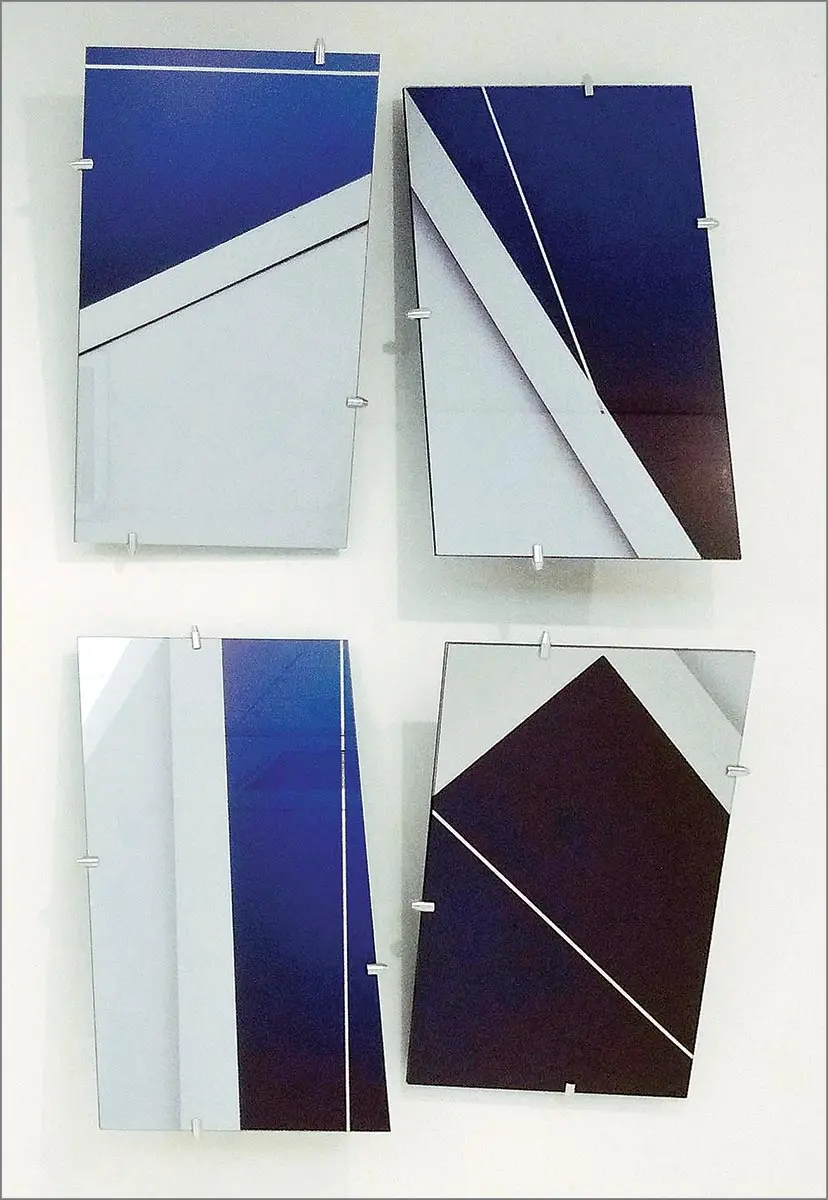
Two more series in the same gallery insist on the exhibition’s subject, but adding a new element: the viewer. Esculturas de dualidad y azar (Sculptures of Duality and Chance) features three steel tubes with holes through which visitors can see, in different ways, whatever is on the other side of the cylinder. It could be anything from the series described above to the motion of other visitors. Using a set of handles, the cylinder can be pointed at different objectives, like a periscope. Ossa’s second proposal in this section is a re-reading of his register from November 9th, 2015, now focusing on dawn and dusk. A number of plates, shifting in position in the manner of solar panels, reflect the viewer’s presence. More abstract and unconnected to the recording of light in the desert, this series stands apart from the rest of the exhibition and diversifies Ossa’s language to an excessive degree. Here, his treatment of discourse goes through many layers of intervention, while in the other proposals on exhibit the artist’s presence is attenuated. Returning to A 250º en 1:30 segundos, we see Ossa’s action reduced to barely a minute and a half, an action or a choreography immortalized in the photographs. And as we have seen in the case of the Polaroids, the trace is also residual.
This concentrated solo exhibition confirms Benjamin Ossa’s versatility as he confronts a problem he has engaged since the start of his career: time and light. The new pathways he explores in the sculptural form present us an artist determined to meet the challenge head-on and with the whole of his powers. The result is something more than a collection of brilliant works of art. It is what remains after the battle.
JUAN JOSÉ SANTOS