
The Anahuacalli Museum has been conducting an interesting program of installations/interventions by Contemporary artists both Mexican and international that establish a dialogue with the permanent collection of pre-Columbian antiquities. Curator Karla del Niño de Guevara explained that the program which has been in place since 2010 has showcased Sarah Lucas (2012), Ugo Rondinone (2014), and Prune Nourry (2014) among others.
This museum’s holdings are actually the celebrated private collection of Pre-Columbian art that was amassed by Diego Rivera throughout his life, and which was a constant drain on his financial resources, but a great source of pride as well as a minefield of inspiration for his work, particularly the frescos; there is a gallery in the museum that illustrates this point displaying the drawings and cartoons that Rivera used for his fresco projects. At his death, the museum, designed by Rivera, was realized with the help of Juan O’Gorman, who was a close friend, a muralist painter, and was also a well-known architect. It was also O’Gorman who built the famous house for Frida and Diego in Mexico City with a connecting bridge between two separate entities, which would allow them to share a life together while maintaining separate private quarters.
The interior of the museum manifests a close allegiance to the pre-Columbian architecture, though naturally adapted by modern influences, it is a most successful amalgamation of the past and the modern in an enclosure that with a large amount of wall space and good natural light is ideal for the display of the collection.
Betsabeé Romero’s installation, titled Idols in Front of Altars is a reversal of the title of a famous book, Idols Behind Altars a work that studies the importance of the Pre-Columbian roots in Mexican modern art. Written by Anita Brenner in 1929, it became an important reference for the development of Mexicanidad, the cultural movement that strengthened and re-defined the country’s identity during the years of the Mexican Revolution. The main idea of the book was to establish a connection between the official Catholic culture, which had been imported during the Colonial period and had metastasized within the parameters of a modern and burgeoning bourgeois culture after Independence at the beginning of the 19th century and was being re-examined by artists and intellectuals within a critical context by the beginning of the 20th century.
The Mexican Revolution was trying to establish new frontiers for Mexico’s future development as a modern and liberal republic, which included a revision of its complex history and culture. As Anita Brenner interpreted it, behind the altars of the imported Catholic faith were the hidden, but alive and present, “idols”, as a presence that was invisible yet represented the authentic culture of the real Mexico.
Betsabeé’s exhibition, which at one point also included an altar for the Day of the Dead, a tradition closely associated with Pre-Columbian ancestor worship, was strikingly effective in this environment. On the outside patio, she created a column with her engraved and carved tires that are her signature mark. The illuminating aspect of this part of the installation is how her use of contemporary utilitarian materials, in this case, the tires, blends so well with the ancient style of the architecture, to the point that from a distance, it looked like a standing column form an earlier temple had been renovated with a fresh coat of paint.
Inside the structure, in the first gallery, there is the first exposition of the intervention, where the artist has provided a series of Pre-Columbian representation of deities with the ray-like gold or silver potencias that are fixed to the heads of the traditional Catholic saints’ sculptures, in this case, the intervention is making a visual bridge between the earlier and later religious culture transposing Catholic symbols unto the ancient culture of Mexico while proposing issues of repression, adaptation, and identity that are particularly relevant for today as Mexico has revisited the issues with the troubled situation of land ownership and appropriation with native communities in the state of Chiapas.
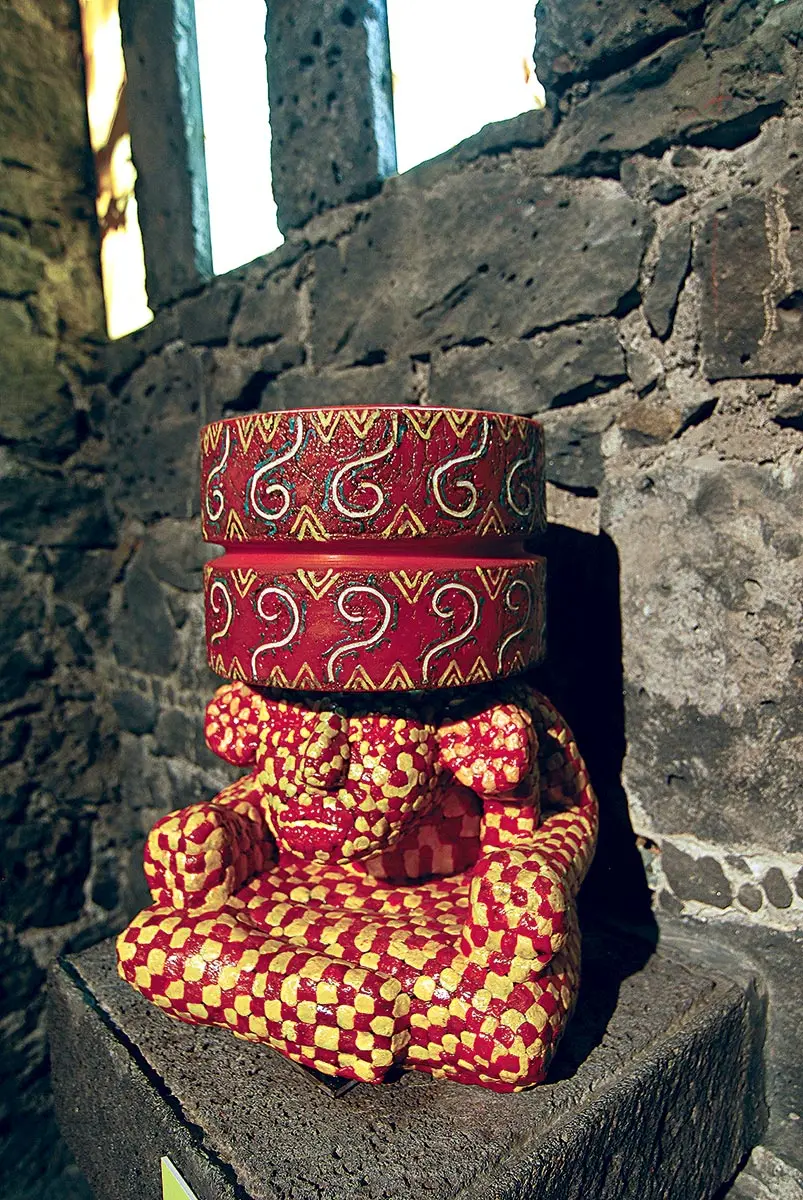
In another gallery, the artist has placed her version of a figure of Huehuetéotl, the god of fire, who also represents the center of the universe according to the Aztec religion. Huehuetéotl-Xiuhtecuhtli was associated with ideas of purification, transformation, and regeneration of the world through fire. As the god that oversaw the passing of the calendar year, he was associated with the cycle of the seasons and regeneration of the earth. Betsabeé depicts the god made out of chicle, (chewing gum) which forms a pattern in different colors for the two interpretations of this theme; one in green and taupe is placed next to its ancient counterpart in exactly the same form: The head with the huge ears and ornaments, crowned by a huge sombrero-like headdress that was used as a brazier; the other in red and yellow colors, wearing a double brazier in his head. These figures are thus rendered as a modern offering manifesting renovation and renewal, within the context of its location, in close proximity to the ancient versions of this important deity.
The issues of migration and re-location, as well as the preservation of memory, are important in Betsabeé’s work.
The tires are a symbol for transport as well as for the possibility of an ephemeral mark on the ground. The artist has also done works, in which her patterns on the tires are reproduced in textiles over which the tires have printed with colored dyes. Though these were not present in this exhibition, in the courtyard there was an installation with four tires, each one carved on a different pattern, and the mark they had made when rolled on the white sand, which reproduces figures and abstracted forms that are very close to the ones used in pre-Columbian codices.
The tires resurfaced again on top of pedestals in the interior galleries, this time imitating the markers for the scoring of points in the ancient ball courts, where the stone circles are believed to have been the basket-like feature through which the ancient players scored points in the game. Here the artist’s versions are adorned with patterns, one of them carved and filled with gold leaf represented the double-headed pre-Columbian snake that is at the sides in the temple staircases and a traditional symbol for Quetzalcoatl, the plumed serpent god with whom Cortez was identified during the conquest. This strong symbol in the tire is exposing a new level of cultural mestizaje which is a concept that has been used by contemporary art critics in Mexico to label the presence of diversity in the cultural production of Mexico; where the ancient symbol is applied to a perishable, industrial object, in contrast to the traditional stone material, yet communicating the strong resonance of power associated with cars as luxury objects, which is at the very root of Betsabeé’s practice, as her first works were cars that she had intervened with her decorative techniques.
The juxtaposition and dialogue created by the artist’s installations and interventions in the Anahuacalli was not only inspired and created a challenging and interesting aesthetic dialogue between her work and the collection. It also was an ideal situation to see work in context within its art historical roots, and an art practice that re-generates itself and finds the right locus to demonstrate the conceptual evolution of Mexican Contemporary Art.
ALBERTO BARRAL