
After not exhibiting in Cuba for more than two decades, Carlos Alberto García de la Nuez presented twelve paintings at the Museo Nacional de Bellas Artes under the title of Cardinales (Cardinals). Eight of these paintings were large formats, 285 x 285 cm; the remaining four, medium formats, 150 x 120 cm. Warm colors, reds, and yellows, in contrast with black, dominated the set. Combining impasto, drybrush sweeps to emphasize flat surfaces, typographical inscriptions, sgraffito, and drawing, the painter displayed an impressive formal range with equal degrees of ease and precision.
García de la Nuez attended the San Alejandro Academy and later the then-recently established Instituto Superior de Arte (ISA) in Havana, where he studied under Soviet professors. Through these experiences, he acquired the rigorous craftsmanship that was soon to characterize his pictorial production, as he stepped into a professorship at ISA and joined the legendary 4x4 group. A staunch advocate for painting in a decade when more novel modes of expression were widely favored, García de la Nuez has remained loyal to the genre without losing his ability to experiment and grow. Indeed, he has inscribed the conceptualization of his practice in connection with the history of Cuban art and the abstract painting tradition in modern Western art.
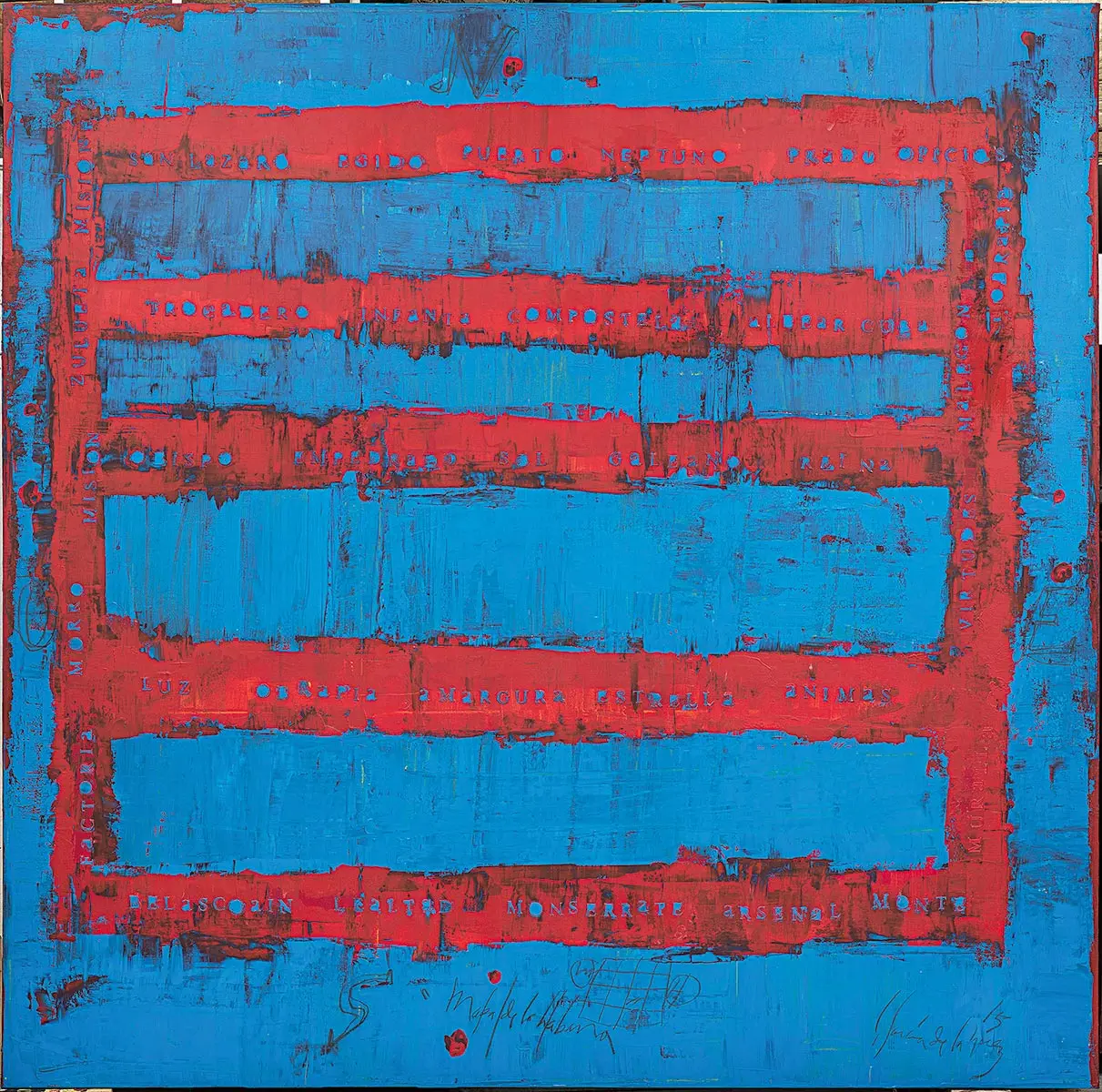
Mapa de La Habana (Map of Havana) is the visual focal point that opens the exhibition. Against a blue background, the artist painted a slightly square structure featuring thick red stripes. Two vertical ones flank five horizontal stripes. Along with the red stripes, we see the names of well known Havana streets: Prado, Factoría, Obrapía, Amargura, Trocadero. The texts are rendered in the same blue color of the painting’s background, resembling a typographical cutout. The pigmentation of both background and structure is very intense, and the surface has been treated as a drybrush sweep, with traces of the black base behind the pictorial surface. These resources produce an enhanced optical effect of depth.
In some of his paintings, García de la Nuez harks back to old bird’s-eye view maps. This style of semi-abstract representation of urban spaces is one of the earliest visual records of the New World, documenting the transplant of European culture. The artist revisits it in works like La colonia (The Colony) as a singularly rich source of formal references for exploring the representational ambiguity of the pictorial space. Appearing against a black background is a series of 41 irregular yellow shapes, which the artist calls “houses”; on them, García de la Nuez has drawn perspective lines to indicate depth. The lines suggest corners, stairways, banisters, ramps, and by virtue of them, the semi-abstract shapes become windows or openings into domestic interiors. Each shape resembles an expandable painting. Indeed, Escalera (Stairway), with its whimsical combination of shapes staggered in different directions against a yellow background, could very well be understood as a zoom-out and occupy the place of one of the 41 “houses”.
Cuatro casas en fuego (Four Houses on Fire), in medium format, is a tribute to four artists whose names García de la Nuez explicitly inscribes as referents in the modernist tradition toward abstraction: Turner, Monet, Rothko, and Twombly. Against a scratched blue background, schematic outlines of houses in an intense red hue sprinkled with yellow are placed at the cardinal points of the pictorial space. The text is also red. As in Mapa, the contrast between background and figure is translated into the creation of a sense of depth, without wholly representing spatial perspective.
Another notable aspect is the reflexivity of the shapes, expressed at times on the canvas’s very surface. In Dos (Two), the artist wrote: “With one hand we open the circle that the other hand has just closed” and “Because light is thin and shadow is fat.” These texts appear above and below, respectively, of a thick horizontal band formed by two rectangles, black and red, at the center of the painting. In turn, four irregular circles made with thin, wire-like black lines against a yellow field circumscribe the horizontal band. This painting is a sign whose actualization is as important as its meaning. In it, as in the rest of his work, Carlos García explores the dichotomy between semiotics and aesthetics that has so intensely preoccupied modern artists since it became clear that creating a language is only possible through the abstraction of reality.
ELVIS FUENTES