
Walking around Essential, an exhibition of works by Carlos Medina (Barquisimeto, Venezuela, 1953), one had the impression of being in a kind of laboratory where experiments about the laws of thermodynamics and quantum physics were being conducted. Occupying spaces on the gallery floor and tracing ascending or descending trajectories, these installations and “paintings” advanced, with their very titles, approaches to the material reality of nature and the infinite universe of its expression.
Titles like Superficie con neutrinos II (Surface with Neutrinos II, 2014), Neutrinos AGM. Spatial intervention (2015), Fragmentos de lluvia. Spatial intervention (Fragments of Rain. Spatial Intervention, 2016) or Estudio para superficie negra 15 y 20 (Study for a Black Surface 15 and 20, 2013), told us about Carlos Medina’s marked interest in testing the boundaries of our perceptual-sensorial system. His work, besides being rooted in the terrain of geometric abstraction, also interprets the expressive resources of a neo-conceptualist poetics.
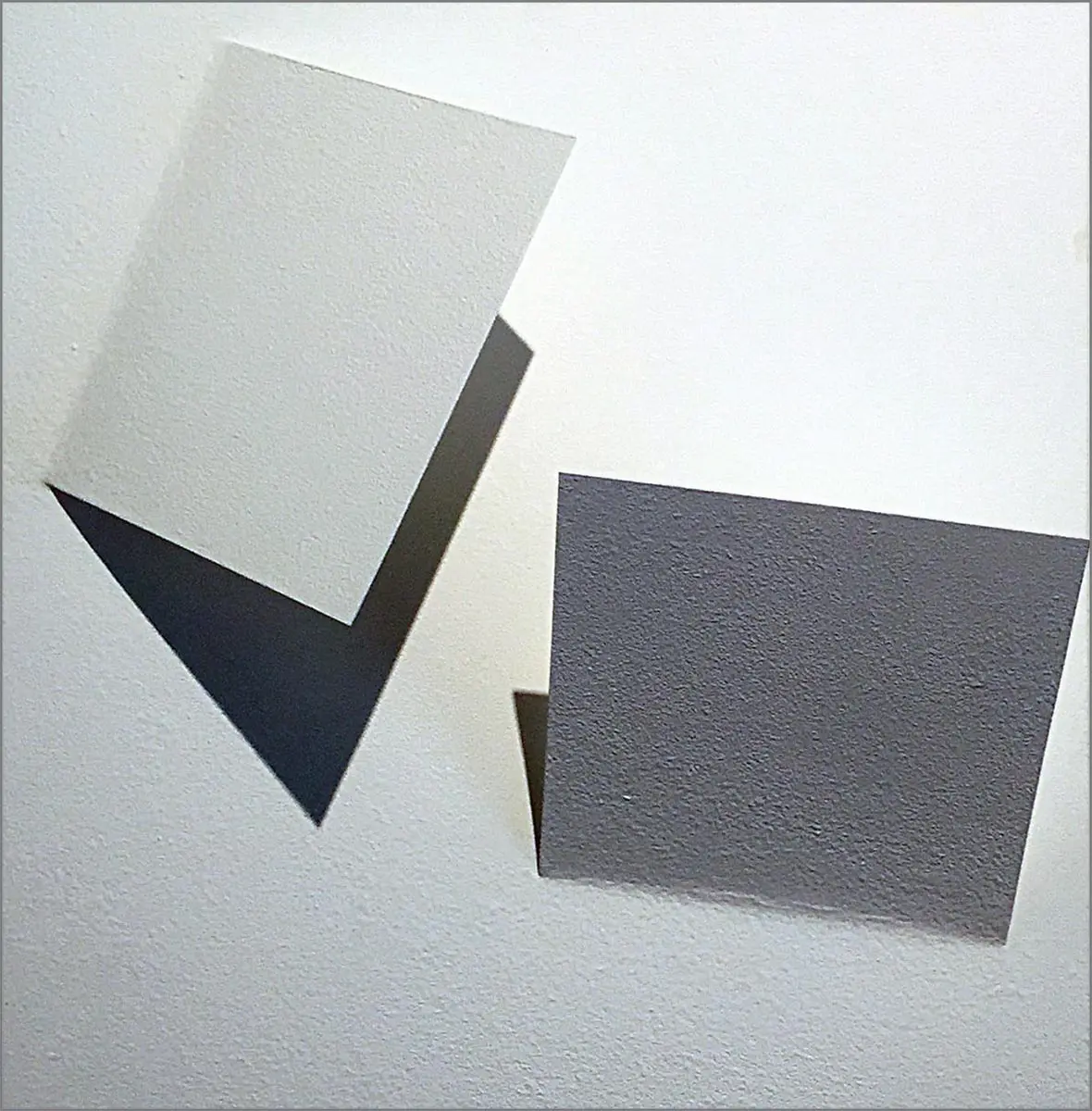
In Essential, viewers are allowed a view of the mechanisms on which such approaches to the unfathomable perceptual phenomenology of Being ground their articulation—the phenomenology that emerges from the relationship between the subject of knowledge and the material-world objects that surround and determine it. In installations like Fragmento de Cascada AGM. Spatial intervention (Fragment of Cascade AGM. Spatial Intervention) and Neutrinos AGM. Spatial intervention, among others, art expands in space. The works occupy and “inhabit” space, albeit in a fragile, weak way, making it possible for viewers (and inviting them) to experience them sensorially inside the very space that, in turn, the work itself demarcates and interprets. As a result, these works incorporate, somewhat in the manner of Soto’s penetrables, a high degree of permeability, a kind of fragility that renders them “accessible”, if you will, for the body of the viewer, who perceives them as weightless, aerial as if they were somehow floating without a precise or localizable center of gravity. The line of motion in these works comes and goes, with meanings whose order can be perceived, at the same time, as a sustained movement towards the external, or vice versa. A perpetual shuffle of force and energy.
But, while this is the perceptual behavior of the works mentioned above, there are others, like Estudio para superficie negra 15 y 20, Superficie a dos cuadrados (Surface in Two Squares), or Superficie con neutrinos II that turn this dynamic around. Where the former expand space, the latter contract and constrain it, emphasizing its materiality to a greater degree. These works also deal with the properties of space, but unlike the former, they do so by demarcating volumes that are more tangible, less ethereal, and combining on white planes geometric elements that can have the same or a different color, but are whose sum in all cases projects a much more compact and rotund physicality. Given their more constructivist-like construction, these are works where motion appears frozen. It is a kind of constructivism that, in a way, reminds us of Carmelo Arden Quin and Gyula Kosice, the founders of the MADI group (Movimiento-Abstracción-Dimensión-Invención), which starting in 1946 defended geometric art in its purest, non-figurative forms with universal and constructive values, and whose influence is central in any historical understanding of the development of contemporary Latin American art.
In Essential’s selection of two-dimensional works, we encounter an artist who, interestingly, puts forth an idea of modernity, in the sense that all art seeks the specificity of its medium. In abstraction—one of modernity’s foundational spirits—this gesture means that painting can be reduced, in essence, to line and color. By virtue of this, these abstract-geometric works, like all spheres of modern knowledge, come to reinforce the autonomy of the artistic sphere. Yet we also perceive in Medina’s works—more installative, more illusory, and, as such, less tangible—the inverse dialectic, in the sense that they, unlike others, transcend the categories of the perceptual-sensorial and emphasize the conceptual aspect. Against the perceptual-sensorial, they emphasize the conceptual, which is to say, they build, in direct opposition to autonomy, a heteronomy that construes art as a concept as much as perception. Thus the fact that Medina’s works “fly” or “float”, connecting and intercommunicating aesthetic and scientific discourses and nevertheless telling us about the subject’s inapprehensible, inexpressible experience of being in the world.
DENNYS MATOS