
Blurred Borders, an exhibition of works by Carola Bravo (Caracas) at FIU’s Frost Art Museum, is an immersive installation where the outlines of visitors moving through the cozy gallery are promptly integrated into the projections that populate the space with poignant scenes of immigrant life.
The video installations featured in this exhibition come from two series: Migration Dreams Series and The Immigrant Portrait.
The former is an appropriate starting point for analyzing the subject of migration and its implications for the immigrant’s memory and identity.
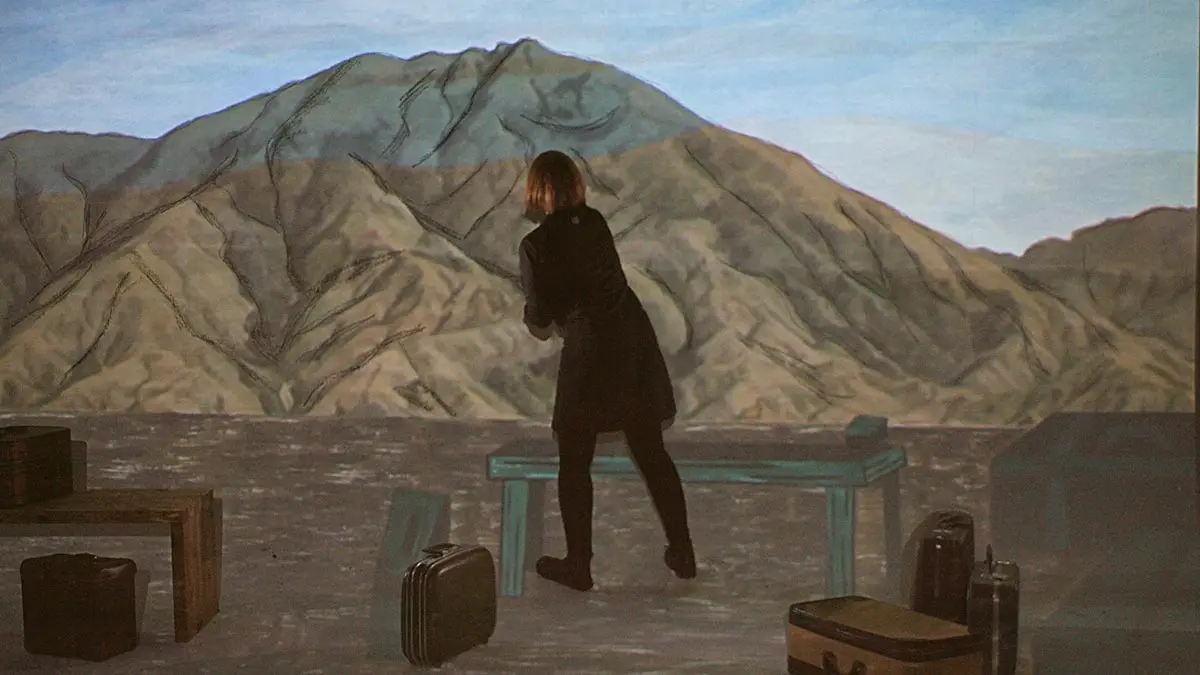
Taking the Great Migration1 as an inspiration and emotional analogy, Bravo appropriates—and pays tribute to—Jacob Lawrence’s iconic Migration Series (1940-1941). She uses the image of simplified color planes that summarize crucial scenes and moments in an immigrant’s journey as the background for new approaches to the issue of immigration in the US, now re-contextualized by waves of immigrants from Central and South America.
Renunciation, determination, loneliness, nostalgia, exile, and, above all, hope, are the leitmotivs holding Bravo’s series together, which infuse new life into Lawrence’s work via animations that emphasize the desire and persistence of immigrants as they go through their turbulent passage. Reality and illusion become at times interchangeable for characters—embodied by the artist herself—who seek to find their way in unknown landscapes and/or situations, and who, more often than not, find themselves wrapped up in and confronted by a new reality that isolates them as it drives their ultimate determination to build a better life.
Migration Dream Series # 2 (based on Jacob Lawrence’s Panel #25) finds inspiration in Gabriel García Márquez’s novel One Hundred Years of Solitude. Bravo rearranges elements from Lawrence’s original work just like an immigrant tries to adapt a new reality to his or her own history. From a window, we see an image of Caracas, and gradually a swarm of yellow butterflies emerges to inundate the video in a kind of vital dreamlike allegory.
Carefully selected, each one of the symbols active in these videos—yellow butterflies, white doves, suitcases, among others—contribute to weave and enliven the paintings revisited by the artist.
Another highlight in this series is the show’s central video installation, Migrations Dream Series # 3, which, projected on a life-size scale, envelops visitors in a warm embrace.
Migrations Dream Series # 3 takes as its starting point Panel #60 in Jacob Lawrence’s series, which portrays the anxiousness of waiting in a bustling platform and presents the artist’s own figure hauling his heavy baggage. The bench at the center of the gallery becomes one more bench in the platform, incorporating the visitor into the expectation of a journey as yearned for as it is feared.
This series also includes references to the work of painter Manuel Cabré, specifically his well-known landscapes of Caracas’ Mount Ávila, and to the celebrated quilt-making tradition in Gee’s Bend, Alabama, where African-American women have been creating patchwork quilts in geometric compositions since the Nineteenth Century.
The second series in Blurred Borders, titled The Immigrant Portrait, involves a much more personal vision, where memories and dreams connect in a circular poetics, and the boundaries between reality and unreality dissolve to become part of the unique world that an immigrant builds for his or her ultimate survival. Here, Bravo starts with Roy Lichtenstein’s portraits of crying women to create an inward-oriented trilogy of great poeticism and sensibility.
The Immigrant Portrait # 3 comprises three extreme close-ups of Bravo’s face covered by yellow butterflies that drink her tears. It is based on a real-life fact: butterflies gather on the heads of tortoises in the eastern region of the Amazon basin and drink their tears to obtain sodium, which is scarce in the area. Bravo’s installation alludes to the continuum of life and the feedback loop involved in migration, beyond personal suffering.
The intimate and immersive character of Blurred Borders, with its symbolism and emotion, makes us personal and collective participants in this tempestuous, agonizing, and yet magnificent adventure that is migration.
NOTE
1. The term defines the largest internal migration in the history of the United States. The Great Migration, marked by the mass displacement of African Americans from the rural South to the industrial North, began in 1915 and lasted for several decades (until 1970), ultimately transforming the country’s ethnic, economic, and cultural structure.
JANET BATET