
The interesting thing about those theses proposed by French sociologists about the complex world of simulation, virtuality, reality, real-time, etc., is that the speed with which things occur today surpass any of their postulates. Change, innovation, and the blurring of the boundaries of that which is regarded as “private” are everyday occurrences. The interesting thing about the analyses offered by Virilio, Baudrillard, Levy, and the company, is that they need to be adapted to the changes occurring in the technological world, in the same manner, that a tablet becomes outdated as soon as it is sold when compared to other tablets about to hit the market. It is not that reading their works is worthless or that it does not help us to comprehend the environment in which we live. But in order to fully take advantage of them, we must first understand the context in which those books were written, the technological age of the times that they make reference to.
Three decades ago, having a computer at home was unthinkable; two decades back, owning a mobile phone was rare; and years later, who could have thought that mobile phones would be used to surf the internet, take photos, and record video. Today, we witness a period in which we are “connected” with the present lives of the entire world; we can have direct contact, real-time conversations, with several people from several places around the world at the same time. We can access all types of information with the click of a mouse, check out commercials, and, on any given day, we can “be” in several places while having lunch. This is not strange in the contemporary world. Nonetheless, this much happiness and access to immediacy end up taking us back to essential questions human beings have been asking for centuries. What happens to the relationship between the “self” and the “other,” when the “self” becomes so mesmerized by its own reflection? What is real when looking through a mirror? Why do conversations so recurrently turn to concepts like “vanity” and, thus, “death,” after one has been talking about things like “reality,” “mirrors,” or the “self”?
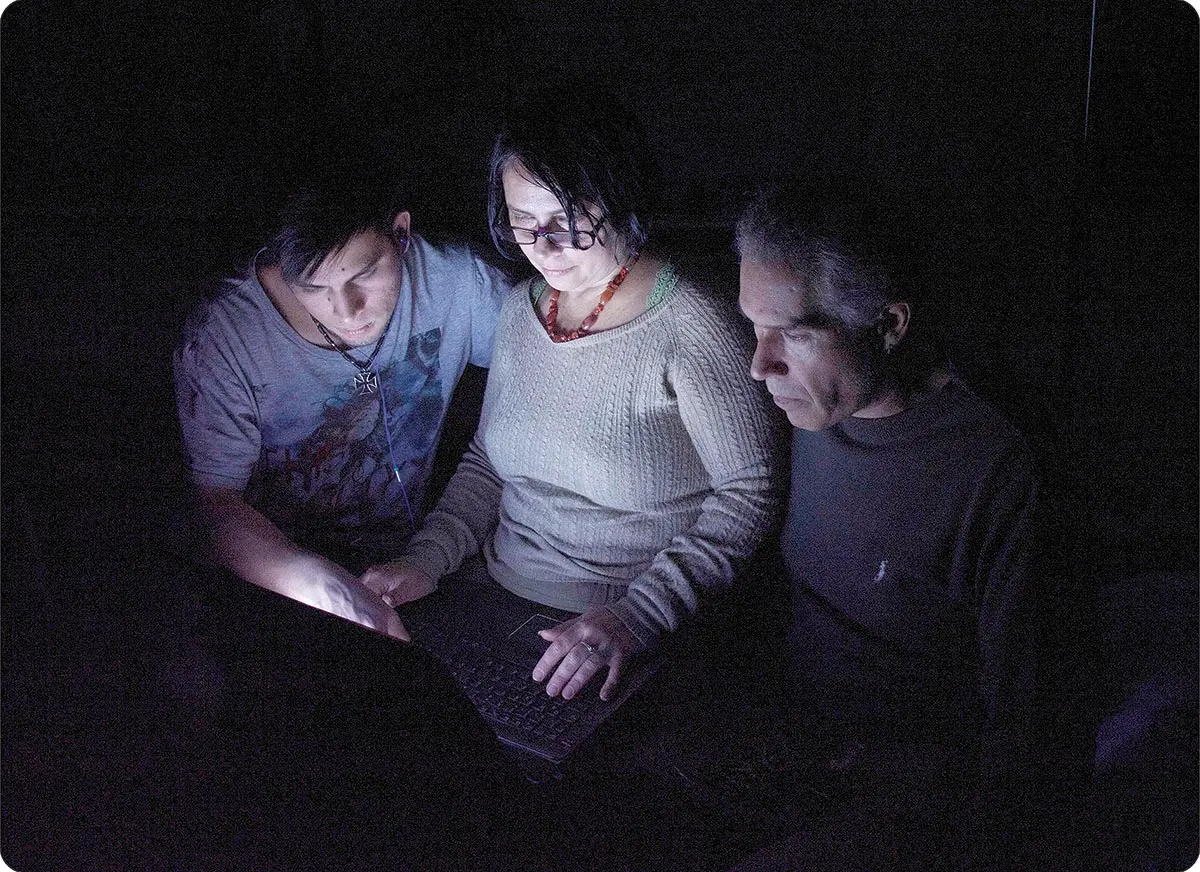
Narkissos, the title that Edgar Guzmanruiz decided to give to his exhibition, takes a look precisely at the “narcotic” effect of screens on people. When Narcissus is condemned to desire his own image reflected on a pond, he does nothing else but goes there every day to adore himself. Nothing and nobody, not even beautiful Echo, can take away from that infatuation with himself, that addiction to his reflection; until one day, in a desperate move to possess the object of his desire, he dives into the mirror of water and dies. In this manner, Guzmanruiz analyzes the way in which the virtual world traps, blinds, and forces people to be in permanent contact with the screen. The body posture becomes reverential and submissive before the light that emanates from these devices. Interpersonal changes and, indeed, the screen as mirror converge into new forms of life. The way in which mysticism gradually transforms is not very different from that process. If art and the museum space were regarded as places of retreat similar to religious temples, if loyal participants were to replace the silence of praying by the confrontation of the exhibited image; and, if after all, self-absorption can also occur in a bus, a coffee shop, a bedroom, or a living room, it is then time to begin to regard the screen as a sort of supreme, omnipresent, being. The reflection endorsed in this exhibition by Guzmanruiz is geared towards the new forms in which numbing adoration is manifested through the interaction of the “self” and a light-emitting superior world that traps the gaze and submits the body.
In this exhibition Guzmanruiz underscores several aspects, including the unavoidable “selfies,” ponds turned into mirrors, screens that achieve the same dramatic effect of old chiaroscuro, and of the characteristic sound of a server connecting to the internet. While the exhibition offers rivers of conversations in “chats,” viewers cannot escape the anguish generated by not being able to see their reflections in the show. The images exclude us from the frames of selfies and away from those absorbed with their screens. Like in Las Meninas, the famous painting by Velázquez, we are left to wonder about the content in the canvas being painted. In the case of Guzmanruiz’s work, we are left to uneasily wonder about the content in the screen illuminating the faces of the possessed subjects. Although the evasive images do not stare back at us they are nonetheless an unsettling reflection of ourselves.
ANDRÉS GAITÁN T.