
It was 35 years ago that Mexican artist Francisco Toledo (Juchitán, Oaxaca, 1940) presented a retrospective exhibition at the Museo de Arte Moderno in Mexico City. Today, he returns to this museum with one of the most visited and compelling exhibitions in recent years: Francisco Toledo. Grieving.
Consisting of a hundred ceramic pieces created in the Taller Canela with the collaboration of ceramist Claudio Jerónimo López, Toledo conveys one of the most painful stories in Mexico of recent years: the dramatic increase of force disappearances, torture, and murders that go unresolved and unpunished, in a country where the rule of law is not capable of addressing a situation in which the state is clearly involved in criminal activities.
One of Toledo’s preoccupations when producing this series was the necessary coexistence of his vast aesthetic language with the themes that generate anxiety in public opinion. Nonetheless, each of his works manages to expressively convey the tragedy of thousands of people murdered or disappeared, and, with a brutal economy of means, leave viewers to reflect on the consequences of a sort of undeclared war.
In this manner, the exhibition Francisco Toledo. Grieving welcomes visitors with a basket full of ears. This piece not solely references the crimes of a famous kidnapper (today imprisoned) known for cutting off the ears of his victims to send them to the victims’ families, but also the old pre-Columbian narrative according to which worriers would return from battle carrying baskets full of ears that belonged to the defeated enemy. The exhibition unfolds with a splendid museography by Patricia Álvarez, who placed the ceramics on long black tables arranged together to form stars and following the round shape of the exhibition area of the Museo de Arte Moderno.
It is true that Mexico has a long and documented relationship with the theme of death. The pre-Columbian tzompantli were walls with stoned carved human skulls. Stakes would be placed on these walls with the heads of fallen enemies. There are also the funny skulls by José Guadalupe Posada, who chronicled everyday life through engravings filled with skeletons smooching, dancing, enjoying themselves, singing derisive coplas that destroyed politicians; there were the skeletons, of living people and dead people. Since childhood, they have got us used to live with death.
The death that comes from the hands of Francisco Toledo is nothing like Posada’s playful skeletons. They are closer to a hell shaped by the aesthetics of suffering and the senselessness of violence. The macabre beauty of the intervened ceramic dishes, the faces extracted from the mud, the simple, and yet symbolic, objects of persons who no longer exist, become in this exhibition a powerful symbiotic reference to absence/presence.
Toledo’s imaginary and cosmogony are given free rein in each of these high temperature and polychromatic pieces—mostly reds, blacks, and earth colors. Faces without eyes, hands separated from their bodies, remnants like shoes, belts, pants, and bones that are very similar to those found in clandestine graves, nourish a very strange and macabre beauty that, nonetheless, confers the artistic object a compelling presence without detriment to the subject matter. According to Toledo, “When you are dealing with a subject that is so painful, you realize that, despite the pain, there is also an aesthetic element that you cannot ignore.”
The animals that have accompanied him throughout his long artistic trajectory also appear in this exhibition: frogs, dogs, octopuses, spiders, and bats, among others. It would appear that Toledo has summoned them to lighten the load of a difficult process of one of the most critical and accusatory exhibitions that he has produced in the last two decades. Social activist, philanthropic, environmentalist, cultural promoter, and collector, Toledo is above all a prolific creator that has known to translate his activism to one of the most relevant bodies of work produced since the second half of the 20th century.
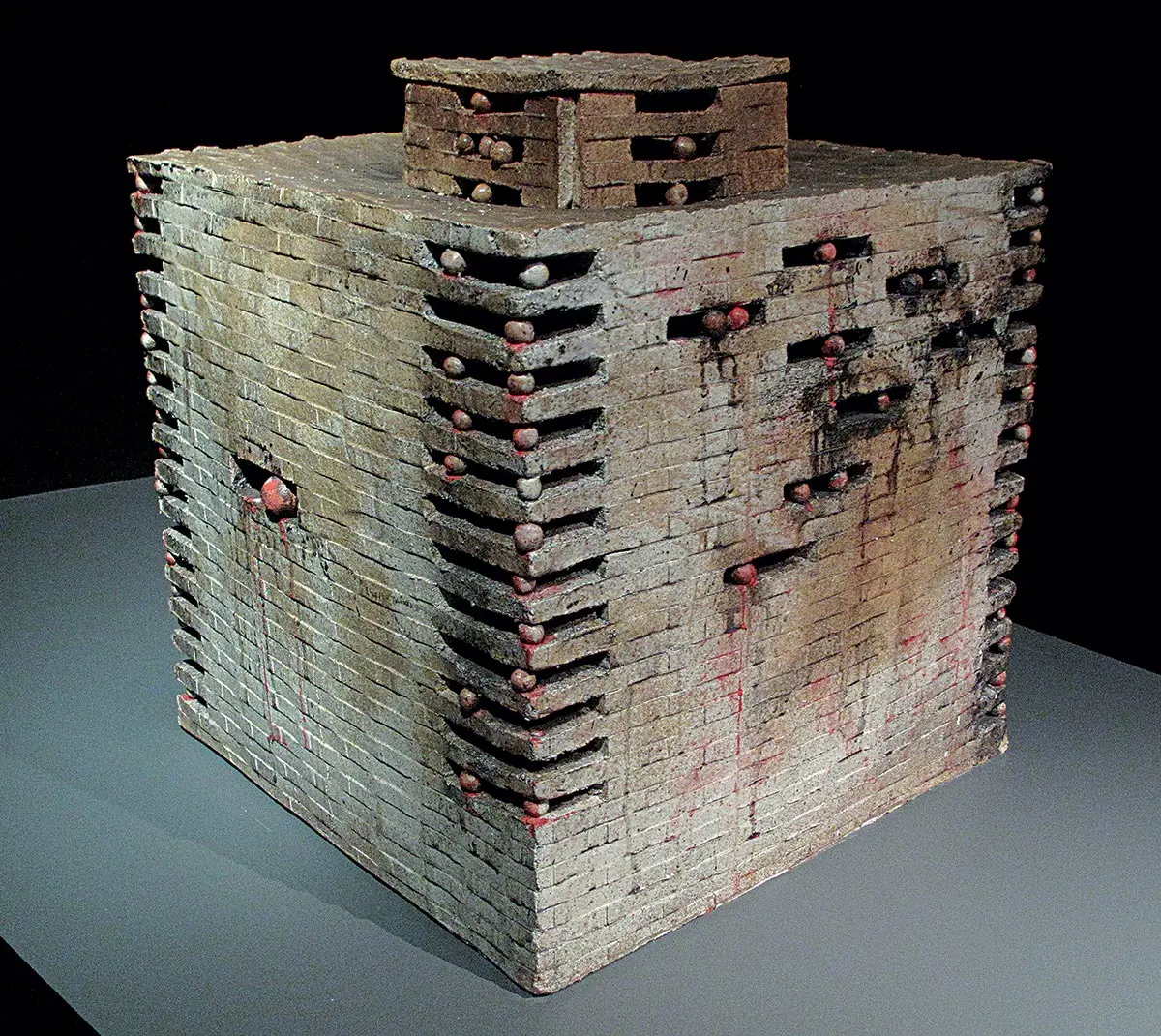
The high-temperature ceramic work (cooked at 1,500 °C) involves an almost ritualistic and purifying activity. Without making preparation sketches, molds, or drawings, Toledo shaped each piece until reaching a macabrely beautiful denunciation. The presence of several mortuary urns in the exhibition—like the one specially created to contain the ashes of recently deceased photographer Mary Ellen Mark, with the head and bones of a dog, as an homage to her love for this animal; or the one that recreates clandestine places of captivity—outlines a map that surveys accusations, reconstructs spaces, and underscores geography armed with unmentionable secrets.
At 75 years old, Francisco Toledo continues his struggle for justice, for not giving in, for saying that which needs to be said, and fighting for the most complex caused. Francisco Toledo. Grieving entrenches a memory that must not be forgotten. This exhibition is a tribute to the victims of violence, torture, and injustice.
SANTIAGO ESPINOSA DE LOS MONTEROS