
Serial is a repetition in every sense. It is a repetition of superimposed images, a collection of fortuitous findings, and a reutilization of discarded materials. It is a chain of movements, displacements, and actions in the creation of which the artist repeated, accumulated and archived almost obsessively. Similarly, Serial is a reproduction of sounds that communicate via silences and rhythms, a dance of lights and shadows, that are recontextualized and gain new meanings. It is a composition of images and stories that dialog, expand, and complement one another on space and time.
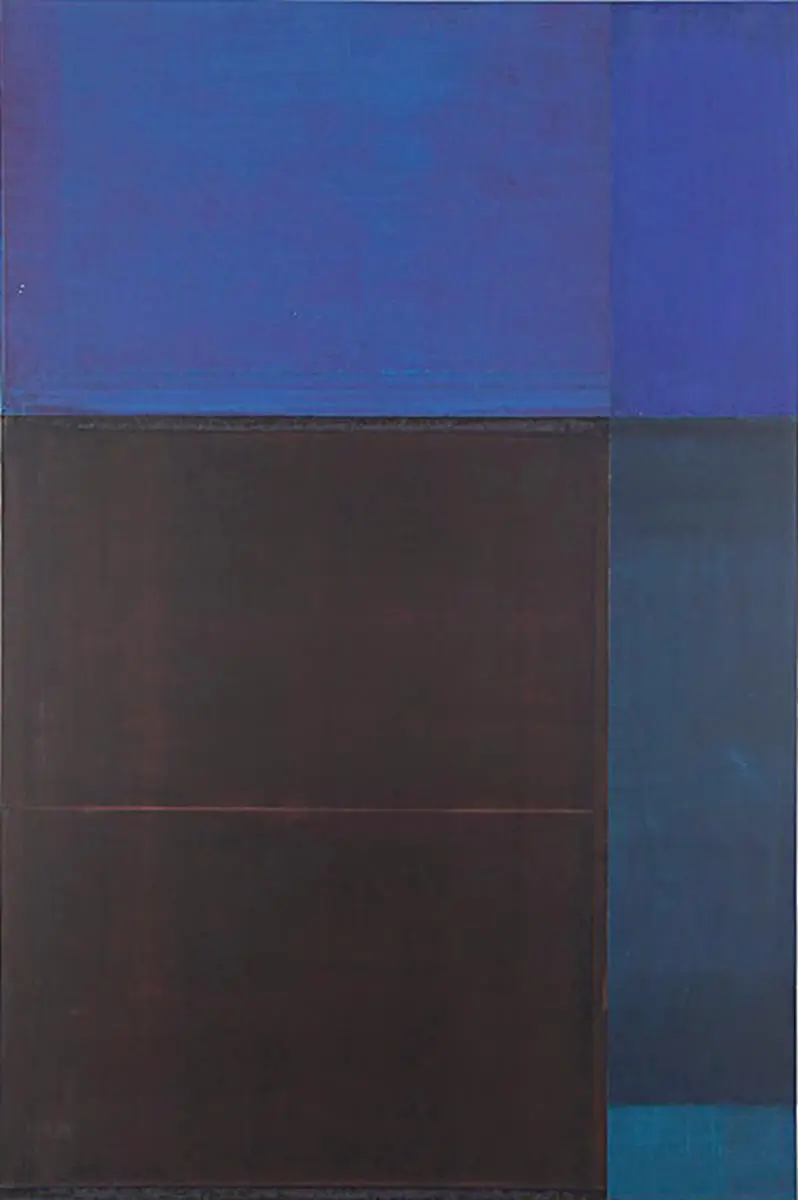
This is Mexican artist Gabriel de la Mora’s first solo exhibition in Europe. Presented at the Timothy Taylor gallery in London, it features three new bodies of work, arranged in two spaces. The first section welcomes us with two series of two-dimensional works in a variety of formats. As we enter, we initially think of the abstract paintings of geometric shapes in dark colors, almost monochrome. As we approach them for closer inspection, however, they start to seem like collages in another kind of material, made from fragments of advertising images and several different types of disfigured, inserted, and transformed iconographies. Looking at the images again we realize that they contain a much more complex narrative and story, and we discover that they are made with rubber sponges and aluminum plaques of the kind used in offset printing, found, appropriated, and manipulated. We can clearly see a series of blurrings and superpositions of color, generated by the continuous use of the four inks of the offset process: magenta, cyan, yellow, and black.
For the creation of these works, De la Mora used materials found in a print shop located under his own studio in the Roma borough of Mexico City. The artist has been using the same space for twelve years, but it was only recently that he noticed the print shop. What appealed to him, in particular, was the sound of machines dating from the 1920s-40s, which have a rhythm resembling that of minimalist music. The sound guided him to find a number of rubber and aluminum pieces that were ready for disposal. He noticed their textures and shades of color, similar to painting. Later he became interested in their history: the patina that results from thousands of reproductions made over time; the machines are cleaned for each new run, but they are never absolutely clean, which causes the blurring effect. Finally, the artist set for himself the task of accumulating the most he could of these materials from different sites, archiving and classifying them with the advice of a restorer who instructed him in the use of chemical cleaners to clean or manipulate the pieces. Hence the title of the exhibition, Serial. It has to do with a chain of movements and actions; with obsession, accumulation and archiving. These works explore the relationship between the image (painting and graphics) with reproduction, time, and accident.
Located in the second section, more sequestered and less central to the exhibition is a site-specific installation titled Crystals of Inevidence. This work fulfills the function of seriality by means of an effect contrary to the gesture of transforming and giving new meaning to discarded objects. Here, the artist inserted into the gallery wall a series of microscope coverings or glasses in a mathematically rhythmic pattern. The light shining on them produces an effect of motion, reflections, and shadows, which shifts depending on the angle at which each piece is posed. The color of the wall also shifts: it appears clearer, more intense, or darker, and it becomes segmented. In this way, the glasses cease to be coverings or microscope pieces and are transformed into a sculpture or installation, a work of art. The work is contemplative, fragile, and beautiful. We sit on a bench in the gallery and think on that which is not evident, in the glasses’ very fragile, almost invisible materiality; they are instruments for our eyes, equally fragile and equally invisible to us (their owners), to see what they can’t see by themselves.
At the end of our visit, we breathe and get up. We think that both the production and the contemplation of art are philosophical exercises. For De la Mora, the encounter with the work begins with the gaze and is later made stable via the emotions and the other senses. When one observes and contemplates, questions and ideas emerge. “Thinking and doing go hand in hand, as do seeing and thinking, or walking, thinking, and seeing,” the artist says. The conclusion, then, is that Serial is a reflection about time, about the re-signification, re-encounter, and re-production of images and stories, including concepts of possibility, control, and accident.
PAULA LÓPEZ ZAMBRANO