
The work by painter Gustavo Díaz-Sosa (Sagua La Grande, Cuba, 1983) is defiant in its narrative approach. The exhibition titled Epopee for a New Millennium is on display at the Galería BAT Alberto Cornejo in Madrid, Spain.
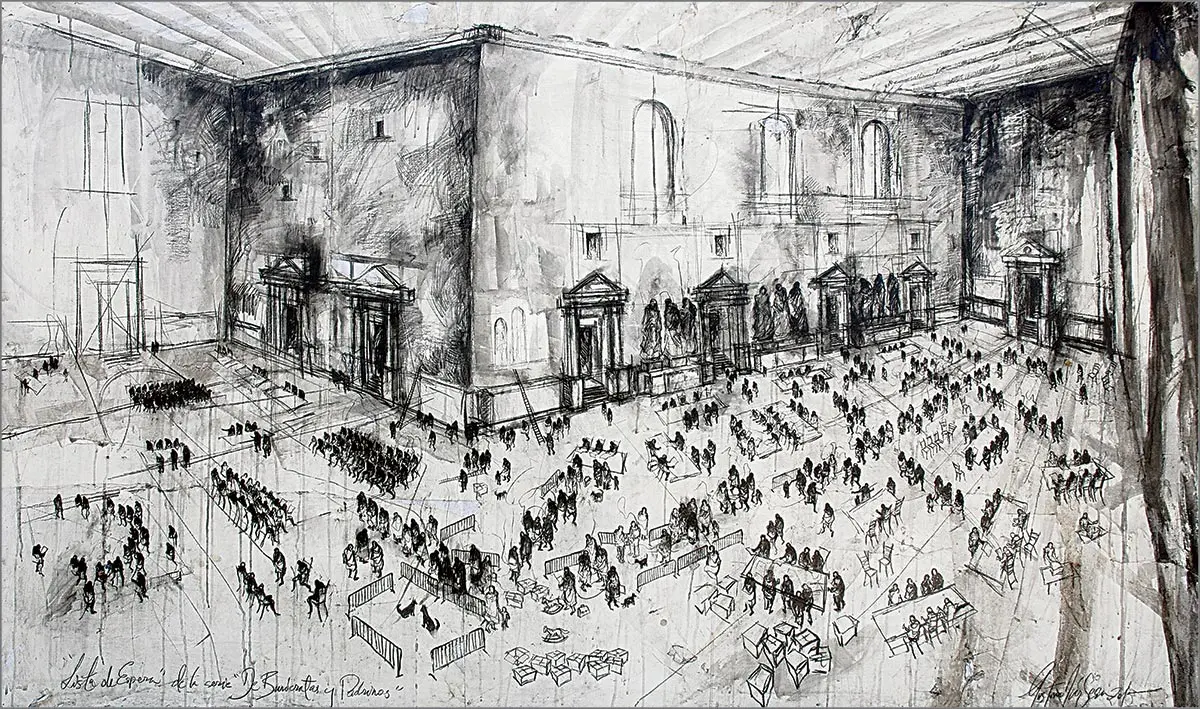
In his painting Díaz-Sosa employs a clearly recognizable iconography: monumental architectures, individual identity subjected to a collective one, waiting lines, modern bureaucratic situations and an almost futuristic style in search of a unitary vision of society.
In his series titled Exodus of the New Millennium, Díaz-Sosa includes legends like “and now we are just like yesterday” or “exodus and the desire to continue.” The composition is placed on streets that are approached as collective and shared spaces in which to identify flows, changes and speed. The work titled Éxodos. Odisea y Supervivencia (Exoduses. Odyssey and Survival) reiterates the idea of travel, transition and movement, but this time by alluding to immigration through the representation of a boat.
Díaz-Sosa’s own statement reads as follows: “I try to describe an exhausted and desperate universal society in the face of that which is considered a “Democracy” at the global level. My characters continue to escape towards nowhere in search of doors or exits in the monumental walls that surround and contain them in bureaucracies and established norms. Like sheep, they wander in herds trying to save themselves without regard for others.” This take on social unrest and the back and forth of subjectivity is conveyed on the canvas through mixed media that layers brushstrokes with, for instance, fragments of phonebooks that allude to the homogenization of identities through numbers and, metaphorically, to the “archival furor” coined by Suely Rolnik.
There is also a place for punishment in this almost Foucauldian take on institutions, surveillance, and social structures. The piece titled Purgatorio (Purgatory) describes a circular building that houses a prison in which people are constantly leaving or entering. The cold chromatic palette in this work emphasizes the feeling of guilt. All the works in the exhibition share two elements: institutional architecture as a device that generates an entire series of relationships, movements, and identity forms surrounding the piece, and human beings as a mere instruments at the service of mechanisms of power. On this same vein, the work in the series titled Huérfanos de Babel (Babel Orphans) recreates, as the title suggests, a Tower of Babel spiraling and unfolding in black and yellow lines. The work appeals to the confusion of languages that is present in the famous biblical story, which is often associated with postmodernity and, specifically with the architecture that vindicates contradiction in the face of the fragmentation of the modern project. In the case of Gustavo Díaz-Sosa, that image of polyphony and confusion is revisited to recreate the chaos of a contemporary world framed by a transcendental and teleological dimension.
Another work from the same series includes the representation of a Trojan horse that rises above the crowd. It is, on the one hand, an omen of what could happen (war?), but also about the introduction of an epic episode that takes us to that intra-historical perspective offered by Díaz-Sosa.
The series titled Of Bureaucrats and Godparents reflects a collectivity in constant flow and certain bureaucratic “traps” like waiting in line or dealing with public servants in bureaucratic settings. The architecture that frames the entire composition is grandiloquent, classic, institutional and ideal-based. It is set in contrast to the reality of the confusion associated with the body and identity. Lines are blurred and torn through techniques often expressionistic in nature that can sometimes even border on the surrealist.
One of the most surprising aspects of Díaz-Sosa’s painting is the recovery of that which is real, of narrative, figuration, and even historicism. As we have got used to observing in galleries art that is increasingly more dematerialized, conceptual and processual, it is noteworthy to once again stand before work that resorts to an iconography that is traditional to a certain extent and that represents the most matteric brand of painting.
Conversely, El Proceso Según Cuenta K (The Process According to K) conveys a situation of surveillance and judgment dramatized through some witnesses. Once again, we observe the apparition of the institution as the staging of power and its procedures to establish a particular order.
The work titled Apoteosis de la Humanidad (Apotheosis of Humanity) is framed by a bleak, dry and fragmented territory. Díaz-Sosa once again relies on phonebook fragments and textured reddish colors that insist on the idea of scarcity. The paintings by Díaz-Sosa compellingly envelop his vision about the new millennium and his perhaps prophetic take on the future of the modern world.
ANA FOLGUERA