
Culture and nature co-exist tensely in the sublime paintings of Hugo Bastidas. Socio-economics, eco-politics, and conceptual arrangements come together in an ironic sensibility that is inventive, seductive, and troubling. In his latest show called Illuminations 1, the artist continues to propose surreal allegories that compel speculation about our identity and our future.
Bastidas has always found inspiration in nature. In horizontal depictions of profuse flora, beauty and danger commingle. Exotic landscapes are rendered in gray, pencil-like tones that are slightly blurred, making one look closely and inviting intimacy while evoking temporality. These conjured moments represent an ontological intersection between memory, presence, and projection.
Underpinning all of the work is an investigation of collective assumptions about interrelatedness and our place in the world. In Study for Flowers from the Place of the T’s the scene is overexposed. Light blasts a bank of blossoms. The glare mimics our media-centric society as it spotlights the riotous overgrowth. The repetitive flower shapes suggest that individuality is sacrificed in a community of uniformity.
Circles were repeated in a rhythmic manner in So Similar. Cherries hung like discs in a welter of branches and vines. Some of these spherical shapes appeared as if they were props in a staged scene. Flattened and distorted, they seemed more like reproductions than actual products of nature.
The loose grid of discs was suspended in a network of unruly lines, imposing artificial order onto a chaotic lattice of inter-looping plants. The abstracted forms were poised in elemental opposition. As the circles and vines interacted, they directed the gaze into a portal where the pictorial space bent in to create a recessed sanctuary — or subtle pathway.
Significantly, there were no humans in any works except for Knowing Where You Are. What appears to be a lone figure perched as if in meditation atop a canopy of trees. Impossibly light on the high branches, the small shape was tenuous and inarticulate. Bastidas lets you question your own sight in this touch of magic realism that also served as a metaphor for both aspiration and anomie.
Study for Grand Connectedness introduced a potent symbol. In the foreground, just off-center, a chandelier dangled from a gnarly, twisted tree trunk. A weather-eaten log lay along the bottom, echoing the large branches above and framing the chandelier. A cluster of bushes and long-leafed plants burst forth. The dichotomous subject matter was polemical but remained open-ended.
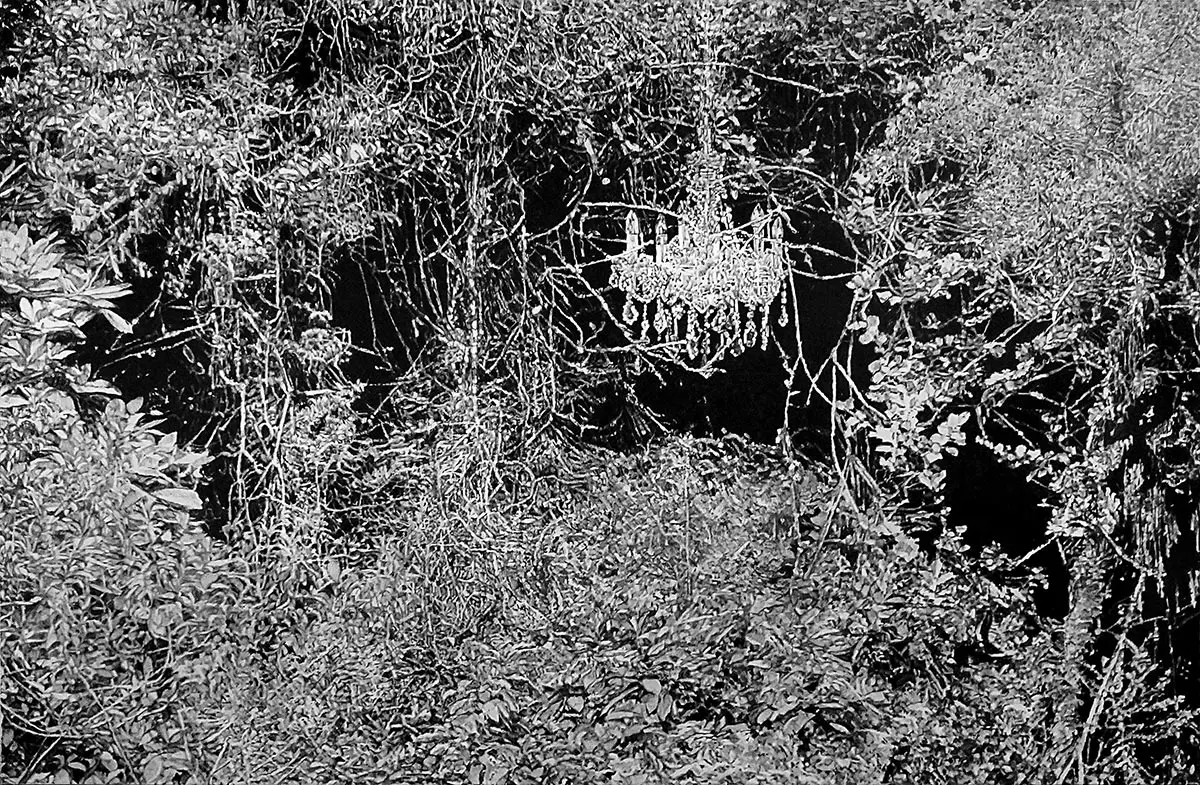
Several other paintings positioned a chandelier in the wilderness. The clear standout of these was the sole black and white work. Again, a jumble of vegetation spread out exuberantly. Leaves, vines, and stalks were brightly sketched against dense, inky recesses. Just to the right of center and back a bit hung a chandelier. Aesthetically, its symmetry balanced the tangled tendrils and climbing creepers while its anachronism was disorienting, warping our sense of time. The incongruous imposition was at once attractive and intrusive.
Romantic and emblematic of desire, chandeliers evoke palaces and nightclubs. They symbolize illumination. Yet Bastidas presents them outdoors in daylight, stripping away context and utility. Chandeliers also symbolize wealth and privilege. They allude to colonialism. They imply unsustainable practices, generating a menacing undertow. The absurd juxtapositions call to mind excesses that lead to revolution and point to the existential threat of global warming.
The interaction between the divergent subject matter makes these works “targets” in the way Marshall McLuhan described the term. “Art… acts as an early alarm system, enabling us to discover social and psychic targets in lots of time to prepare to cope with them. The concept of the arts as prophetic contrasts with the popular idea of them as mere self-expression.”
One-Sided could be prophetic. A commando bridge (only half of a suspension bridge) was partially submerged. It crossed a swollen stream and continued on the other side, disappearing into lush foliage. In this wry piece, Batidas played with several motifs including faith, mortality, and volition.
A final piece, November on the Seine, portrayed a deserted rowboat full of dried leaves. Could this be our Eleventh Hour as the title suggests? Is our extinction destined as these unpopulated paintings imply? On our trip across Lethe, will our legacy be a cargo of death? Questions of preservation and idealization confront the viewer in this melancholic but sly, humorous vignette.
If Bastidas only did good-looking landscapes, his lyric compositions and hovering brushwork would be satisfying on their own. Adding a surreal and conceptual overlayer makes his paintings undeniably relevant. He has the skill and unique vision to focus our attention on spirituality, survival, and aesthetics all at once. His robust style is balanced by a nuanced technique, resulting in a complex and resonant oeuvre. This important exhibition revealed a mature artist at the height of his prowess. Few artists fuse such disparate subjects with as much effect and portent.
JEFFREY WRIGHT