
Iván Contreras Brunet (Santiago de Chile, 1927) followed a highly personal path. His work is on exhibit simultaneously at Maison de l’Amerique latine under the title of Passage de la couleur (The Passage of Color) and at Gimpel & Müller as Iván Contreras Brunet. Homenaje. The visibility that these two spaces give him now coincides with new perspectives for reading the art of this representative of Latin America’s geometric and optical-art schools. The expansion of knowledge and new scientific discoveries produce a continuity of expressions.
Contreras Brunet began his studies at the School of Fine Arts in Santiago de Chile in 1949; there he was a student of Gregorio de la Fuente and Marta Colvin. He has lived in Paris since 1952. In 1968 he was a founder of the Co-Mo group (Constructivism and Motion), whose projections connect him with the work of Russian constructivists like Vladimir Tatlin and Alexander Rodchenko, and to others like Vantongerloo or Jesús Soto. Contreras Brunet lived in New York City for four years between 1957 and 1961, when he returned to Paris. In that period, his art focused on materials, spatial depth, and peripheral vision.
Despite their maturity, Contreras Brunet’s works participate in this spirit of change. This artist did not stop at propitiating viewer’s autonomous perceptions but produced a chromatic range all of his own. The study of Impressionism’s rules for the use of color and its concept of the capture of time drove him naturally to the field of chromatics. Subtlety and aesthetic intimacy are alloyed in these structures. After experimenting with several different materials, he chose wood, acrylic, and metal mesh. As installations, on the ground or suspended from the ceiling, his forms retain an element of independence or complementarity that adds fluidity to the scheme. These works can be read individually in alternating fashion or as a whole as they incorporate shapes into space and add uniformity to the relief.
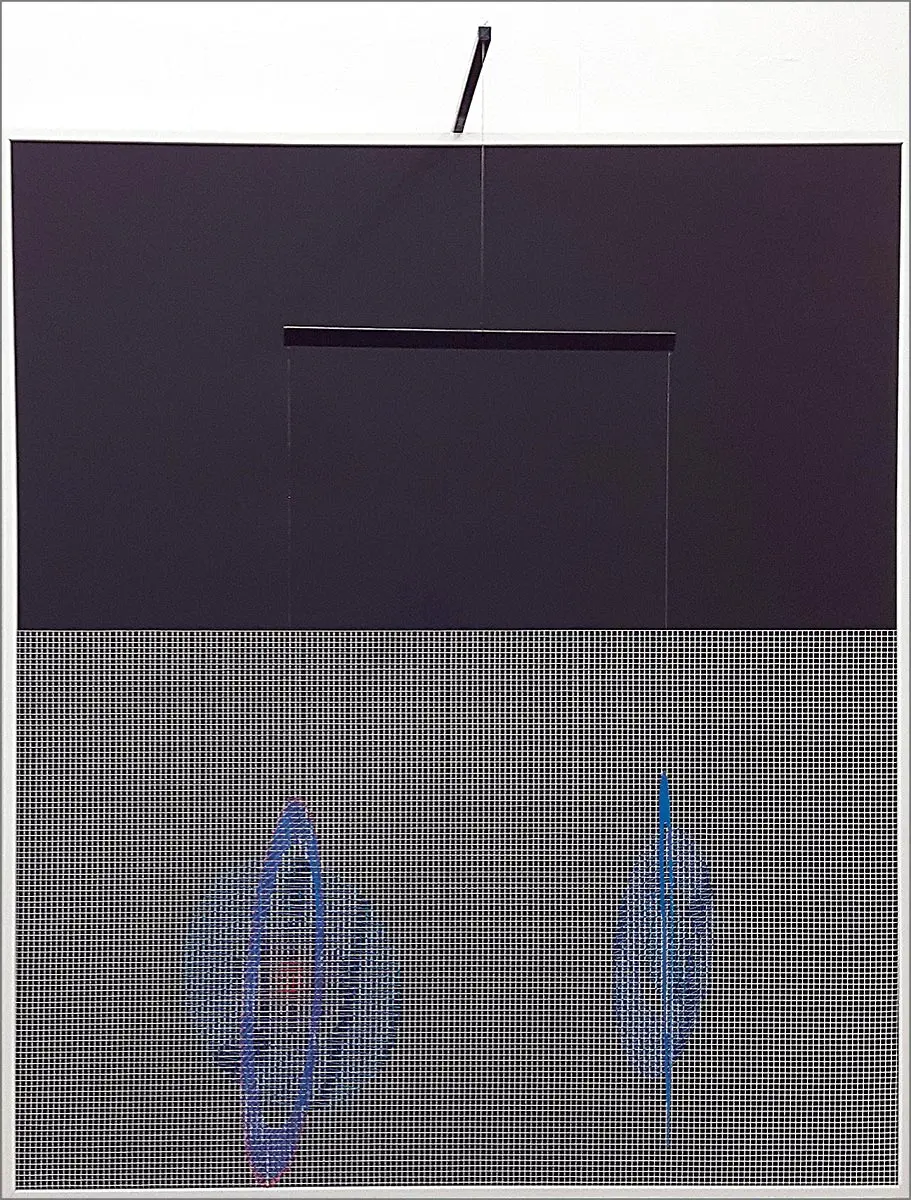
Contreras Brunet’s achievement is to have introduced a spatial structure that, overlapping like a net, questions the essential elements of the flat surface, where it does not fragment color or surface but is able to produce a harmonious tone that transcends shape. These works, made on a monochrome basis, produce an original visual effect.
The pictorial surface is revisited or vested—a tactile process between vision and vestment—by this netting, which, indistinctly colored, cuts and structures the plane. To the support thus elaborated, Contreras Brunet adds suspended circles or ellipses of small metal rods. The shapes in space of a metallic net, almost scientifically colored, complete a perspectival visual grid of great impact. The layers of material intercut each other and present us with a shifting landscape. Thus, many of his works are named Pasajes (Passages).
An effort is required on the part of viewers for the contemplation and completion of the visual itinerary in front of them. Physical space and atmosphere come together in artworks that demand keen and patient readings. Motion and perception make these works vibrate, and they can be read from different angles. There are as many variations as destinations and points of view to be chosen.
Contreras Brunet eschews the notion of monumentality in the work of art, in the sense that he adds an apparent fragility and a kind of intimate space into this aesthetic journey. He prompts a commingling between viewers and experience and its implications. He not only introduces unusual elements in terms of the optical mixture but also new structural aspects into the work. His will to experiment drives him to utilize modules, grids, pochoirs, and other painting or cutting techniques that produce an effect of modernity and set him apart from genre academicism.
Contreras Brunet was the first artist to represent Chile at the Venice Biennale, in 1972, thanks to the good offices of Michel Seuphor and the Italy-Latin America Institute in Rome. Also worth noting are his retrospective at the Isabel Aninat gallery in Santiago de Chile, with works dated between 1958 and 2012, and Relieves móviles (Mobile Reliefs), at the Museo de Arte Contemporáneo in Buenos Aires, in 2014.
Several works by Contreras Brunet are in private collections and institutions. He has exhibited and created works at the Museo de Cuauhtémoc (Mexico); the Museo Jesús Soto in Ciudad Bolívar (Venezuela); the Centre Georges Pompidou; the Museum of Modern Art of the City of Paris; the Cambray and Cholet museums in France; and the Stedelijk Museum Schiedam (The Netherlands), among others.
SUSANA SULIC