
About war, we have the valiant testimony of those who lived it. Robert Capa’s Slightly out-of-focus, a summary of the great photographer’s dangerous adventures on various WWII fronts, is a key example of war as experienced by a photographer. It is a fact that for over 100 years no armed conflict has gone unphotographed. The worst news, the images of the harshest suffering, still reach us via this medium. Unfailingly, war images speak of loss and absence. Who was there? What triggered such evil, such fury? What dam burst for such violence to explode? What inner darkness takes us, generation after generation, to perform war’s bloody ritual? What thin line separates reason from madness? What will destroy are we operating under? And, ultimately, how do matter, intelligence, and technology reach this state of affairs?
War photography includes many unforgettable images and many forgotten photographers, who in most cases risked their lives in the laudable attempt to bear witness to the events. Jesús Abad Coronado is part of that history. The son of a family displaced by war, he grew up in Medellin during the city’s period of greatest cultural blooming. It was the 1970s and Medellin celebrated the various editions of its International Biennial, established its Museum of Modern Art, and held its First Non-Objectual Art Colloquium and Exhibition, while the journal Re-vista del arte y la arquitectura en América Latina was in circulation. It was also the period of a brief honeymoon between Antioquia society and the emerging entrepreneurs of the cocaine business.
Those years also saw the first group of female photographers employed by El Mundo newspaper: Gloria Elena Monsalve, Rosita Coronel, Liliana Estrada, and Luz Elena Castro. And, obviously, great photographers of national stature were also active at the time in Medellin: Benjamín de la Calle, Melitón Rodríguez, Gabriel Carvajal, León Ruiz, and Rodrigo Moya; the latter continued his career in Mexico and, paradoxically, is renowned as a Mexican photographer. Finally, this was also the Medellin where important conceptual artists took up photography as their medium: Jorge Ortiz and Luis Fernando Valencia.
As the 1980s marched on, violence spilled in Antioquia and Colombia as a whole, and Medellin became its epicenter, the city of no future. Paramilitary squads connected to law enforcement agencies, urban militias deployed by various guerrilla organizations, “social-cleansing” groups, child-age hitmen, and a motley assortment of narcos fought for control of the city, turning Medellin into a terrifying theater of operations and its political leaders, journalists, judicial authorities, and—especially—human-rights advocates into the easiest of preys.
Colorado, Trained as a journalist at Universidad de Antioquia, incensed and shielded only by his camera, Abad Colorado launched himself not into an abyss but into the eye of the storm, in search of a direct, authentic encounter with the actors and protagonists of the conflict.
As a student, Jesús Abad Colorado shot portraits of Bernardo Jaramillo Ossa and Carlos Pizarro, leftist candidates assassinated in the dismal 1990 electoral campaign. Almost immediately afterward, when he worked for Medellin’s El Colombiano daily, he was there photographing the war theater, alongside such great reporters as Zoraida Díaz, Juan Carlos Sierra, León Darío Peláez, Julio Linares, Donaldo Zuluaga, Stephen Ferry, and Henry Agudelo.
Progressively, Colorado gained recognition as an artist, one of the few “pure” photographers whose work has been accepted into the local art circuit, something that has been denied a long list of practitioners with just a handful of exceptions: Nereo López, Hernán Díaz, Abdu Eljaiek, and above all Fernell Franco.
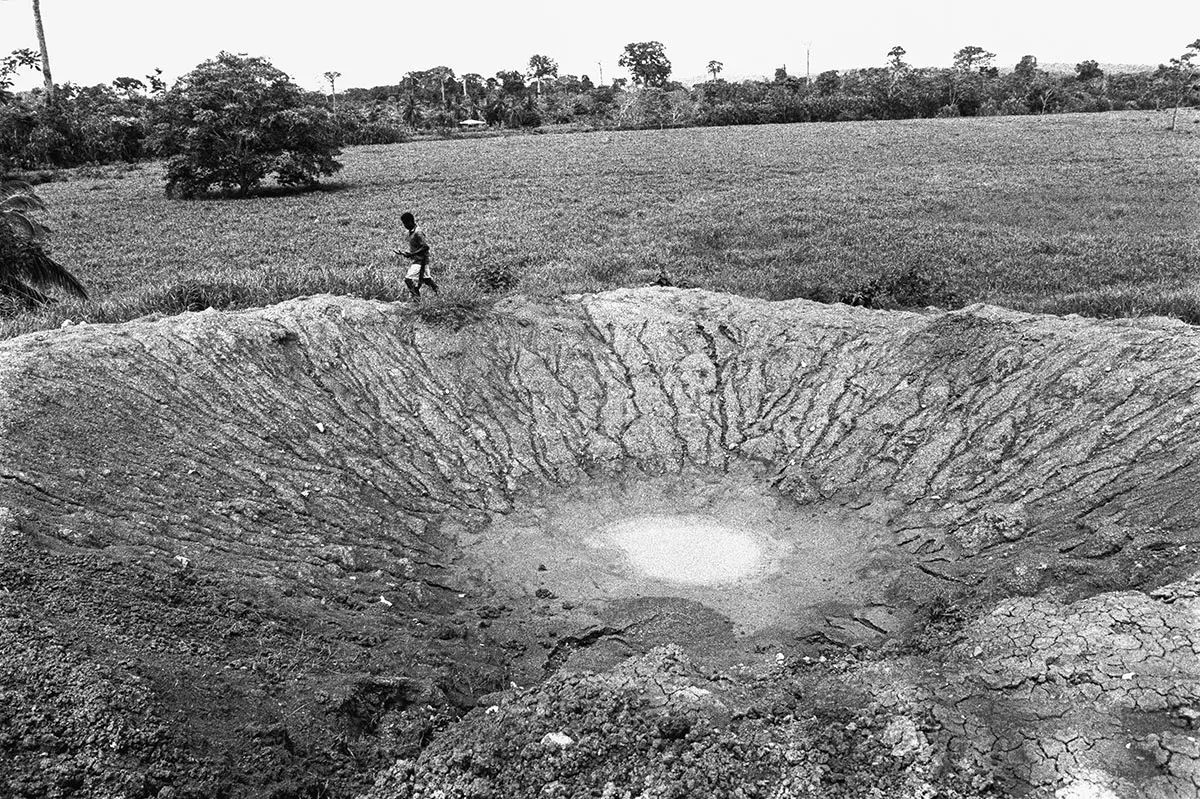
Colorado’s work has been the subject of critical treatment by authors like, among others, Andrés Gaitán, Efrén Giraldo, and Jacobo Cardona. His war landscapes may have been the key to this recognition. Desolate and mysterious images of burnt forests; large, unreal holes on the ground left by the armed forces’ bombing campaigns; columns of black smoke and petroleum spilling into rivers, the consequence of guerrilla attacks on pipelines: images that describe the unredeemable tragedy of this war and equal in their temperature, emotion, density, and poeticism the works of artists who have also engaged the conflict using photography, like Erika Diettes, Libia Posada, Camilo Restrepo, and Juan Manuel Echavarría, among others.
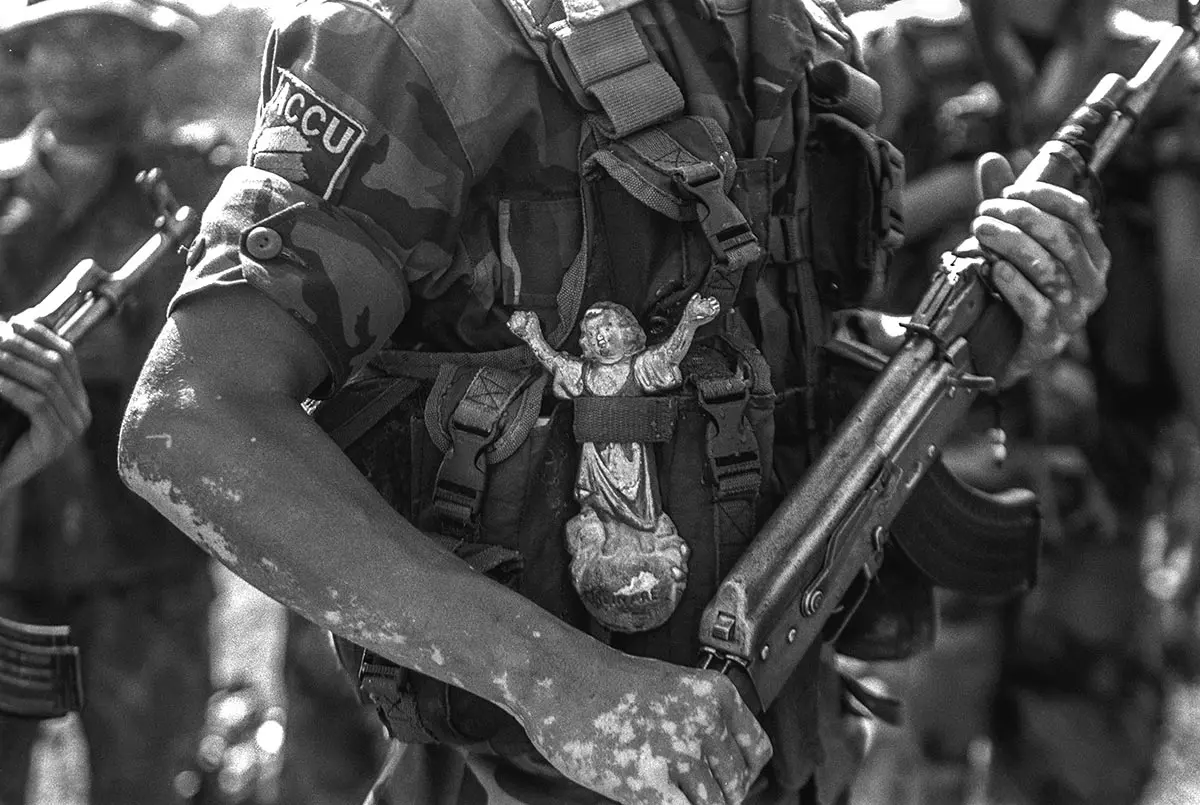
Equally celebrated for their cultural depth, other images by Abad Colorado explore the obsessive presence of charms, amulets, and sacred images of the combatants (from any side), which are carefully tended to, venerated, and carried on different parts of the body. In these images, Abad Colorado underscores questions about the role so often played by religion in war and armed conflict, a subject also of studies by María Victoria Uribe, films by Víctor Gaviria, Fernando Vallejo’s novel Our Lady of the Assassins, and José Alejandro Restrepo’s Habeas corpus.
In Colorado’s case, unlike some of the writers and artists mentioned above, what we have is the version of someone who witnessed the war directly. Jesús Abad Colorado is not a photographer of the decisive instant and he does not report on battles; his photography happens after, in a way. His attitude toward his subject is measured, meditative, and respectful; he moves closer only when he is sure he won’t invade their privacy, attempting to establish a relationship of reciprocity and communication before taking his shot. His approach is direct and intended to accompany his subjects, offering them the possibility of constructing their own memories via the photographer’s camera. What he is after is the possibility of confronting tragedy, the will to disarticulate a necessary tendency towards destructiveness that can nevertheless be tamped down with images in order to generate new potential for life.
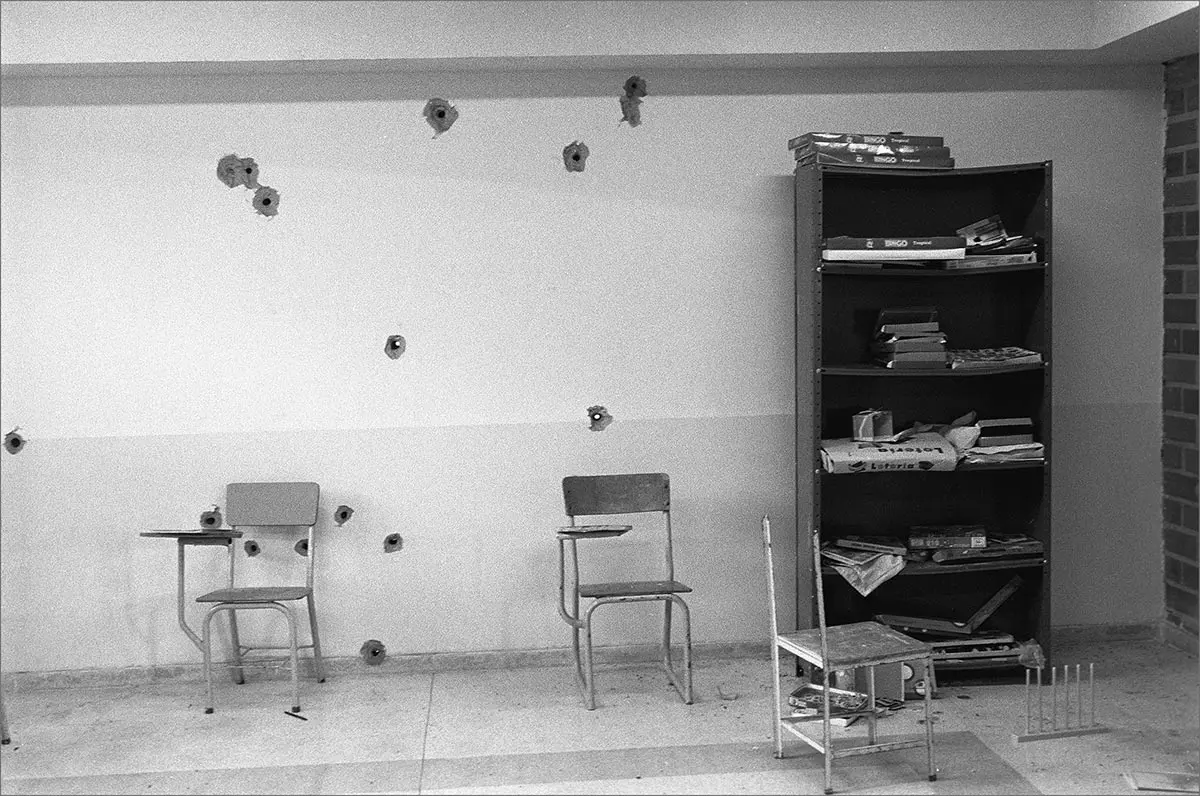
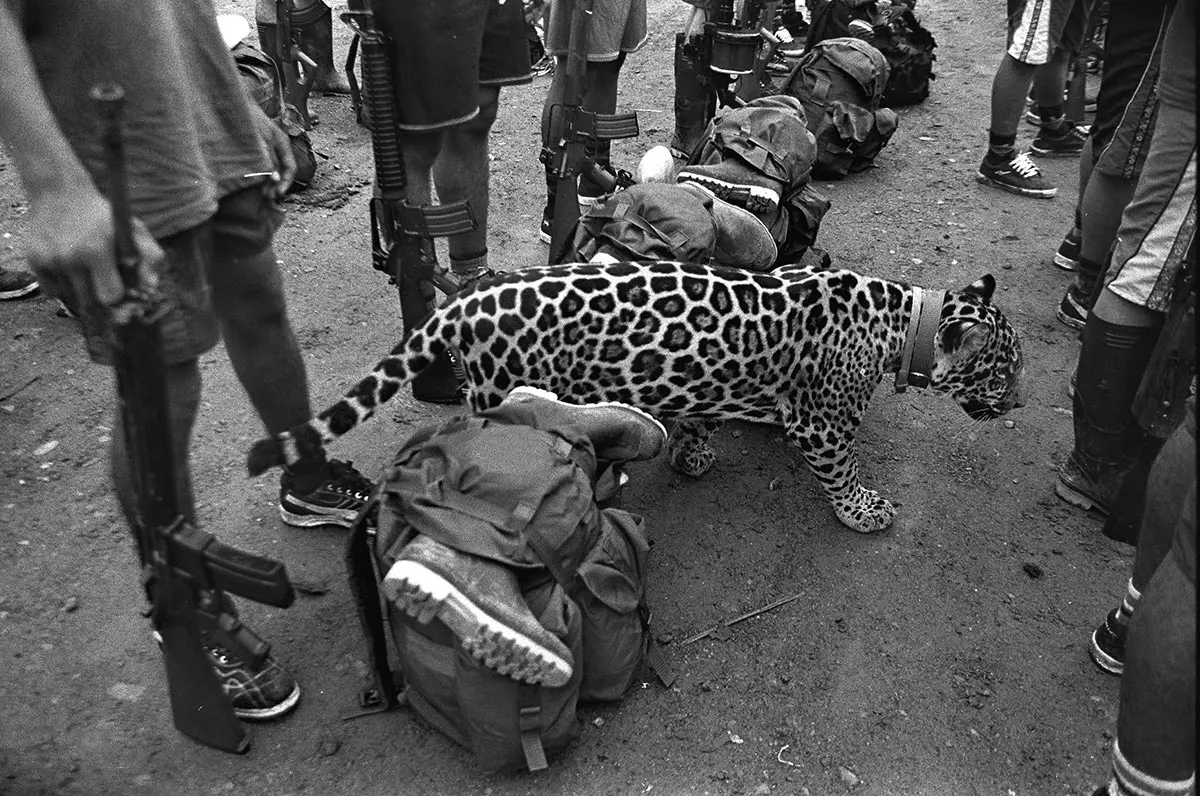
Yet in Colorado’s images, we also find destroyed schools with bullet-riddled boards; funeral ceremonies in villages whose inhabitants avoid participating, lest they be seen as collaborators; people fleeing with their few belongings tied to their backs; brave human-rights advocates and peasant leaders; police and military personnel patrolling civilian areas or watchfully barricaded; teenage guerillas carrying heavy weapons that almost exceed them in size. I’d like to highlight one specific image: a paramilitary training exercise in Tierralta, Córdoba, in 2004. Jesús Abad Colorado shoots it from above and we can see, besides the flimsiness of the uniforms—rubber boots and tennis shoes—a strange mascot, a jaguar, a wild animal captured and subjected to abuse. A symbol of power and war in Mesoamerican societies, and also a potent metaphor of war’s disciplinary brutality, transformed into a weapon to threaten, intimidate, and torture others. The image, with the feline’s almost unbelievable docility, reveals the true nature of a war that unfolds in the cities and jungles of one of the world’s most biodiverse countries: it destroys men, women, animals, and landscapes.
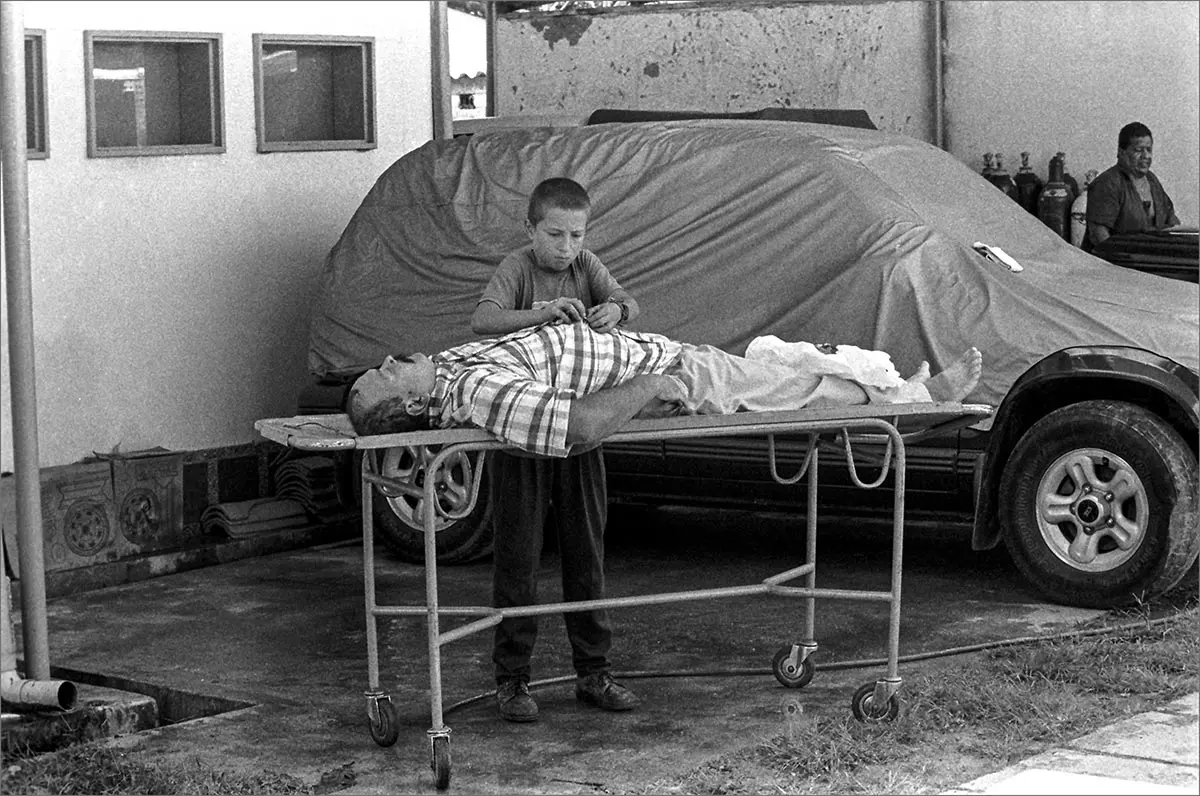
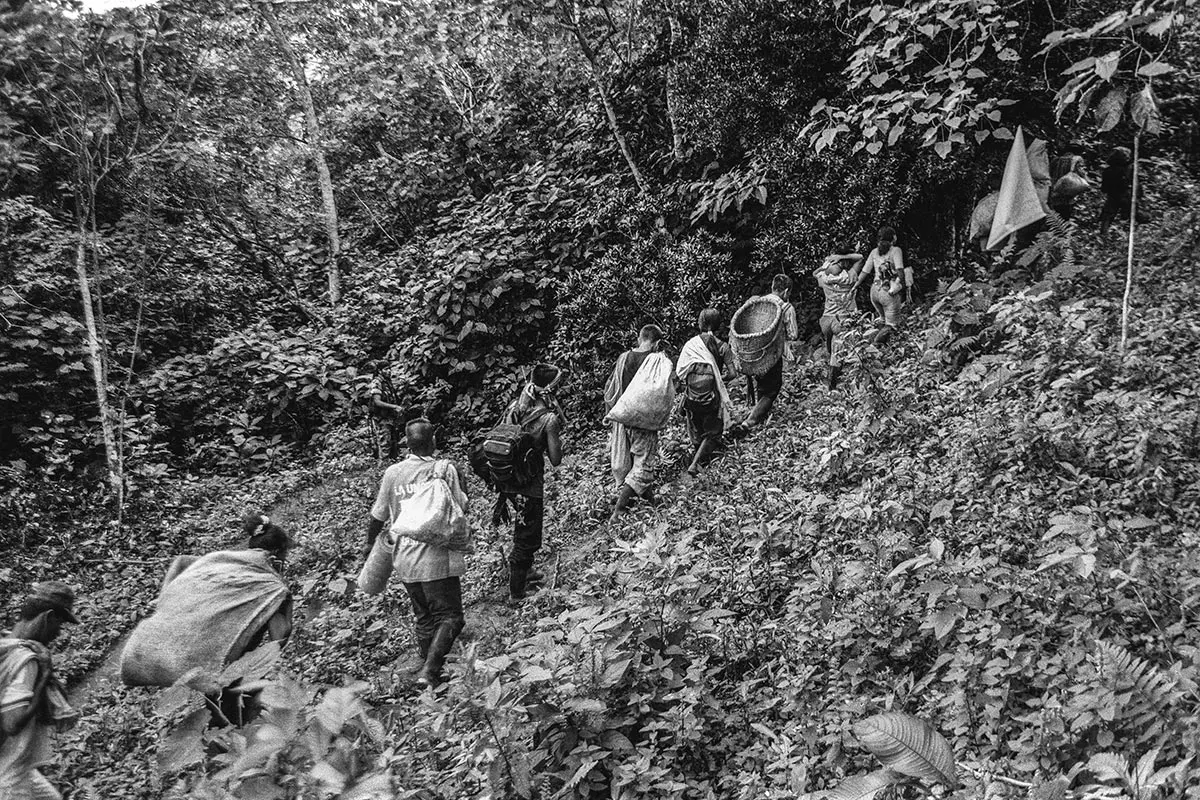
Another important set of images is devoted to peasant marches, be it impromptu protests or actions organized to confront the conflict’s actors (including the State), or the cruel exodus caused by the armed groups that expel people from the land. Essentially, Colorado has been a defender of the life of country peoples, peasant communities, afro-descendant, and indigenous groups, and very few individuals know the country at war as deeply as he does—a photographer who is, in the end, also a human-rights advocate.
In 2014, María Victoria Mahecha and Gloria Samper, the directors of Paralelo 10, were able to publish Jesús Abad Colorado. Mirar de la vida profunda, a retrospective of the photographer’s work featuring essays by Carolina Ponce de León. Sorely needed in a country that has seen not a single day of peace, this book summarizes a 25-year career covering the war, especially in rural areas. Mirar de la vida profunda came to complement Stephen Ferry’s exhibition and book Violentología, un manual del conflicto colombiano, a brave effort on the part of a photographer who has devoted a good part of his life to Colombia.
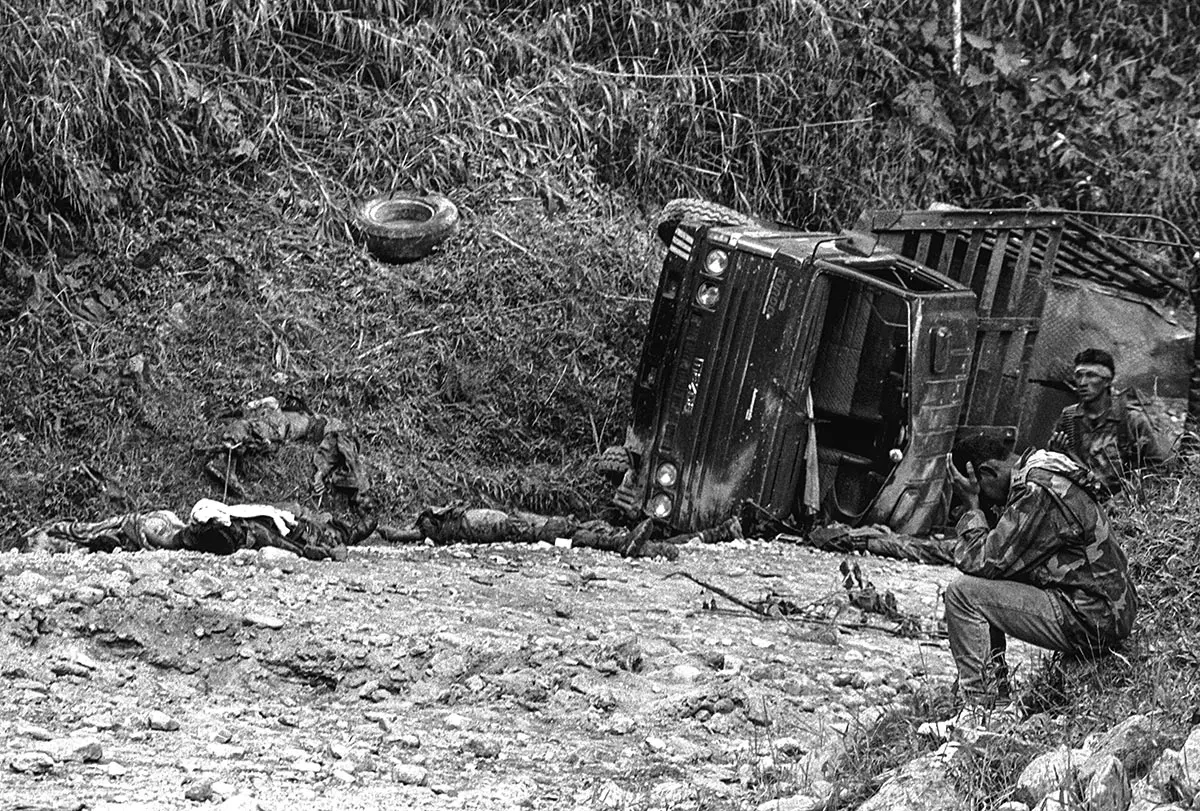
In Jesús Abad Colorado. Mirar de la vida profunda, Ponce de León mentions the importance of Colorado’s images and the uses they have been given, as witnesses of war articulated to his efforts as an activist: “Abad Colorado’s photographs have different social uses: justice tribunals, the media, and investigative reports, along with their appearances in books, conferences, and exhibition galleries. Some of his photographs are forensic in character and are reserved for the investigation and archives of memory (…). The systematic work of reconstructing, preserving, and expanding memory is for him ‘a commitment to dignity, the present, and the future.’ This effort is challenged by the continuation of the conflict while peace negotiations between the government and the FARC guerrilla remain underway in Havana without reaching an accord.”
In an interview with Alvaro Sierra Restrepo also featured in the book, Jesús Abad Colorado offers these reflections about his work:
“It is not a matter of keeping one’s distance, but of looking at things from a non-military point of view, and understanding the suffering of the victims. This helps us gain the equilibrium necessary in order not to go mad or give up, and allows us to continue thinking about life and hope in the midst of such barbarity. Always supporting a peace process. For me, that means life. For there not to be any more victims, dead soldiers, child fighters. For us to understand the tragedy we have experienced but are incapable of beholding.”
* Photos courtesy of Jesús Abad Colorado.
SANTIAGO RUEDA