
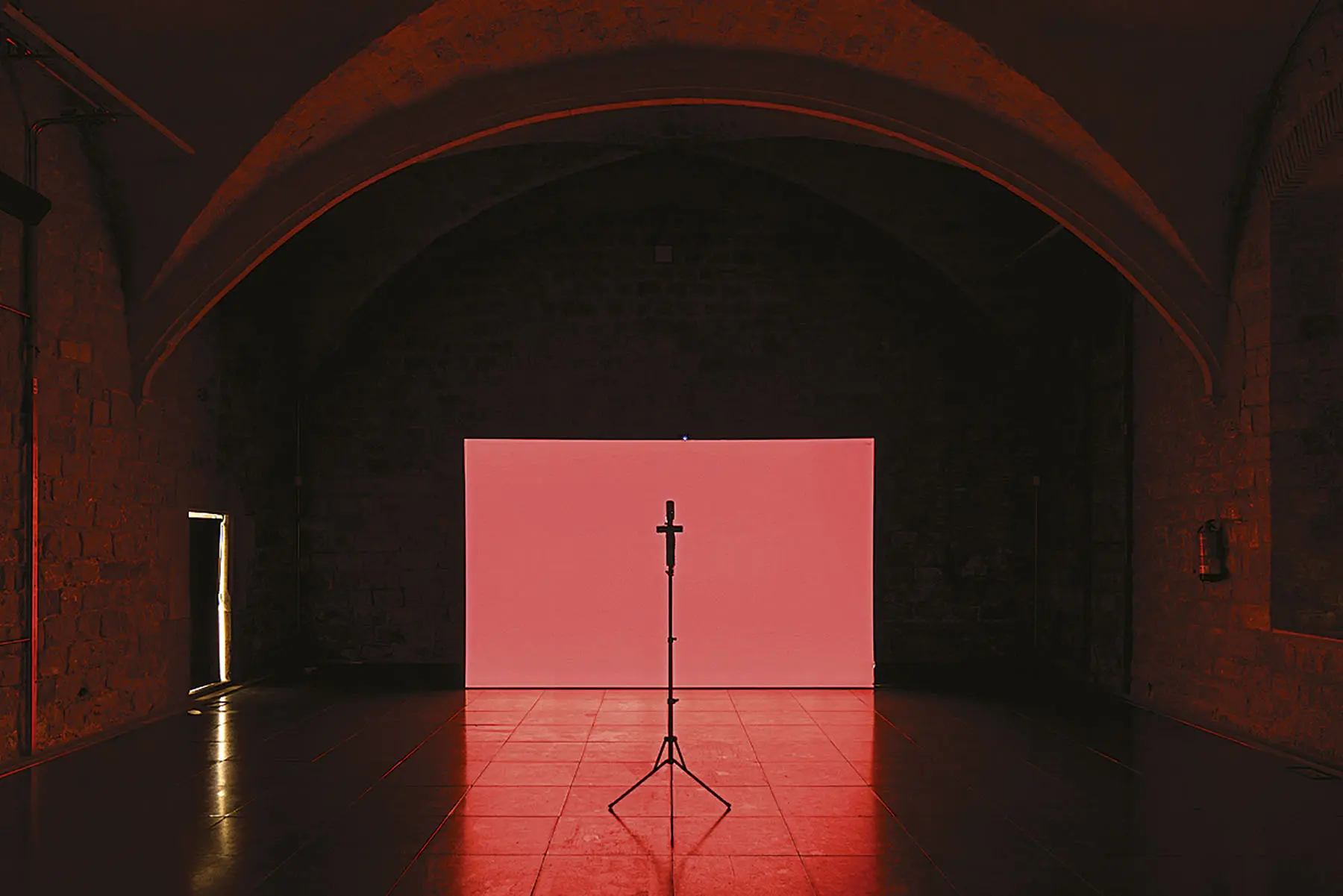
No temeré mal alguno (I Will Fear No Evil) is a timely revision of key works in José Antonio Hernández-Díez’s career, works that a quarter-century into the artist’s journey retain their power and their incisiveness, and remain symptomatic of the course of contemporary art. Video installations, taxidermy, and complex mechanisms make it possible to interrogate and dissect a complex mesh of the supernatural and the votive; that which transcends life and death; technology doomed to disappearance and displacement; the abject, visceral, and corruptible that by force insists on its own preservation, in forceful contrast with the intangible and the eternal—that which possesses the power of moving freely across dislocated temporal planes, which is precisely the exhibition’s turning point.
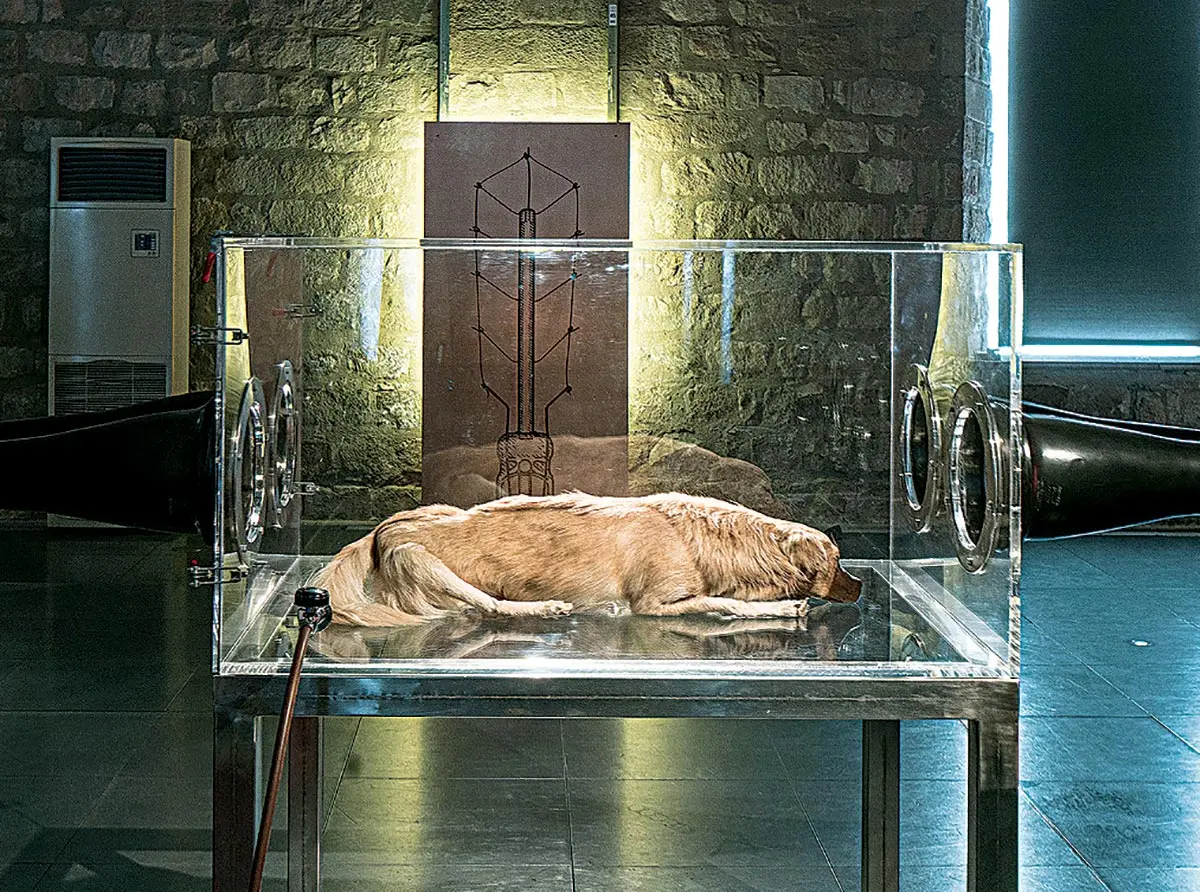
For the show’s curators, the works selected for display have a “phantasmatic” dimension through which past entities are expressed into the present. One could wonder whether it is by chance that the magnificent stone masonry of a Sixteenth-Century chapel, impregnated with the legend of a holy dog who many centuries ago guarded its main entrance, is now the setting for an impeccable glass cabinet for the repose of Saint Guinefort, a taxidermy “immaculate” dog presented by the artist thirty years ago in Caracas.
One could say that the placing of this controversial artwork in Barcelona opens up a temporal dimension that allows for a re-reading of other works included in the now-mythical exhibition San Guinefort y otras devociones (San Guinefort and Other Devotions) presented in 1991 at Sala RG CLEARG, Caracas. At that time, the founding director of the space, Miguel García, coincided with the show’s curator, Luis Ángel, in asserting that Hernández-Díez represents “the rarest and most unexpected invention in Venezuelan art of the last decade.”
Since then, Hernández-Díez (1964) has been the creator of brilliant, trailblazing proposals wholly attuned to the postulates of his generation’s most accredited artists, like France’s Pierre Huyghe (1962) and, especially, Britain’s Damien Hirst (1965). It is worth noting that José Antonio exhibited his cleanly encased taxidermy dog a year before Hirst presented his famous “shark” suspended in formaldehyde under the title of The Physical Impossibility of Death in the Mind of Someone Living; Hirst’s work was conceived in 1991 but debuted in 1992, in the first Young British Artists show at Saatchi Gallery in London.
José Antonio Hernández-Díez defines the sterility of a “pop syncretism” and neatly demystifies the complex pantheon of referents implied in having been raised in a Catholic family in such a rich and variegated context as the Caribbean, where practices like the “wake of the little angel,” expressed in his Vas pa’l cielo y vas llorando (You Go to Heaven and You Go Crying, 1992), are rather common.
Using technology, Hernández-Díez unfurls a “new religious iconography” ore in accordance with the era yet equally prone to disappearing. He deploys the scientific method in order to aestheticize and dispel doubt, isolating in diaphanous display cases phenomena that for centuries were understood in connection with metaphysics, with the unexplainable, with that which is unquestionable because of a faith’s dogmas.
Hernández-Díez makes reference to other artists who transversally engage the profuse variety of Caribbean beliefs and superstitions and are characterized by the density, and even the viscosity, of their proposals, among them Venezuela’s Miguel Von Dangel, Carlos Zerpa, and Rolando Peña, and Cuba’s Juan Francisco Elso and José Bedia. Like them, Hernández-Díez is engaged in erecting new reliquaries; unlike them, he crystallizes and aseptic “soulless spirituality.”
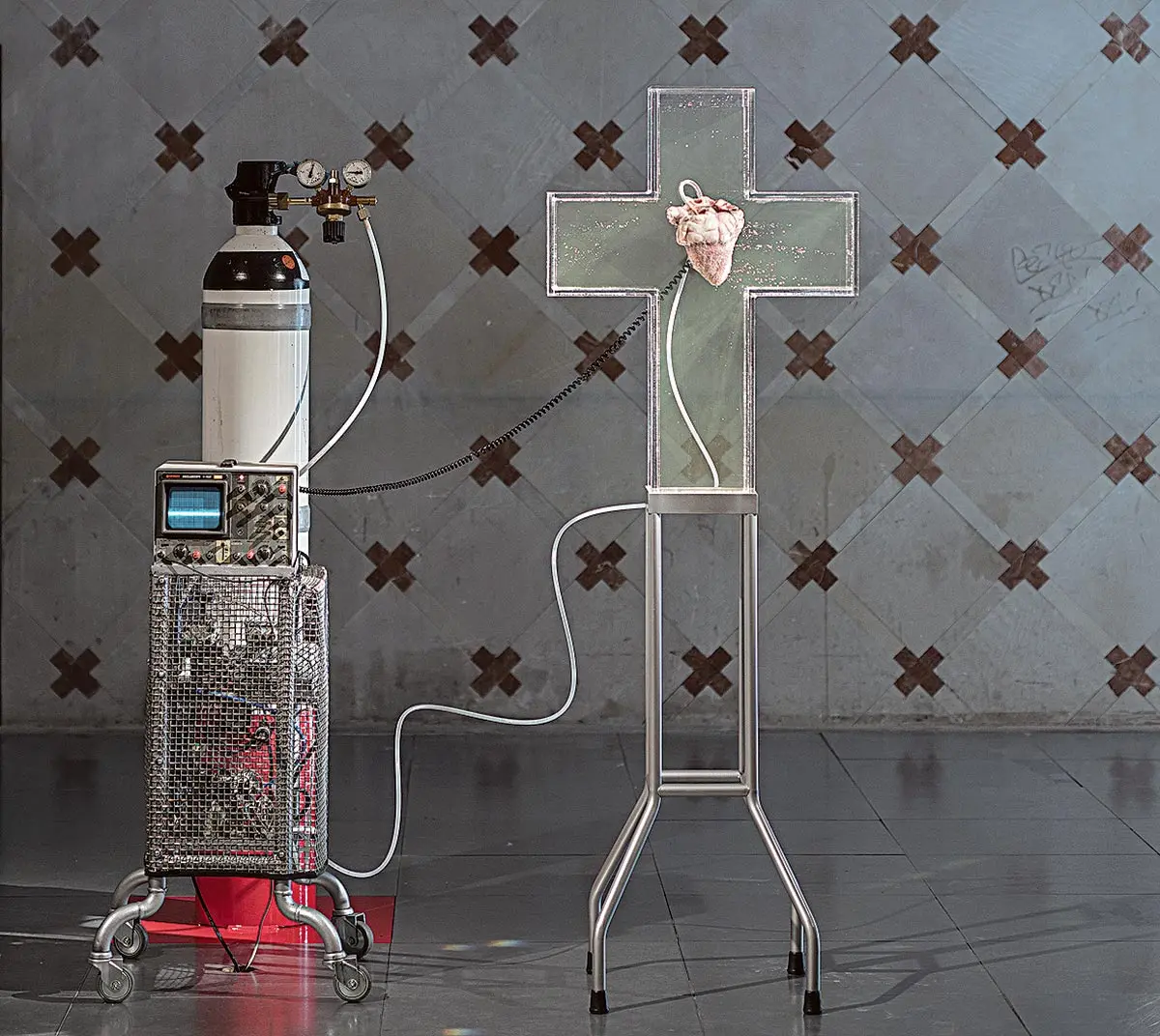
Along those lines he presents us with Sagrado corazón activo (Active Sacred Heart, 1991), a work literally reinstalled at the heart of the new exhibition; it features a hyper-realist heart preserved in formaldehyde, beating inside a container shaped like a transparent cross while it is reanimated by an obsolete medical device that is practically a modern archaeological artifact. Since then, this work brings to light our self-sufficiency with respect to the divine will and even makes it possible for us to reflect on our evolution from the standpoints of advances in biotechnology and cybernetics.
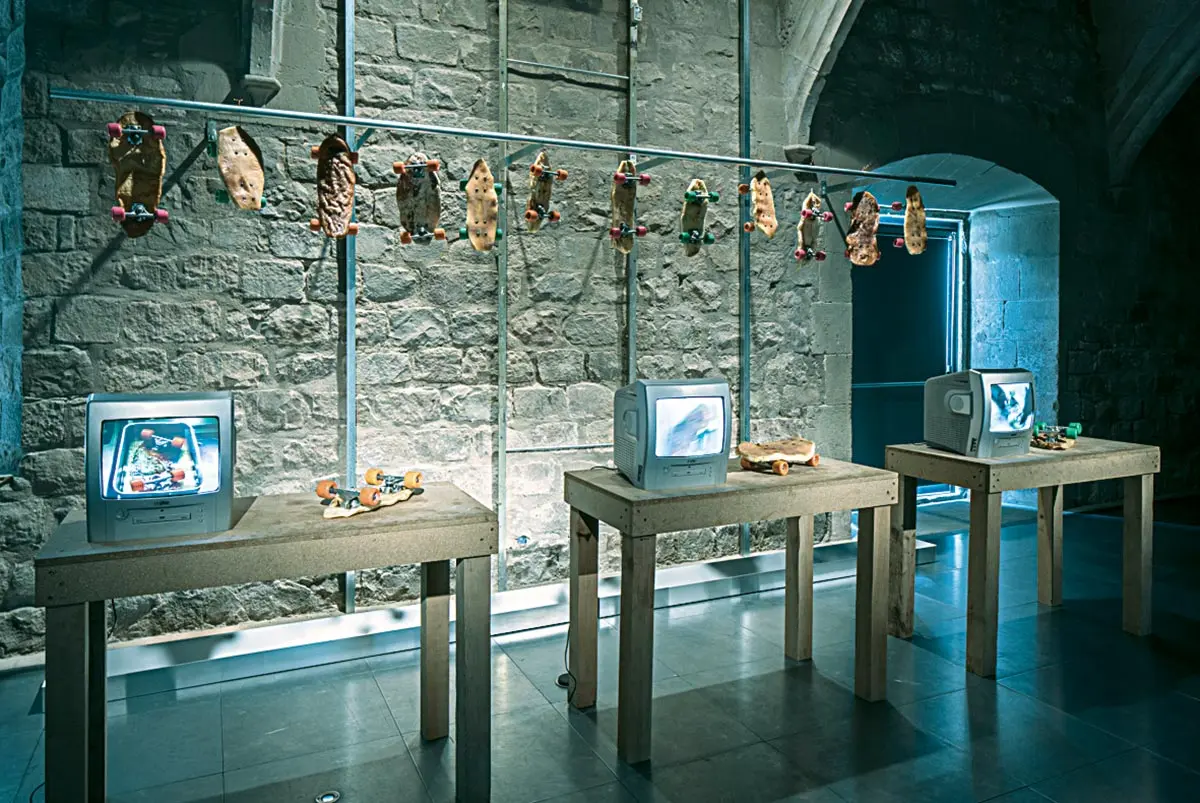
The artist confesses his lack of interest in technology as a utopia, and he does not present us with a critique of the television medium in the style common in the late-1970s. For Hernández-Díez, the screens that are the support of his discourse compress a message that it is still possible to decipher, but will become encrypted in the future, only translatable and exhibited at great technical difficulty and cost.
No temeré mal alguno emphasizes Hernández-Díez’s experimental video works of the late 1980s and early 1990s. One standout among them is La hermandad (The Brotherhood, 1994), a three-monitor installation presenting the grotesque process of frying pig skins (“for a snack”), the basis for the confection of the rather “pop” patinetes-corteza, which we then see devoured by a pack of hungry dogs—a reflection of our own voracity—and also hanging above the monitors, like final products exhibited in a serialized way.
Hernández-Díez insists on decoding the transit between life and death. With La caja (The Box, 1991), the artist denounces the cruel fate of the “street children,” the detritus of Latin American society, condemned to degeneration and prostitution.
The artist also explores and disassembles universal myths and characters. His video installation Annabel Lee (1988) turns us into spectators, via a subterranean monitor, of the anguishing state of Edgar Allan Poe’s character, who was buried alive.
Houdini (1989) is an intelligent metaphor for the complex mechanism of “illusion.” A monitor sunk into a liquid-filled transparent container displays the image of the artist freeing himself of chains under a swimming pool. The famous escape artist’s distressing trick is thus revealed, and it is possible for us to inspect, again behind a glass partition, the workings of the cathode-ray tube that makes it possible for past events to reemerge.
In El resplandor de la Santa Conjunción aleja los demonios (The Shining of the Holy Conjunction Keeps Demons Away, 1991), the flash from the camera-cross facing an abyss of red luminous barrier produces the moaning of some “demons.” The artist develops the topic of submission vs. interactivity, how we react to advertising or “the temptation” prompting us to consume, and how can we respond with good criteria, with clarity.
Finally, specifically for the spaces of the Capella, Hernández-Díez presents Filamentos (Filaments, 2016), a set of magnificent copper plates inscribed with the filaments that made possible the invention of the light bulb. These delicate works were conceived to be infused with the smoke of candles lit right in front of the same, contrasting the divine intersection of mystical light vs. artificial light, the civilizational “miracle” that dispels darkness and unmakes the monster-producing dreams of reason.
* Photos: Miquel Coll, MACBA.
ELISA RODRÍGUEZ
Graduate of Fine Arts UCV, Venezuela.