
The blue immensity of the ocean, the deafening noise of the waves, the unstable swinging of the boat, the smell of the sea in the wind. These references directly refer us to the brute and uncontrollable force of the natural environment. But on this occasion, we are actually referring to the installation titled Tiamm Schuoomm Cash! by artist José Spaniol, displayed at the Pinacoteca do Estado de São Paulo, in the heart of the concrete forest that is the largest metropolis in South America. The piece is part of a series of works associated with the sounds produced by ocean waves. It consists of two wooden boats, each measuring 6 feet long, which appear to be floating 10 meters up in the air but are actually supported by bamboo sticks. The bottom-up perspective offered to viewers generates an additional sense of strangeness to the already unusual placement of the boats—elevated and not surrounded by water. Arranged in the center of the octagon, flooded by the natural light that enters through the building’s glass ceiling, the installation is positioned like a three-dimensional version of the traditional reverential paintings usually found on the domes of temples and on the ceilings of palaces. The arrangement of the bamboo sticks is inspired by the rhythm of waves. According to Spaniol, his intention was to create a fictional scenography that unsettles the public: “The elevated planes provoke some vertigo, shorten the dimensions and tend to dissolve boundaries.” Spaniol has always been interested in contrasts and paradoxes, as well as in the relationship that the work of art establishes with the architectural and urban environments. In 1997, Spaniol created the installation Mirante for ArteCiudad III, four rammed earth walls that formed a square with cracks that gave viewers access to the interior. Nothing but the sky could be observed once inside that flat terrain. The work Cadeiras (Chairs) of 2006, materializes onto space the reflection of this piece of furniture, forming a double, conjoined, object that loses its utilitarian function and is offered for aesthetic contemplation like something surrealist. The surroundings have meaning in Spaniol’s work, as he unfolds its entire symbolic dimension and makes it interact with his installations or objects.
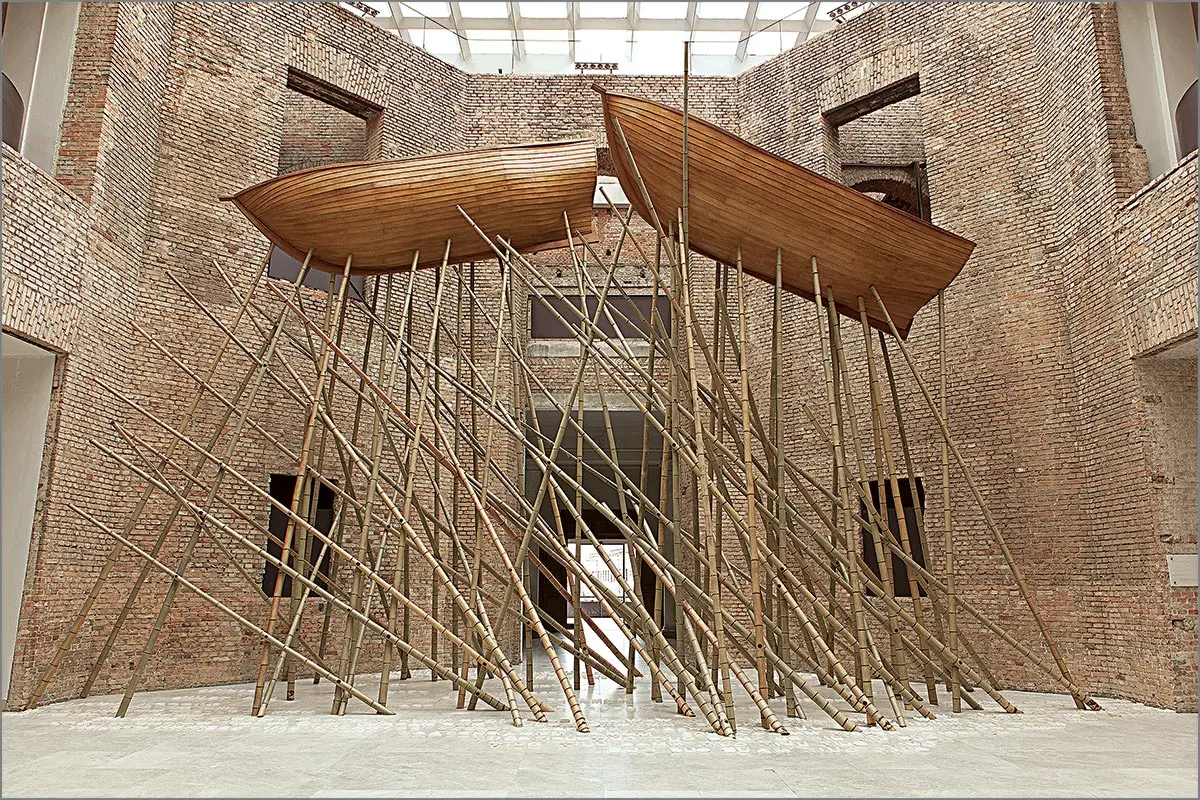
The series of contrasts offered in Tiamm Schuoomm Cash! began as early as in the preparation phase of the elements that make up the work. The very construction of the boats occurred on land, far from the littoral to which they aspire. It involved a team of artists associated with the Serrinha Art Festival, in Bragança Paulista, who worked on the project for a period of two months. José Spaniol has a long-standing relationship with Serrinha. Besides being an artist, he is also a university professor who has participated in several editions of the festival, developing workshops and taking his Universidade Estadual Paulista (UNESP) students to artistic residencies in the estate that houses the event.
Initiated in 2003, Proyecto Octógono is a space centered on contemporary art within the oldest museum of art in the city. Founded in 1905, the museum has an important collection of art from the 19th century, with nearly 9,000 works. In recent years, the institution has been strengthening its ties with contemporary national and international art productions. Proyecto Octógono has already exhibited nearly 40 site-specific installations by artists from Brazil and abroad.
José Paiani Spaniol studied at the Facultad de Artes Plásticas of the Fundação Armando Alvares Penteado (FAAP) and is currently a professor of the Instituto de Artes of the UNESP. At the beginning of his career, he relied on referencing everyday objects, with which he created interactions between their utilitarian and poetic functions. Beginning in the 1990s, he began to focus more on the relationships of his work with architecture and the exhibition space. He participated in countless group and solo exhibitions, both in Brazil and abroad, including the International São Paulo Art Biennial (2010); and has received several awards throughout his artistic career. In 2011, he created the installation Columnas (Columns) at the Palacio Gustavo Capanema in Rio de Janeiro, and O Descanso da Sala (The Resting Area of the Living Room) at the Parque Burle Marx, in São Paulo. In 2012, Spaniol participated in the opening exhibition of the Museu de Arte Contemporânea de Sorocaba (MACS), He received an award at the 3rd Itamaraty Contemporary Art Competition, promoted by Brazil’s Ministry of Foreign Affairs, and at the Honor of Merit, Art, and Patrimony Award 2013, from Brazil’s Ministry of Culture. For years he has been part of the selection of artists represented at SP-Arte by the Galería Dan. In 2014, he participated in ARCO Madrid, and in the exhibitions The Art that Remains, Colección Francisco Chagas Freitas of German art, at the Museo Nacional de Correios, in Brasilia; and Fortune and Magnetism After Dreaming, at the Casa Museu Marta Ortigão Sampaio, in Oporto (Portugal). In 2015, José Spaniol presented a solo exhibition at the Biblioteca Mário de Andrade (BMA) titled Bamp Uuooom Wawai!, as result of the Honor of Merit, Art, and Patrimony Award that he received in 2013 from Brazil’s Ministry of Culture and the Instituto do Patrimônio Histórico e Artístico Nacional (Iphan).
SYLVIA WERNECK