
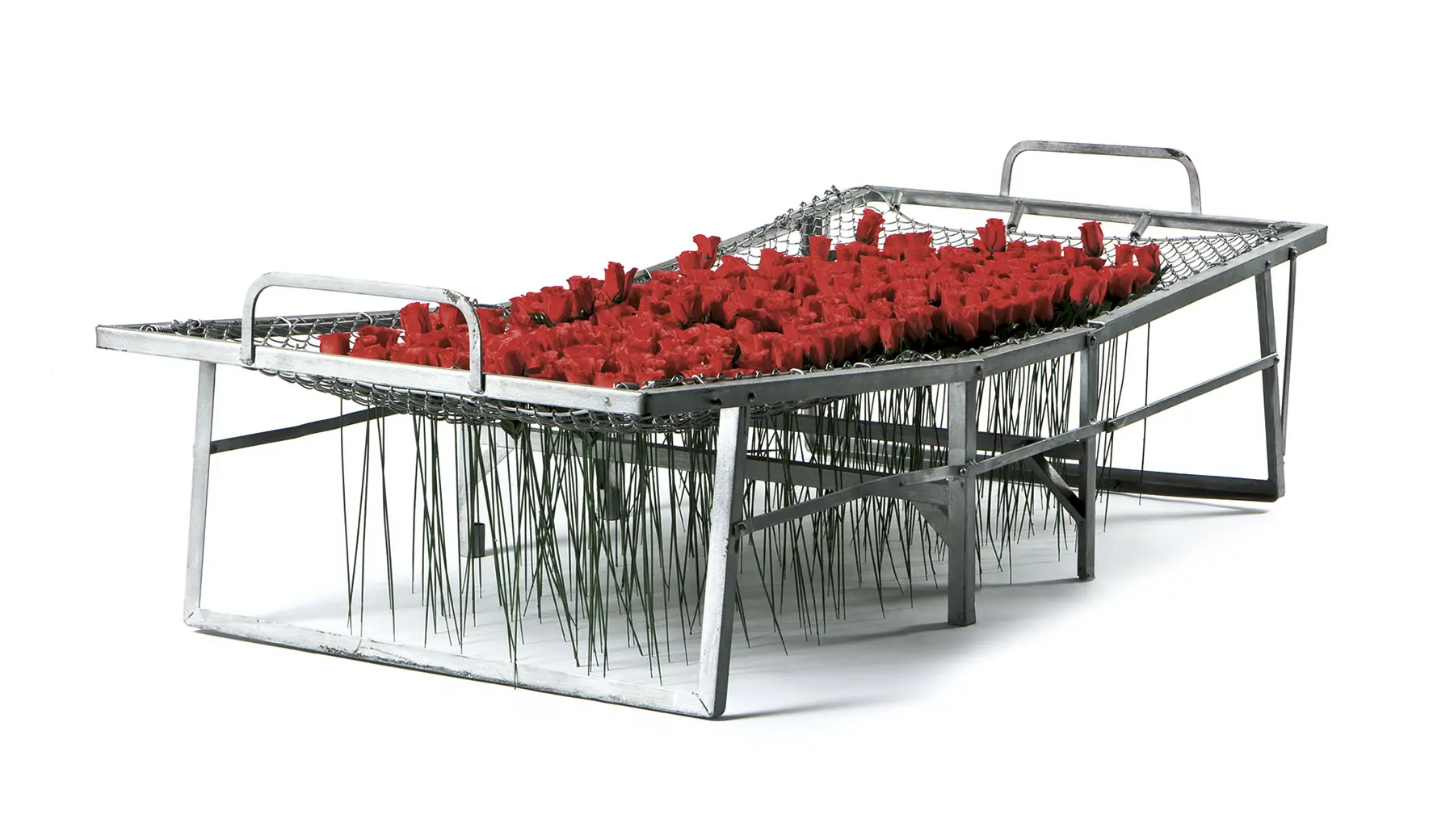
The work of Juan Camilo Uribe forms a most singular corpus in Colombian art of the second half of the Twentieth Century. It confronts the procedural, imaginative, and mental dimension of the aesthetic event, and, more specifically, the many negotiations to which art and images are subjected in the cultural realm. Uribe was an artist who considered cultural objects and, through a thorough analysis, arrived at the conviction that they constitute a form of thinking, a privileged path into the understanding of taste, institutions, and traditions. Supported on playful, ironic, and humorous components, his work was able to reflect on key issues for Colombian society. His production is a definite precursor of attitudes that today have a well-secured presence in the arts.
Yet, while it is true that such preoccupations are found in the work of a significant number of artists belonging to the generation that moved from the modern to the contemporary in Colombia (Álvaro Barrios, Beatriz González, Antonio Caro, Bernardo Salcedo), Juan Camilo Uribe’s exercise transcends mere delectation with the burlesque placement of popular elements in a work of art and seeks to produce formulations with real aesthetic and critical potential. The richness of his work resides, on the one hand, in his skillful articulation of the image with the ideological context that activates it, and, on the other, in his search for utopian possibilities for the artistic project, which at that point became one of the dominant formats for the production of art in Colombia. Both aspects are the result, perhaps, of the crisis of the work of art as an object, which had its most radical expressions during the 1960s.
For a contemporary audience, such quests appear as already overcome. The question for the image’s ideological undercurrents is already standard. But for Uribe and his contemporaries, it had the character of a revelation: they were operating within a culture accustomed to living unthinkingly with its symbols. Iconoclasm, it is worth remembering, is always contextual, as Marta Traba noted when she attributed Uribe’s ironic disposition to the conservatism of Antioquia society and Luis Caballero’s eroticism to Bogotá’s urbanity. On the other hand, in an era like ours—used to the way in which projects and complex speculations are known before their execution, thanks to sketches, digital drawings, and attachments submitted to events and invitations—it’d be easy to overlook the value of Uribe’s projects. The truth is that all evidence signals the inaugural nature of his interest in the imaginary, the speculative, and the utopian, at least in Colombia. Undoubtedly, the importance of projection and speculation, at times to the discredit of the finished work, is an important vector in Uribe’s oeuvre, and it is there where his most important and less recognized contributions lie.
Juan Camilo Uribe was born in Medellin in 1945 and died in 2005. Despite being a self-taught artist, he won several distinctions, among them a mention in the 3rd Coltejer Biennial and awards at the Jorge Tadeo Lozano University’s National independent Salon and the Regional Arts Salon. He represented the country at the São Paulo Biennial, exhibited regularly over thirty years, and was a frequent presence in group shows in Colombia and abroad. We still don’t have a good monographic exploration of a career, Uribe’s, that is essential to any map of conceptualist and Pop-Art developments in Colombia, something that would surely contribute to our understanding of the peculiarities of Colombian art in the context of Latin America’s early contemporary period. We do have, however, the retrospective exhibition Juan Camilo Uribe. Arte con sentido común (Juan Camilo Uribe. Common Sense Art), presented at Banco de la República in 2007 and curated by Alberto Sierra, which paid tribute to a body of work that, despite including several of the representational strategies of its era, sustained distinctive features that make it particularly memorable. As is the case with other artists, Uribe’s work possesses a style, an aesthetic, combined with a critical and humorous attitude.
Despite the validation attained in exhibitions and awards, it must be remembered that proposals such as Uribe’s were not received at the time as enduring or relevant artistic gestures. At first, critics connected his work with an interest in mass popular culture and the erasure of borders between “high” and “low” taste that, on a global scale, was being expressed in a new art of the image. These affiliations always made explicit the derivative, epigonic condition of Uribe and his contemporaries. Research has shown that in countries like Colombia, the approach to mass-popular images includes elements that transcend the mere thematic association with the repertoire of the mass media and of US culture. In fact, critics, particularly those in Uribe’s home town, found in his work a preeminence of humor that deactivated the critical dimension that, supposedly, was the task of high art. We must note that we are talking about a time when a journalist like Arturo Abella posited that Beatriz González’s paintings of independence-era dignitaries were bald-faced plagiarism.
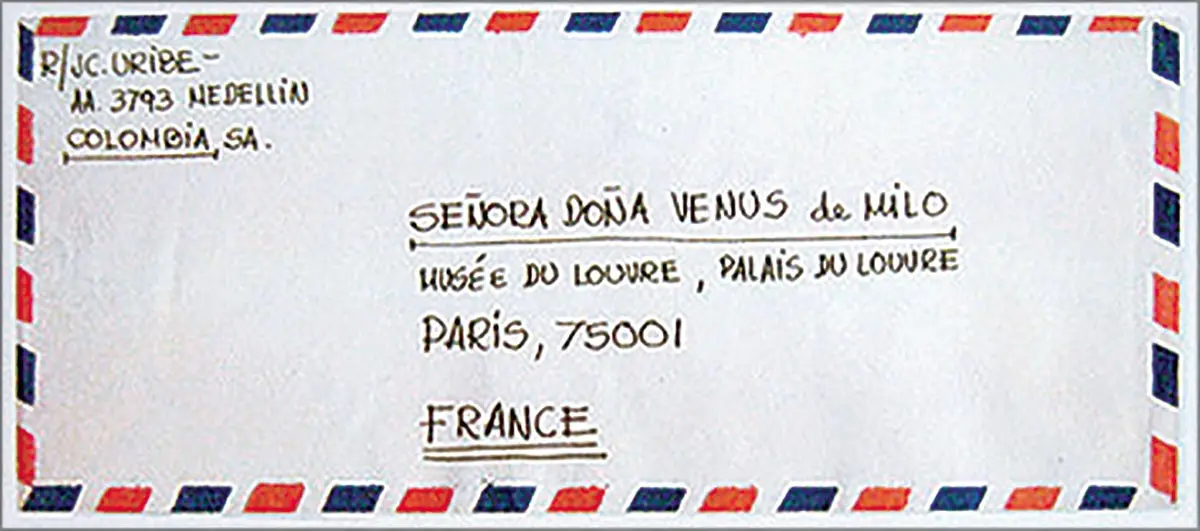
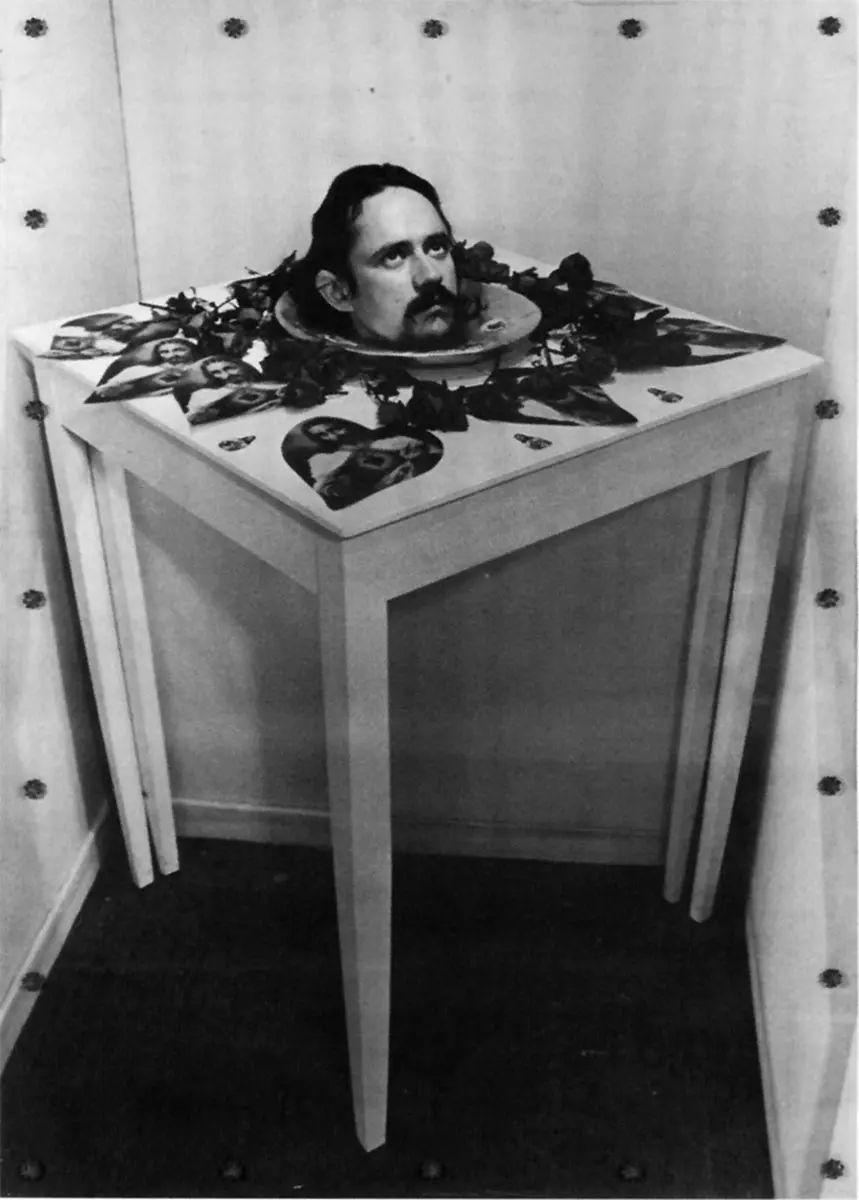
It is understandable, then, that some saw Juan Camilo Uribe’s works as mere visual jokes, send-ups of the Art institution, although what prevailed in them was a systematic and thorough exploration of many of the artistic values established by modernity. It was Marta Traba herself who saw in this generation’s tactics of appropriation a unifying characteristic, as they confronted the flow of images with an attitude that was more recreational than creative, more appropriationist than productive. More recently, the activity of commentators and of curators commissioned by various institutions have given artists like Uribe their proper due, pointing to the essentially critical intention of their works. For example, the very recent exhibition Coordenadas. Historias de la instalación en Antioquia (Coordinates. Histories of Installation in Antioquia) put on display the importance of Uribe’s interactive and ambient works, such as Cabeza parlante (Talking Head) and Medellín un lecho de rosas (Medellin a Bed of Roses), had for the development of installation art in Colombia.
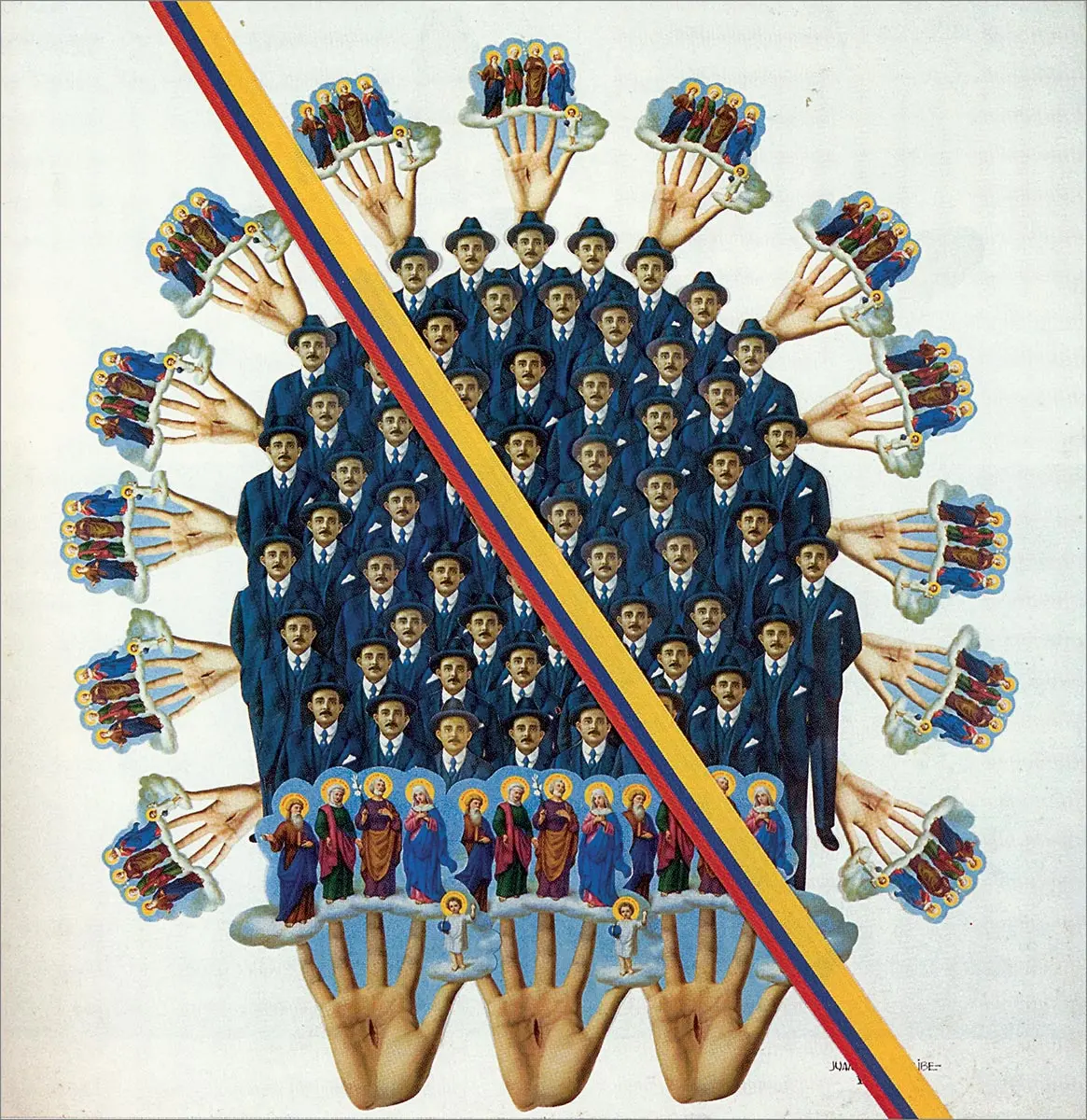
As has been said, in revising Uribe’s collages and photomontages—two good examples are La nueva imagen de Colombia (The New Image of Colombia) and Milagro (Miracle)—we discover an artist who moves from formal and aesthetic concerns to culture as such, a common characteristic in many artistic proposals in Colombia since the 1960s. This process, a central aspect of contemporary art in the country, shows that the recreational and the humorous can coexist with an inquiry intended to produce interpretative outcomes. As the critic Eduardo Serrano—one of the closest observers of this generation—noted at the time, Juan Carlos Uribe presents us with art understood as a creative attitude—one, we could add, where behaviors, formal decisions, and quests towards an aesthetic expansion come to coexist. The Bogotá-based critic accurately described Uribe by defining his imagery as “pop”, his tone as kitsch, and his inclination for the generation of ideas as “purely conceptual.” From all that, what emerges is a body of work containing much more proposition than exposition, where reason has clear primacy over contemplation.
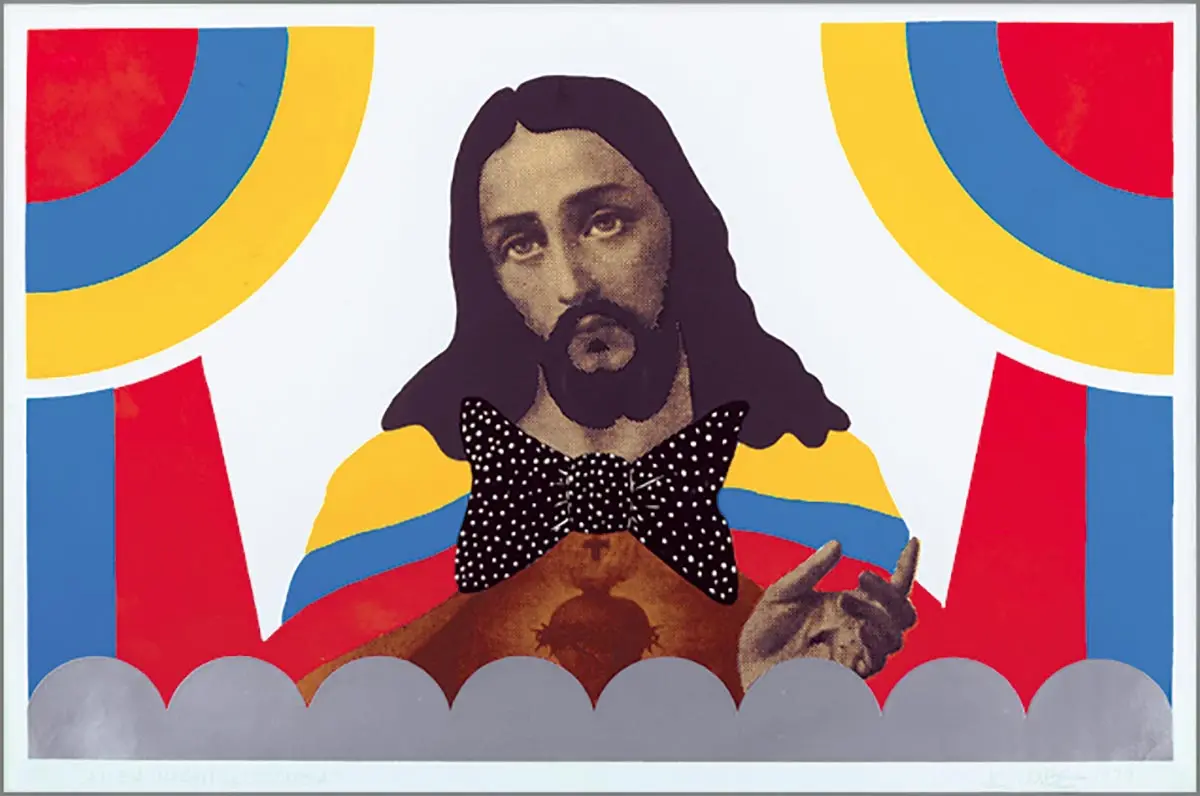
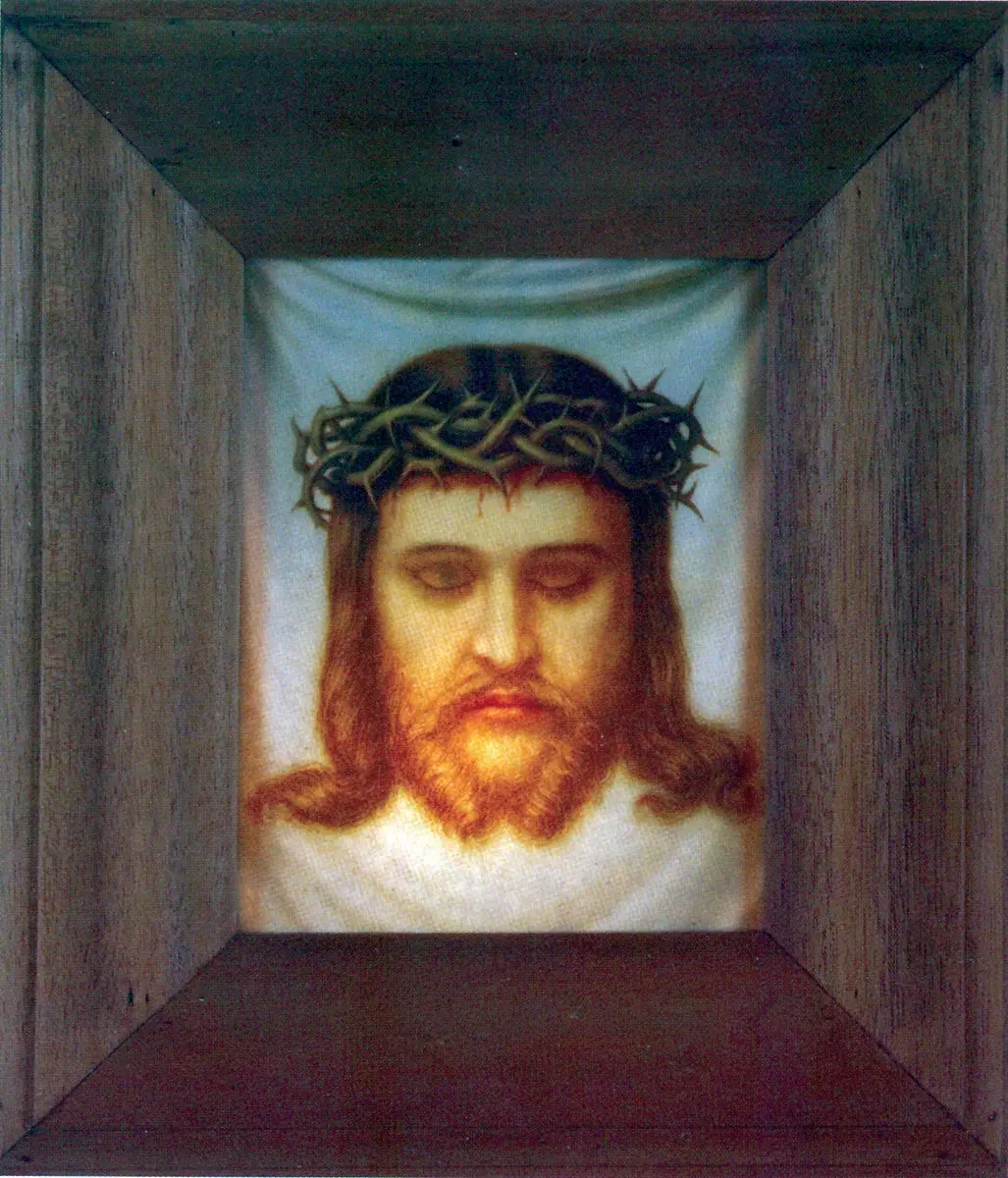
In accordance with this hypothesis, and despite the importance of such inherently formal operations as serial repetition, extrapolation, and intertextuality, Uribe’s fundamental interest is the conceptual inscription of the image—its uses, its participation in a specific ideology. Uribe’s preferred corpus of popular images was that of naïf religiosity, the cult of the prosaic, the very monumentality of the tacky, and the cornball, which, with its rhetorical greediness, has ample powers of social representation. Those who later found in Uribe a representational dimension that should be read not in a mimetic key, but a social one, were not mistaken. In his 2007 curatorship, Alberto Sierra argued that Uribe’s religious images are intended as metaphors for the country. Like Beatriz González, Uribe seems to regard the candid sincerity of popular myths with a paradoxical attitude, while also finding in them an anthropological key, a belonging.
It is not by chance that many of Uribe’s works approach this iconography in dialog with patriotic symbols as if to recognize the connections that exist between them and an insufficiently secular State that can, nevertheless, induce in its citizens the maturity needed to identify and parody those very relationships. In that respect, works like Sin título (Untitled, 1975)—a narrow Colombian flag, resembling a presidential sash, extended over the repeating effigy of José Gregorio Hernández—are eloquent. And the same can be said of works that use the image of the Sacred Heart, the patron saint of the Colombian nation, to make declarations concerned, above all, with the issue of identity.
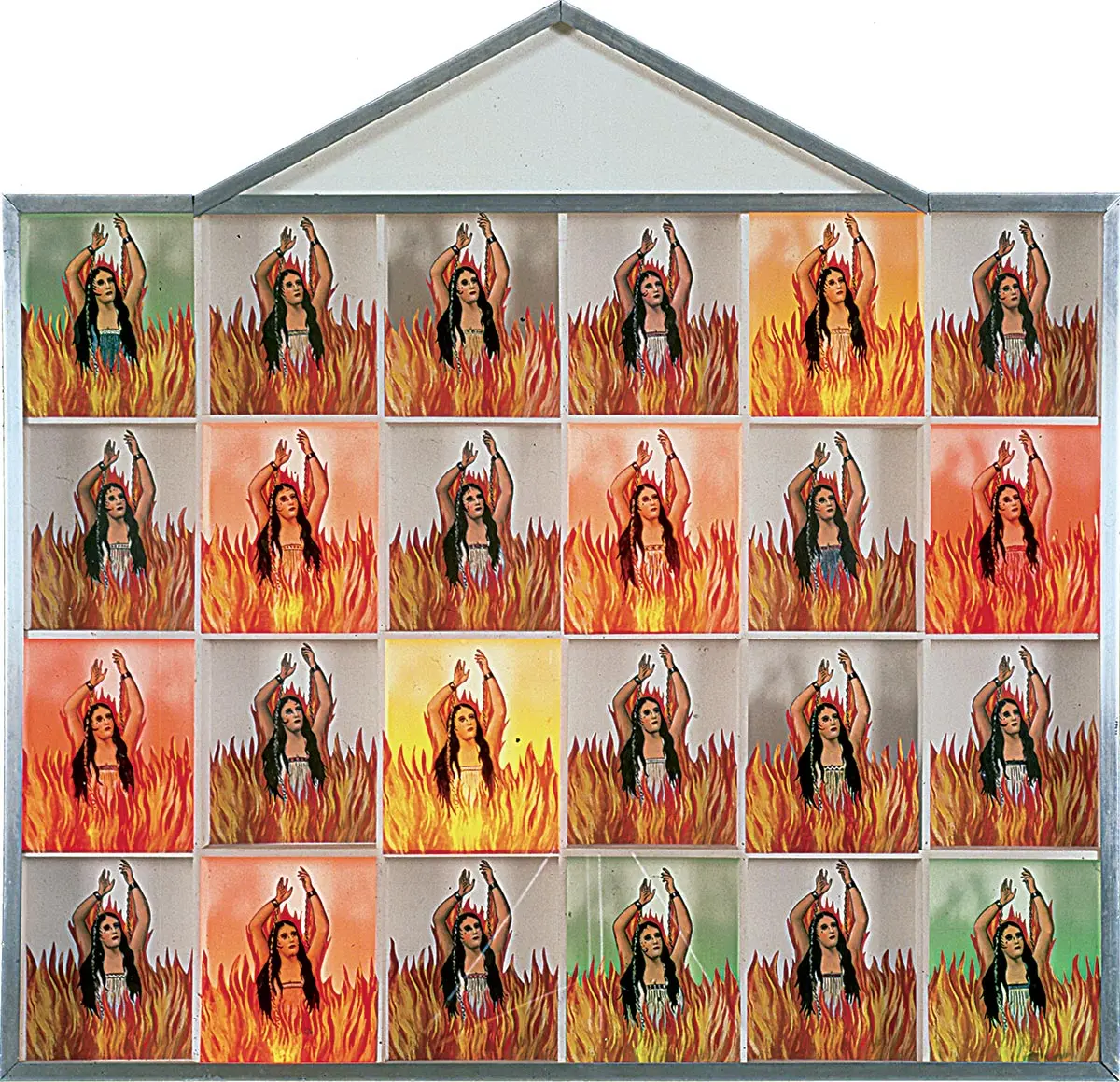
In the later period of his career, Uribe’s fervor for popular culture turns to eroticism, a new subject matter that allowed him to confront anew the issue of taste, the representation of the body, and the ideological inscription of kitsch imagery by means of strategies that now incorporated digital elements. His various “homages to boobs” seem to find in the stereotypical, decorative conception of the female figure a new field of exploration. Humor infuses his approach to aesthetic realities that, as happens in a society so dazzled by bodily modifications, turn grotesque.
All of this confirms the central role of irony in Uribe’s work, as the artist always made use of indirection, an elliptical treatment of his themes and issues, and yet produced, paradoxically, forceful communicative effects. It is worth remembering the recently deceased US critic Thomas McEvilley’s notion that irony allows an artist to qualify his gestures and imbue them with unexpected meanings, without necessarily being a primary intention. This is evident in Juan Camilo Uribe, who in many instances seems to assert the value of something only to quickly deny or relativize it. For example, his figuration seems to embody a desire for appropriation, yet it is also something that demands to be unmasked. Something similar occurs with his works allusive to artistic and cultural institutions, towards which he adopts a celebratory attitude only to demolish them later with his critique. Such is the case of his well-known letters of dismissal for artworks held in the world’s most famous museums, or of the advertisement, he took out in a local newspaper to announce his leaving Medellin as a contribution to the first Latin American Colloquium on Non-Objectual and Public Art in 1981.
We arrive thus at a paradox: in works devoted to the image, we witness an equivocal enthronement of a moribund faith (religion) and something we recognize as a simulacrum (art), which nevertheless retain their drawing power and their ability to generate identity and thought. Popular taste and the devotion to traditional representations are rescued from their obsolescence, displayed as repetition, as rather empty schematics that the only language can fill with its masterful irony.
In Uribe, verbal supplements—titles, to be specific—acquire importance comparable in Colombia only to those of Beatriz González or Bernardo Salcedo. Words make it possible for the images to be reframed, giving them a new code. We discover them thus not aesthetic but social representations, perishable emblems of systems such as art, the State, the Church. When we read titles like Yo aquí quemándome por nada (Here I Am Burning for Nothing), we understand that words are one of the artist’s main resources.
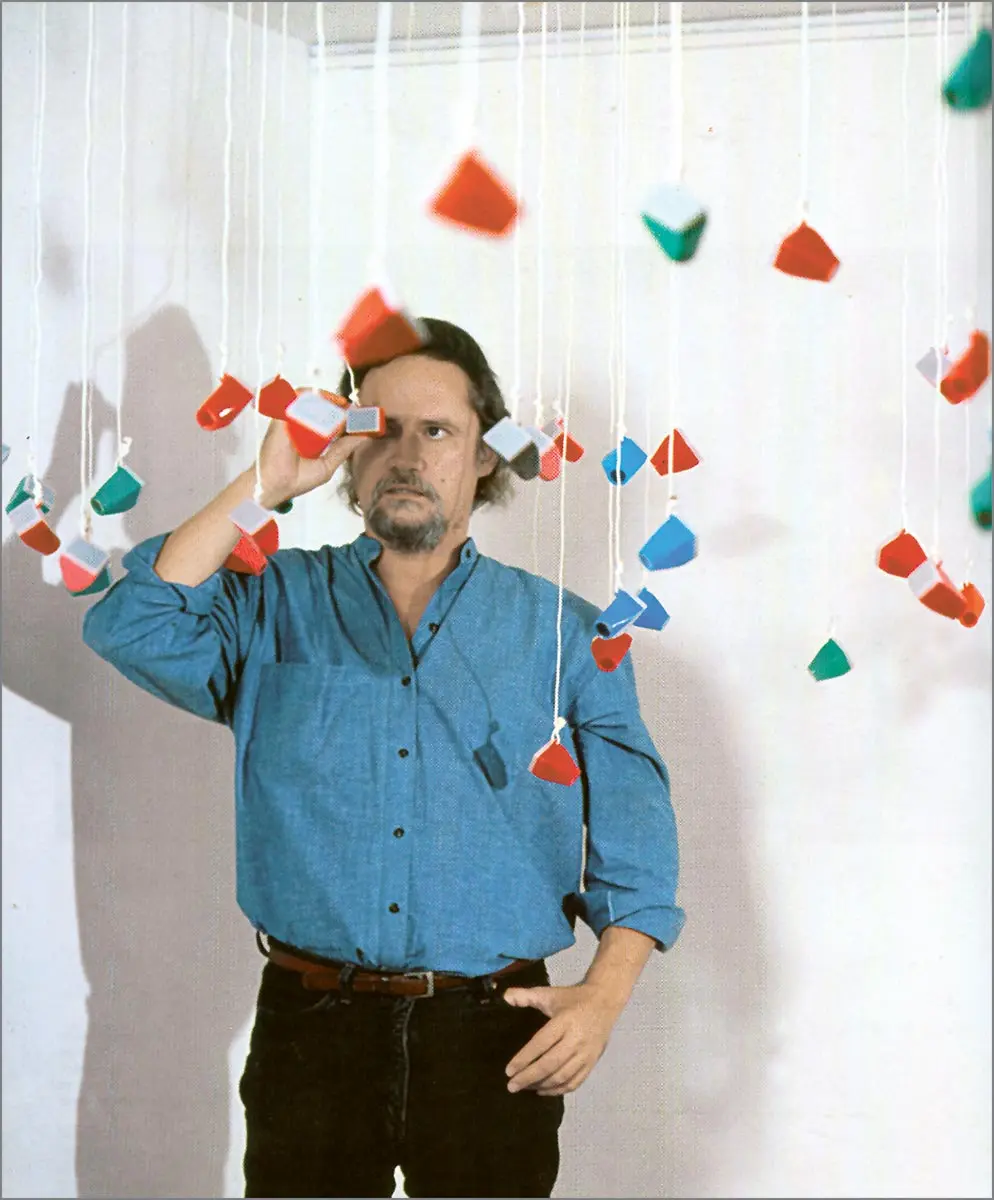
Among Uribe’s most interesting and least explored bodies of work is one centrally concerned with process, ideas, and, above all, an understanding of art as discourse and speculation. It comprises works like Telescopios (Telescopes), an interactive exercise in self-documentation using a technology for the preservation of memories that is very popular in Colombia, which reveals the role played by the extension of the arts for an entire generation of critics, artists, and theoreticians. This is what prompted Armando Montoya to assert, regarding works like the already mentioned Cabeza parlante—a precursor of the incorporation of the body into artistic practice in Colombia—that they aspire to “encompass the world.”
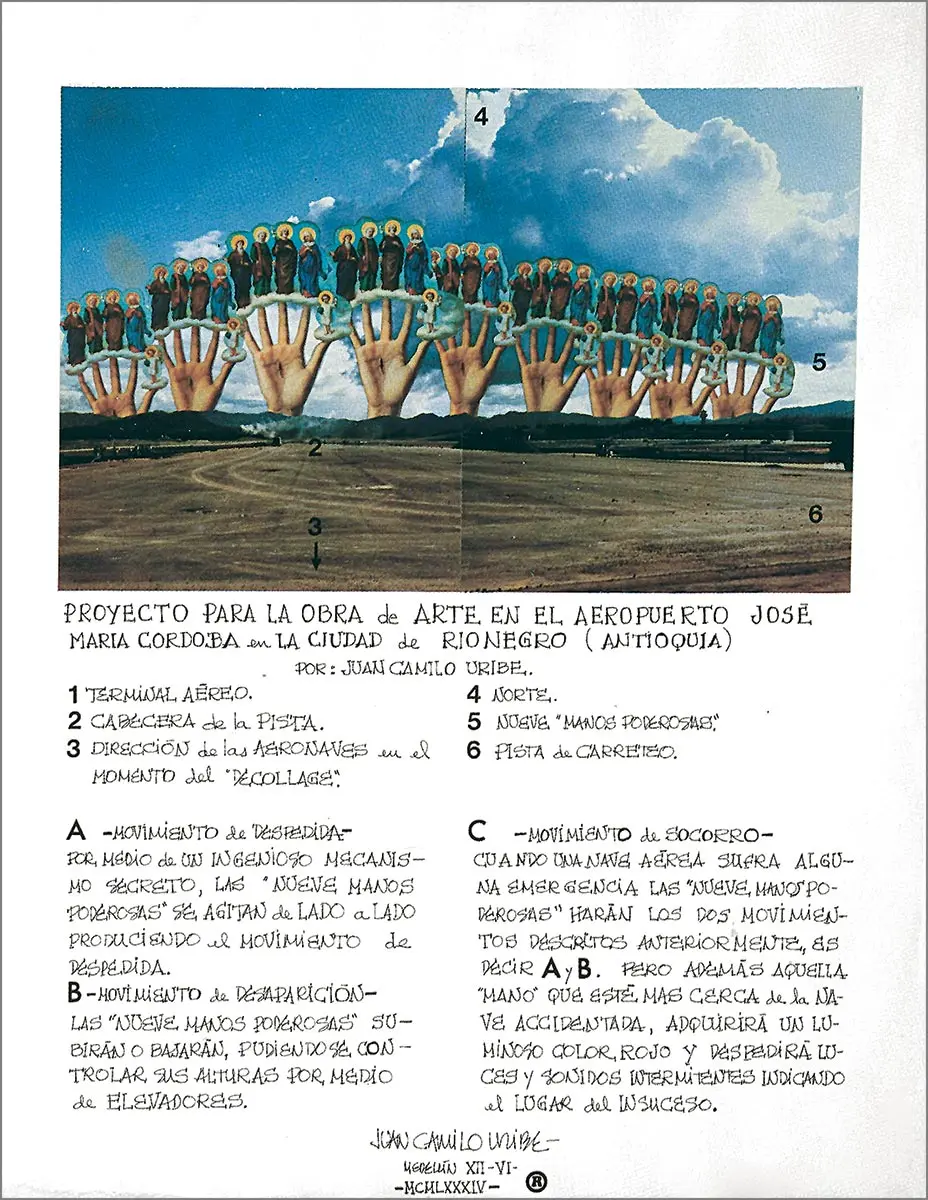
This search for an aesthetic animation of reality can also be seen in yet a third group of works by Uribe. These are his most independent-minded, freer productions, devoted to unbridled speculation and intend on installing in our imagination a perspective valued for its ingenuity, its ability to twist the possibilities of execution in favor of autonomy. Two projects must be mentioned in this connection: the Riogrande hydroelectric and the José María Córdova airport. In the former, invited to present a project for the decoration of the area surrounding a dam, Uribe pokes at the art system with an impossible, unrealizable idea that nevertheless achieves an intense power of memorialization. In the latter, Uribe deploys the imagery he was already well known for in his proposal of a delirious interplay that interrogates the role of culture in infrastructure projects and undermines the monument’s ability to generate social capital. Here, the “powerful hand” (a popular-religious icon) moves from symbol to anti-symbol, from image to satirical artifact.
In the same vein, he produced another work that, despite being anchored in the anecdotal, helps us identify the relational dimensions of an intelligent proposal of surprising relevance today: the Sacred Heart of Jesus Fan Club, which Uribe launched as a prank but continued to manage as a relational device, a social experiment that allowed him to understand—no longer in the fiction of the image, but in his correspondence with real people—the presence of religion in Antioquia society.
These projects bring us to a second paradox: an insistence on the imaginary that, while affirming the power of the non-existent and the barely sketched, helps us value objects, spaces, and possible interventions. This is the always powerful realm of fiction. Art plays with what can only exist in the mind yet exhibits, precisely because of that, the possibility of the new in its purest expression. Humor goes well beyond the visual joke that Medellin critics of the 1970s so feared. It is a refined attitude of playfulness that, in a satirical key, reinvents art with its speculation. We are in the terrain of conjecture, of utopia, one of the ways of extending the arts we have named, lacking a more appropriate designation, “conceptual”, “non-objectual”, or “relational”. As in the case of other Medellin artists who were starting to imagine the city and the art of the future, image and projects herald the territory of the possible.
EFRÉN GIRALDO