
The relationship between architecture and urbanism, the tense pulse between public and private space, became one of contemporary art’s key concerns in the early 1990s. Far from tapering off as time passed and “artistic fashions” came and went, this preoccupation has only grown in the first decade of the Twenty-First Century. It is so ubiquitous as to have come into its own as a discursive domain for the latest contemporary art, albeit from the standpoint of the different poetics that result from specific artistic reflections elaborated within this domain.
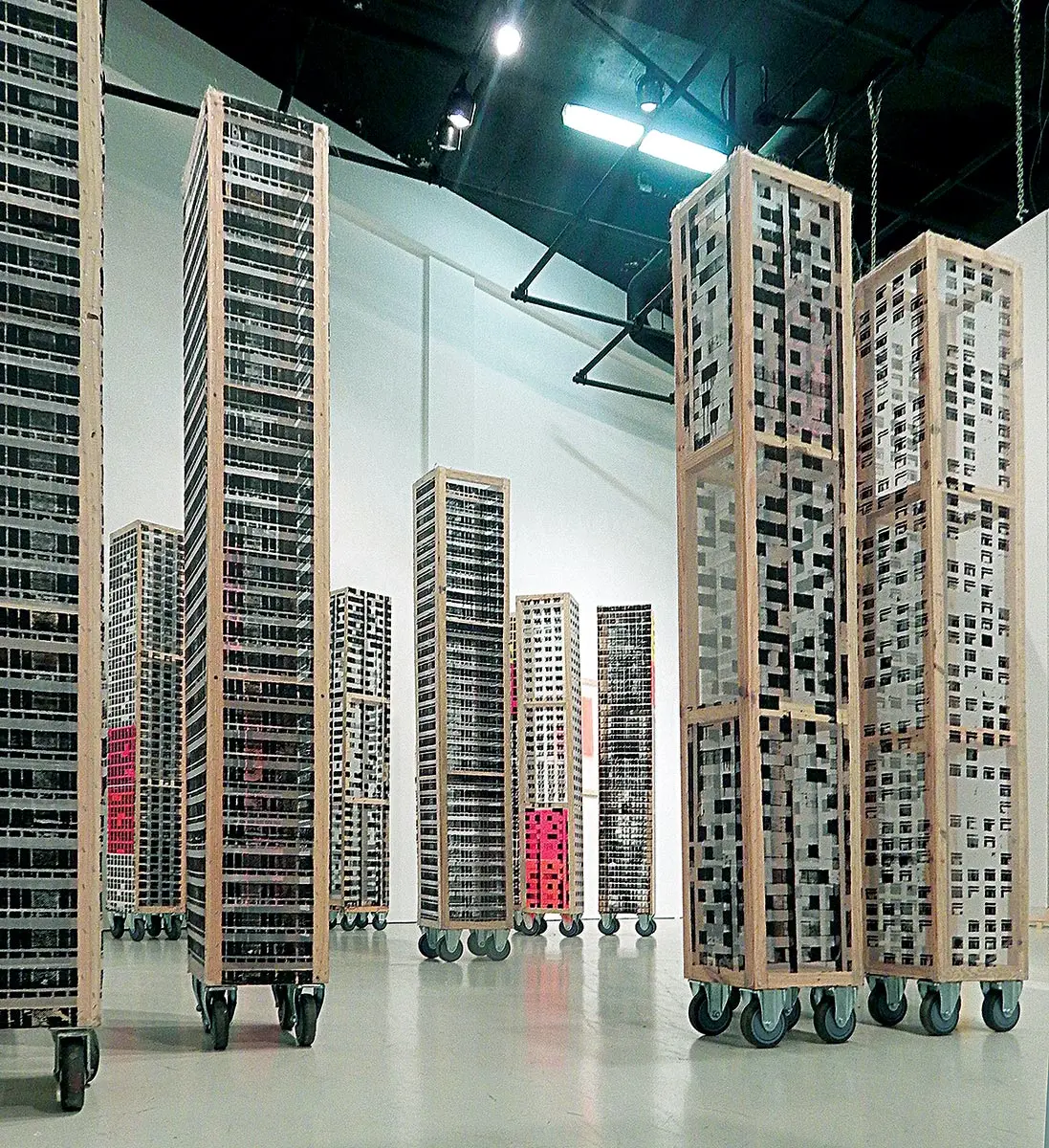
Architectural Playground, an exhibition of works by Juan Raúl Hoyos (Colombia, 1962), curated by Aluna Curatorial Collective (Adriana Herrera and Willy Castellano), deals mainly with the constructive aspect of buildings and urban spaces in our cities in the era of the global village, their dynamics, and the socio-cultural meaning they have acquired. In that sense, Hoyos’ works posit a kind of constructive typology that on the one hand takes the vertical module (especially in his sculptures and installations) as its formal gravitational axis, and on the other reveals the inner workings of the process through which the artist produces these works. This is a constructive typology because Hoyos, finding his inspiration in Le Corbusier’s rationalist architectural ideal, picks up the notion of the module—a reference to the Swiss architect’s concept of the housing unit (Unité d’habitation)—in order to represent, among other things, how it has mutated in the uses of the most contemporary speculative urban construction. Le Corbusier’s revolutionary concept of the housing unit is a component of his functionalist architectural philosophy, where the building, the construction, was supposed to become a “machine for living.” In this way, as a constructive architectural solution of the modern era connected to the “machine for living,” the housing unit spearheaded an architecture whose social-democratic ideology sought to ameliorate housing deficits in European cities devastated by World War II. And it is well known that Le Corbusier’s architectural philosophy, which had the provision of affordable housing as one of its objectives, was adopted as official policy in many countries with the intention of helping the less favored. On the other hand, through an overexposure of the process and the devices used in the production of the works featured in Architectural Playground, Juan Raúl Hoyos brings to the fore symbolic parallelism with the building processes—invisible to the eye—that are used by large corporations in the construction business. Hence Hoyos’ interest in deploying materials and practices that, for example, put on display the processes used in silk-screening and also the fragments or recycled objects used by the author in the production of the work, as he does in Reordenamiento N 31 (Reordering N 31, 2012-2015).
In the words of Adriana Herrera, this work articulates “different artistic movements and styles (including postal art, arte povera, and Bauhaus-influenced abstract art) that ultimately activate a different way of looking at, traverse, and conceptualize contemporary urban life.”
The experience of Architectural Playground reminds us, in a sense, of the conceptual art of Gordon Matta-Clark, a precursor of architectural-space interventions. It does so to the degree that Matta-Clark, in his urbanism interventions of the early 1970s, carved holes in buildings about to be torn down and took out samples from them, thus revealing and at the same time documenting photographically (as Juan Raúl Hoyos did in Project Sintec, 2007-2010) the materials and methods used by construction companies. These biopsy-like procedures reveal the innards of a constructive body that responds, to a large degree, not as much to the need to build a “habitat” for citizens, but to speculative interests and criteria dominated by the surplus-value considerations of capitalistic firms. It is impossible not to connect the modular, rounded towers of the 2014-2015 installation Playground, its “different” and promiscuous constructive typologies, with the phenomenon of global real-estate speculation, and in particular with the case of Miami in recent times. Here, the forces of capital have eclipsed the utopia of architectural modernity in the manner, for instance, of Le Corbusier, who aspired to build cities planned and organized as “machines for living,” capable of generating potentialities that respond to the material and spiritual life of their citizens. It is these forces, expression of the State in its most neo-liberal version, the ones that really create the guiding plans for cities in the new global village. It is them that establish profitability criteria for the use of land and property, cutting off the possibility of a harmonizing relationship between public and private space, between citizen and society, and in the process rendering any true sociability impossible in the urban landscape of the city. The need for a “machine for living” as a manifestation of authentic social and cultural life has been exchanged for a “machine for exploiting” the fantasies of comfort, the mixture of vanity and the ostentation installed as a horizon for the subject’s expectations in postmodern culture. An exhibition like Juan Raúl Hoyos’ Architectural Playground also helps us understand this.
DENNYS MATOS