
Contemplating a work by Juliana Góngora generally involves touching its surface with the tip of one’s nose. Wanting to get every detail, viewers must poke around because the tiniest of points contains a wealth of meaning. Góngora has specialized in the minuscule through an exploration that does not solely involve a different perception of the space but also of time, given that time passes differently for the enormous and for the small. This is the reason physicists must choose between studying atoms or stars as each category is ruled by a different set of equations.
The exhibition Labor, at Flora Ars+Natura centers on an endangered past: the rural home and, thus, the possibility of farming one’s own land; a way of life that survives only through remnants. In this manner, Juliana Góngora focuses on her grandparents’ home in El Espinal (Tolima, Colombia), a hot town in the middle of the Colombian Andes; she created four pieces that were made of time in the most diverse manners.
A still video shows the interior of a home through a door. Shadows and movements caused by wind are the only signs of time going by; elapses that in El Espinal do not appear to occur. In another place in the exhibition, directly on the floor, a rectangular and flat stone-labor, inverted with lime that gradually eats it, has been rendered purposeless, thus its vertical position on one of the gallery walls.
Across from the stone-labor, resting on a wall, there is a wall made of salt, reminiscent of another one made with bahareque, a material used in the construction of peasant houses. The essence of this work, salt is highly charged with symbolism. On the one hand, it was the ancient commodity for trading in the barter system practiced by the indigenous people from the savannah of Bogota—a subject that Góngora has focused on in her earlier work; and, on the other, salt is the element used to preserve meat in warm weather, to stop decomposition, which is, in essence, the same as to stop the passing of time. If water, which always appears new, is Heraclitus, then salt, which always seems ancient, is Parmenides. In this exhibition, the aged appearance of salt was present in the yellow and brown, Paleolithic, patches that began to appear on the wall’s surface soon after the installation was completed. In addition, the gravitational force eventually made the lower mass of the wall wider than its upper section. In fact, the amazing thing is that that wall-clepsydra somehow managed not to fall apart.
When Góngora was asked about this, she said that a sudden collapse was unlikely because salt likes to remain together, preferably in a solid-state, ideally in stones. She then added that, in order to separate it into the particles that we are used to ingesting, it is necessary to combine it with iodine. Thus, she concluded, “the only thing I did was to get it together again.” And Juliana Góngora is well versed in the behavior of particles, tiny stones, and minuscule seeds.
In Ensayos Sobre la Fe (Essays on Faith, 2012), Góngora placed three hundred sandstones, less than a cubic millimeter each, on top of four meters of spider silk. The work was extremely powerful and delicate and its dimensions were unusual: it was tiny but also vast, light but also heavy. All contradictions that surrounded the issue of scale, since a biped—Góngora—55,000 times heavier than a house spider, decided to take the place of the spider to obtain a result that was unattainable according to our sliding scale; an extremely thin thread holding enormous stones. Working within the parameters of a spider, Góngora was able to transform stones into light objects. To do so, she had to be very patient. The sole act of separating the tiny stones from the sand dust took her several hours. It took place, not without humor, in the waiting area of El Dorado airport.
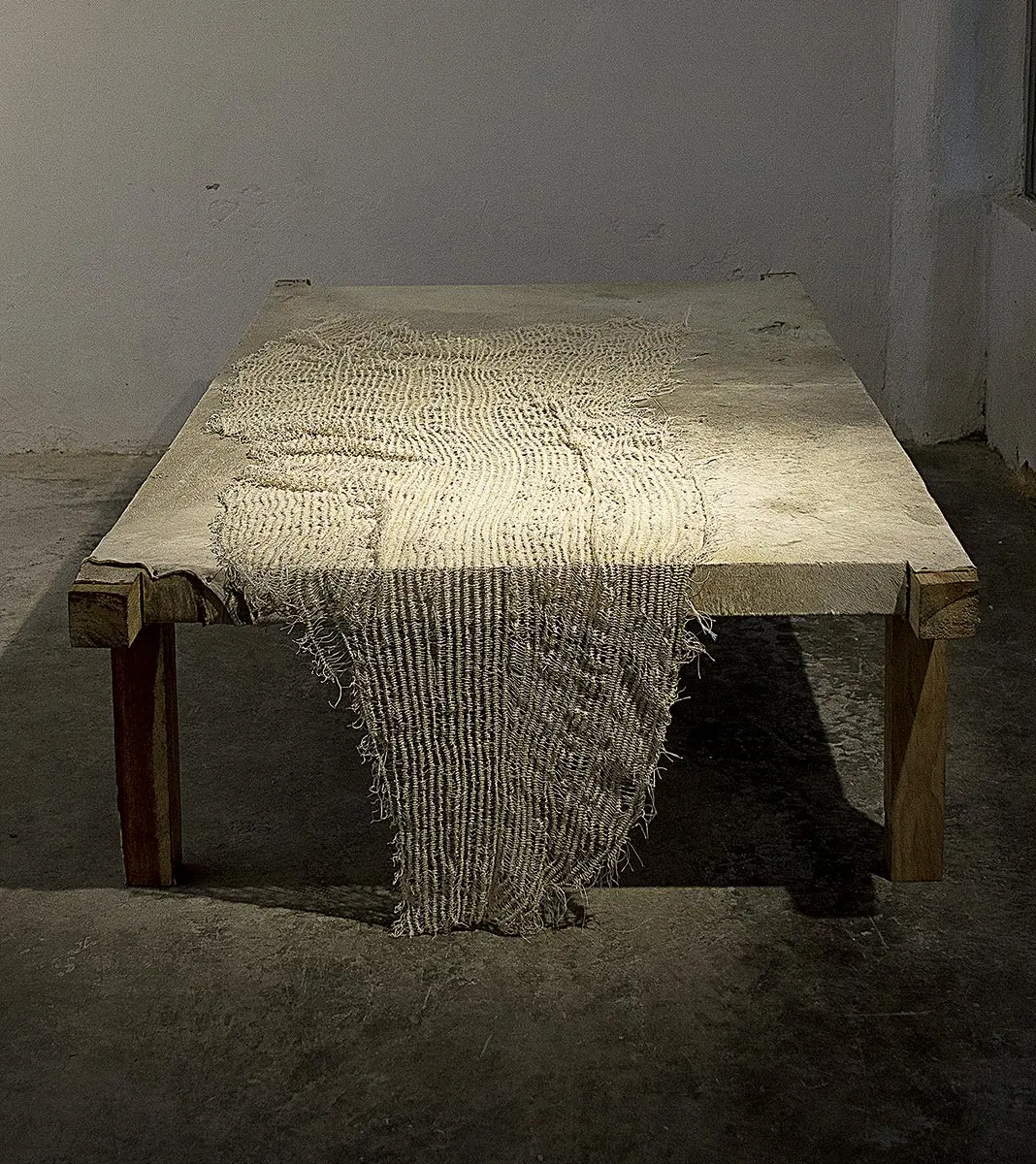
In this last piece of the exhibition, Juliana Góngora returns to learning about spiders. She reconstructs a memory of her father involving the bed on which her grandfather slept in the home of El Espinal. It was a wooden structure covered with stretched calfskin stitched to the bed with very fine thread from a long weave, which gives the piece the appearance of being very light. The contrast between the loose blanket and the tense skin offers an incredible texture to the piece.
But now, in order to understand the blanket, it becomes necessary to get close, because the weave is filled with grains of salt, organized with the geometric regularity of crochet. The amazed reaction of viewers when they observe the grains is similar to the earlier response caused by looking at the tiny stones of spider silk. What are they doing there? I have no idea, but it is very beautiful and, on the other hand, the blanket could be placed on the soil to generate a new harvest. Indeed, the uneven extension of the blanket is the geography of Tolima on the bed, on the cow skin that belongs to the type of cattle that pastures along the mountains. Both converse about the history of farming and the contemporary agro-industrial reality that has devoured our world. But this is only a minuscule interpretation of work full of meanings. It is a piece that envelops time through the most diverse of flanks; the past of her grandfather, the ongoing action of weaving, and the future that, in spite of it all, is contained in each seed.
JULIA BUENAVENTURA