
With the support of the Lasar Segall Museum and of IBRAM, the Brazilian Museum Institute (an organism of the country’s Ministry of Culture), Pinakotheke Gallery is presenting in its São Paulo location an important exhibition of works by Lasar Segall, featuring paintings, drawings, prints, and sculptures by a master of Brazilian modernism and offering a welcome opportunity to revisit the contributions made by the artist born in Vilnius, Lithuania, in 1889. The exhibition encompasses 57 works and a number of documents related to Segall’s biography, with information about his experiences in Germany, where he lived for a time, and in Brazil.
The exhibition’s opening was also the occasion for launching a new publication, with an essay by art historian Vera D’Horta, a specialist in Segall’s work; it includes new information about the artist’s birth year, now established as 1889 rather than 1891 as had been asserted before.
The selection of works makes it possible for us to trace Segall’s various experiences, starting with his works using paper as support and his paintings of the German period, made as WWI raged.
We are surprised by Segall’s assured and sensible draftsmanship in xylographs, lithographs, and graphite or color-pencil works on paper. Portraits, everyday scenes, themes of Jewish culture, and events that marked the artist’s personal life are all present in the show.
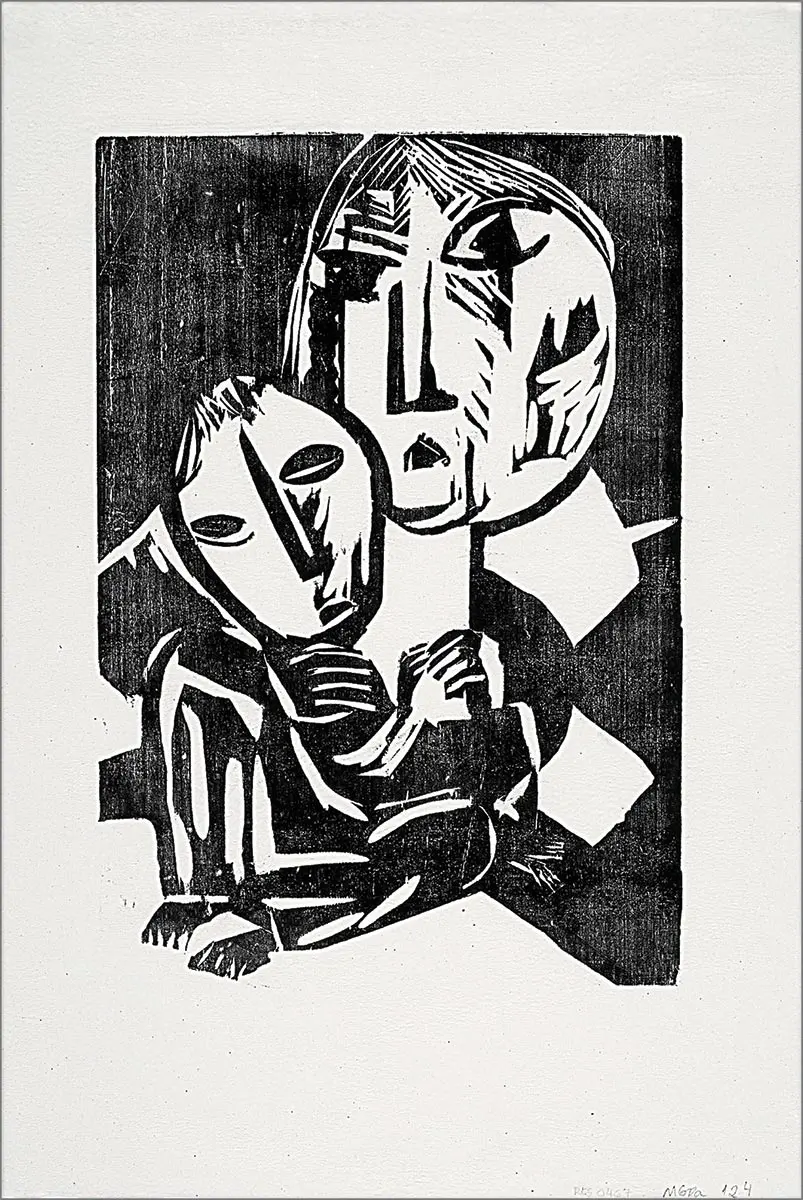
In her introductory essay, Vera D'Horta notes that Segall’s European production is best represented here by the xylographs he made in Germany in the second half of the 1910s and in the 1920s. These works, says D’Horta, are aesthetically and ideologically related to primitive engravings. Evident in the selection on exhibit is Segall’s simplification of forms and his immersion in German expressionism. D’Horta notes that “the artist explores the decisive contrast between black ink-filled surfaces and white spaces carved in the wood matrix, as did his predecessors Erich Heckel and Karl Schmidt-Rottluff—the creators, in 1905, of The Bridge—as well as later, second-generation members (like Segall) of this German artistic movement.”
Present in Segall’s engravings is the subject of the Wandering Jew, memories of his native city, and reminiscences of Orthodox Judaism’s rituals. In her analysis, D’Horta reviews the impressions that the artist retained of Vilnius, occupied and razed by German troops in 1915. This is the context for works like Widow and Son (1918) and Widow (1919), Lunar Prayer (c.1917), Praying Youth (1920), Wandering Women II (1919), and Mother and Son (1921). This repertoire, deeply significant in Segall’s oeuvre, is presented always within an expressionist aesthetic. Another high point in the exhibition is provided by the canvases Segall painted in Meissen in 1915—The Market in Meissen I and II—when he found himself in that city due to World War I: Lithuanians were relocated to Meissen because their country was part of the Russian Empire, Germany’s enemy in the war.
One perceives in those canvases the importance of free-hand brushstrokes for building the composition; the artist creates urban scenes with his brush while his agile and fluid lines reveal the urge for gestures in the elaboration of a painting. In that period, Segall was interested in documenting aspects of the city and its environs, and D’Horta notes a certain influence of German impressionist master Gotthardt Kühl.
Another surprising painting in this exhibition is Funeral Vigil (c. 1928), where the artist reports the death of his father, recording the date and time of his passing (February 10, 1927, 7:30 am). The composition, all in brown hues, includes Segall’s signature in Russian characters. The subject of the death of the father reappears in works such as End and Beginning (1929), which depicts his father and his son, Mauricio, and in xylographs such as Funeral Vigil (c.1927) or the etching Kaddish (1927).
Also included in this exhibition are the significant works Segall made in Campos do Jordão, a small mountain village in the state of São Paulo known as “Brazil’s Switzerland”. Frequenting it from the 1930s on, Segall left important registers of the local landscape, such as Bluff with Houses and Animals (c. 1937) and Animals with Pines (1931), in reference to the tree species endemic to the region.
Another highlight of the show is Closed Glade (1954), a synthetic, almost abstract oil-on-canvas work. Here the artist records, in an arrangement of vertical lines, a vision of tree trunks aligned to cover the entire surface of the support, yet allowing us to see light as it filters through them.
Lasar Segall (1889-1957) settled in São Paulo in 1924, and in that Brazilian city, he built an important part of his life’s trajectory. In São Paulo he married for the second time and raised a family. There he participated in the local modernist movement that burst into the scene with the Modern Art Week of 1922. However, Segall had visited the country before: it was in 1913 when he presented in São Paulo and Campinas a selection of his works, an event that is acknowledged as a significant antecedent for Modern Art in Brazil.
LISBETH REBOLLO GONÇALVES