
In 2015 Lázaro Saavedra was granted Cuba’s National Visual Arts Award. This recognition included the presentation of an exhibition by the artist at the Museo Nacional de Bellas Artes in Havana. The work that Saavedra created for the exhibition was Base/Superstructure that in the end had to be displayed at the Centro Wifredo Lam because a video installation, which included a car, could not fit through the museum’s entrance.
At the Centro Lam, that work welcomed visitors by the entrance hall and part of the outdoor patio. It consisted of a US-manufactured vehicle, popularly known in Cuba as almendrón (big almond), with its hood open as if it were in the middle of being repaired. Projected from the engine, a video was projected onto a white bed sheet hung from a clothesline. The video showed Barack Obama and Raúl Castro seated posing for an official photograph, flanking a monitor showing the documentary that gives the work its title, El Progreso de una Nación (The Progress of a Nation), a film about the former Soviet Union’s first exhibition of scientific-technical achievements in 1961, in the initial museum in which Base/Structure was supposed to be presented. Several clothes hung from the clothesline, including t-shirts with images of prominent works by Saavedra printed on them, including the iconic image of a Christ that, through speech balloons, spoke in Russian and thought in English but had a Cuban flag on its heart.
Saavedra conceptualized the car as a variant of Joseph Beuys’ social sculpture. In an adjacent hall, he defined his own version as “an object from material culture, shaped by a social author-collective.” Next to this, a diagram identified the origin of all of the car’s parts, from its US-made bodywork and chassis to the front brakes taken from a China-made Wuling pickup to the rear bearings from a Soviet Lada Niva. Like Christ’s heart, the battery was made in Cuba.
Fortunately, the change of venue mitigated the piece’s theatricality, thus favoring the other works. Conceived as a parody of the Marxist dichotomy between base and superstructure, the exhibition was divided into two sections. The first floor contained reproductions of works that circulated like emails from Galería Imeil, which represents Saavedra. The images show characters, taken from the mass cultures of the US, the Soviet Union, and Cuba, presented in humorous situations.
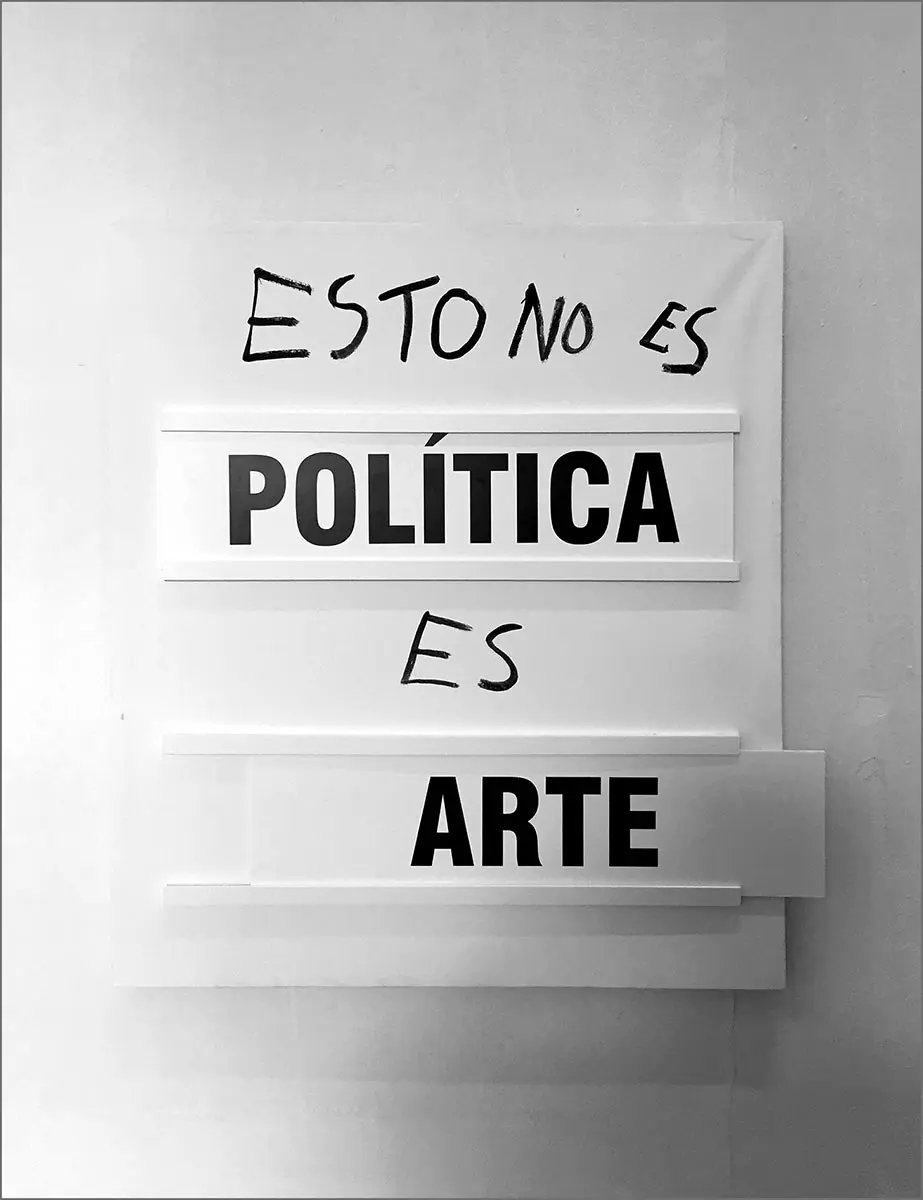
Dedicated to the Superstructure, the part of the exhibition found on the second floor unfolds like a series of installations connected by thick irregular lines drawn on the floor. Their central elements were direct drawings on paper and the use of framed canvases, some of these painted but left blank for the most part. Irony was everywhere, and the first thing we were told was that “Art is not to be read. Its purpose is to offer aesthetic pleasure or pain.” Saavedra incorporated text in many of the works and accompanied them with fake and out of place critical comments.
Saavedra studied at the Instituto Superior de Arte and was a member of the legendary Puré group during the 1980s, characterized by their irreverent attitude towards institutions and their use of sarcasm. In keeping with this tradition, he would scathingly criticize concepts overused in art theory. His sharp intellect was evident in his work. With maxims about what art should be, Saavedra rehashed terms that have been overused (political art, emerging art, protest art), and introduced others (opportunistic art, affirmative art), employing an old strategy that his generation transformed into a modus operandi: based on the literal interpretation of official propaganda phraseology. Saavedra appeared to be comparing the jargon used in theoretical-critical discourse with the one used in politics, questioning its emptiness of meaning as a result of being overused.
Located in a small exhibition room, the piece Articido (Articide), presented a hanging rope that supported a blank painting whose canvas had been cut in the style of Lucio Fontana. An overturned chair was on the floor. This motif of the chair reappeared on the other side of the gallery in the form of a drawing on the wall titled Cabesilla, a play on words that combined the Spanish words for “head” and “chair.” There, Saavedra alluded to present motifs as the chair appeared within the head of a figure with an outlined torso. Thus the chair was no longer the symbol for surrender conveyed in the earlier work but a symbol of power in this one. Saavedra has demonstrated his sharpness in many works in which he used blank canvases. While Un Lienzo lo Aguanta Todo (A Canvas Can Support Anything) consisted of a canvas resting on a wall, the accompanying critical text wondered whether it was actually the other way around and the work was supporting the institution’s wall.
Lastly, in a work the conveyed a gesture of estrangement Saavedra portrayed himself as a victim. It consisted of the enormous writing of his last name on black vinyl glued to the floor, on which viewers had to stand up in order to be able to read a phrase written with a very small font: "cuando estás abajo, todo el mundo te pisa" (when you are down, everybody steps on you). The seriousness of this statement contrasted with the predominant ironic one in the rest of the exhibition. By the end of the show, one cannot but wonder whether everything was a joke used by Saavedra to solidify his image of a martyred enfant terrible, now from the superstructure of Cuban art.
ELVIS FUENTES