
From the anatomical studies by Berengario da Carpi (1521), Andreas Vesalius (1543), Jan Steven Calcar (1543), Jean Valverde de Amusco (1586), Gasparo Becerra (1556), Peter Hille (1576), Lucas Kilian (1639), Guido Guidi (1626) and Gérdard de Lairesse (1685); to the history of the art covered in works like The Development of the Study of Anatomy from the Renaissance to Cartesianism by Raphael Cuir; philosophical writings like Ouvrir-Vénus. Le temps des Images by George Didi-Huberman; to, of course, the Anatomical Studies by Leonardo Da Vinci, Rembrandt’s The Anatomy Lesson of Dr. Nicolaes Tulp, or Omniprésence (Omnipresence) by ORLAN, among many others who would be impossible to list here; it is clear that The Body Within is completely fascinating. And Leonel Castañeda addresses such fascination in his recent personal exhibition that inaugurated the new Espacio El Dorado space. It is a subject that can also be problematic because it questions our taste, our willingness to observe that which we never see, beyond any considerations relating to beauty—an ideology in and of itself, as Karl Rosenkranz declared in his famous book titled Aesthetics of Ugliness (1850): “It is in this hell of the beauty that we wish to descend.” The exhibition by Castañeda is an immersion into the hell of the beautiful in which the sinister (that strangely familiar Freudian notion) invites us to recognize ourselves in that which he usually wishes to negate: the body-corpse, the body-remains.
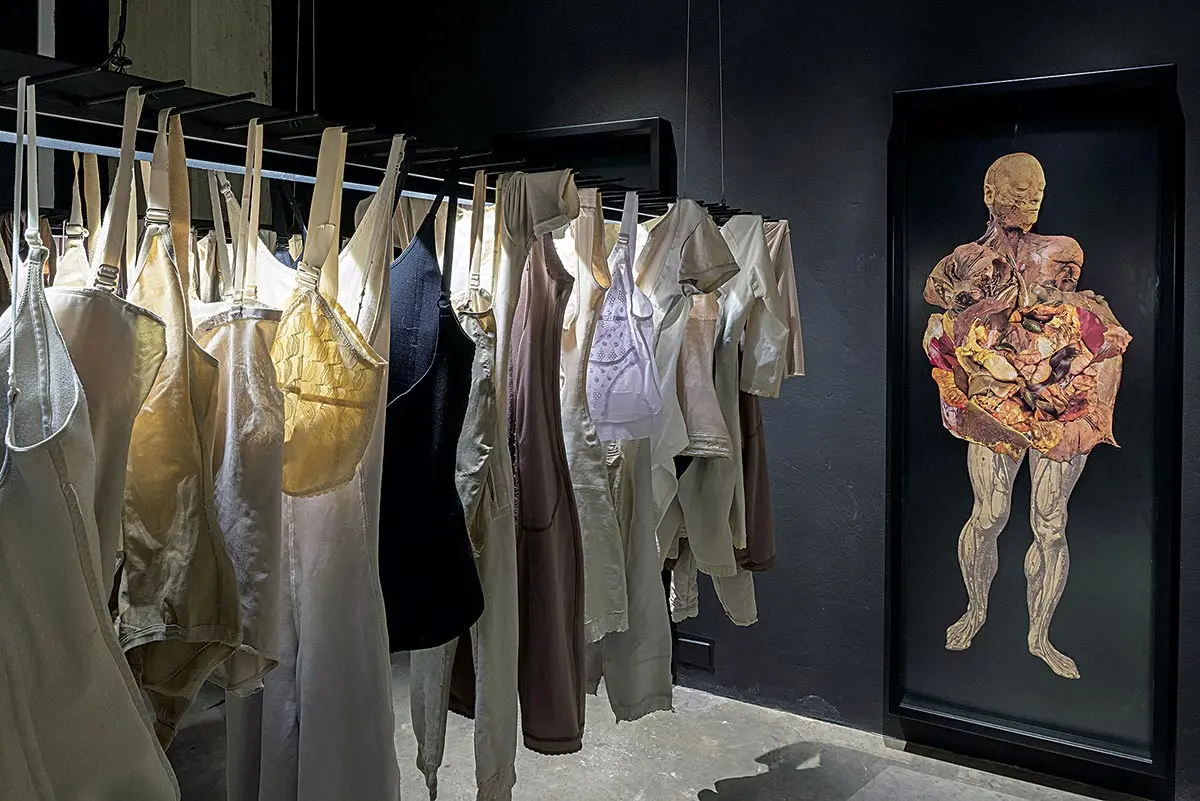
Divided across three levels, the exhibition proposes a survey of the body as habit-girdle, as fragment-archive, and as object-animal, respectively. In the first part, the exhibition room was in complete darkness, only some well-directed points of light focused on several rows of girdles arranged one after another like articles of clothing. In each row and on the wall, a photograph showed a dissected body that revealed what we usually do not see. The tension generated between the articles of clothing—most of them for women—hanging from a metal structure, become “skins” and the unfolding of those bodies shown in the color photographs over a black background. Flesh and habit; how not to be reminded of Hanna Sterbak and her Flesh Dress or ORLAN’s Manifeste de L’Art Charnel (Manifesto of Carnal Art). Castañeda masterfully succeeds to immerse us inside the body, which is, in my opinion, where true nudity lives.
The second part consists of a series of display cases that jealously guard several magazines, books, sheets, photographs, and other printed material that promiscuously cohabit with found objects and objects bought at street markets in the downtown area of Bogota: The pulgeros and the famous agáchese or informal market located along street sidewalks. Collected for a period of over fifteen years, all these objects allude to the body: dental prostheses, sexual objects, and women’s shoes, among others. In this manner, Castañeda’s success in developing a perverse narrative of the body, in which texts, images, and objects tie together that I have called a text-gram1. It is a body of language that reveals a singular gaze on the absent body. We, the viewers, read anything we wish into it, as we freely associate images with texts and objects. This type of visual reading forms a different idea of the body, whose presence is marked by the real world, the world of medicine since the images come from 19th-century French anatomy books, combined with pornographic images and images taken in the morgue. Castañeda explains: “My intention was not to rediscover the body in the context of images already established.” It is a true work of aesthetic and cultural archeology.
Lastly, several aluminum display cases enclose skins and other fragments from dissected animals that have been intelligently intervened: horns with nails, a colt with a muzzle full of teeth, serpent skins, rabbit skins, turtle shells, among others, that remind us of those cabinets of curiosities from the 16th and 17th centuries, preludes to the museum where animals elements were placed alongside the monstrous and the exotic. Here, the animal body is exalted, desiccated skins become eternal witnesses, while the body loses its vitality and becomes something else.
These three moments offer us a comprehensive idea of what the body is, observed and experimented on from within, in its eternal nakedness—for the naked body is the one that is divested of its own skin. The exhibition by Leonel Castañeda shows work that we are just beginning to know; work that had remained unknown for many years and whose potential had been only appreciated by a few people like Carmen María Jaramillo and Beatriz González. They showed one of his display cases at the Banco de la República collection. Espacio El Dorado was inaugurated with an excellent exhibition that will be hard to forget.
NOTE
1. This concept refers to the union between text and image, between text and object. Ricardo Arcos-Palma, La corporé it é du langage. Le corps comme pre-texte et comme texte en soi même (The Physicality of Language. The Body as Pretext and as Text Unto Itself) Thesis Submission. Bibliothèque de la Sorbonne. Paris, 2005.
RICARDO ARCOS-PALMA