
The subtitle of the retrospective exhibition by Mónica Mayer, A Retrocollective Exhibition, does justice to the reach, complicities, and collective work involved in the work by this Mexican artist in the last forty years. It is true that Mayer is a central figure, literally or even in the sense that the center position in basketball is—where the forward player can no longer bounce the ball after he ends his dribble and must decide whether to try to score or pass the ball up, down, to one side or the other, with the hope of completing the play and score.
The works by Mónica Mayer are physical in that way. They are at once imposing and suggesting, strategy and symbolism, struggle and support. They are political, social, ludic, textual, and documental. But above everything else, they are art. She does not care about boundaries and does not bow to conventional supports, but instead favors the possibilities offered by adverse and conflicting environments that propel her to create works that are illuminating and subversive, humorous and confident, to the same extent that they are also critical about the prevailing cultural and institutional prejudices in Mexico and around the world. These components have been present in her work since the 77/78 Salon: New Tendencies, exhibited at the Museo de Arte Moderno in Mexico City, where she participated with the installation titled El Tendedero (The Clothesline) when she was still a student. In this piece, she used a clothesline as the literal support. It consisted of successive lines of cord—like a clothesline for hanging clothes to dry—supported by a freestanding red metal structure filled with pieces of paper fastened to the cord with clothespins. Women from all spheres and social classes were invited to interact with the piece by writing on the pieces of paper something that completed the sentence: “As a woman, the thing that I most detest in the city is…” Mayer has used this approach throughout the years in different latitudes, formats, and questions. In the current exhibition, she has even expanded the participation by using social media (through a Facebook page). Another approach in the same vein was Pinto Mi Raya (I Paint My Stripe), a project that Mayer founded in 1989 with Víctor Lerma, her partner, and accomplice in both her private and public life. The project began as a gallery but soon became a platform from which to organize conceptual art projects, including—and as a result of the clear absence in Mexico of bibliographic material on contemporary art—an archive that, to this date, has collected more than 300,000 texts published in the Mexican press about performance art, feminist art, cultural policies, among other themes.
Mónica Mayer has always stood out as one of the most multifaceted and militant exponents of a generation of artists dedicated to breaking the schemes of the status quo through strategies that seek originality. Her art has been pigeonholed as feminist—and it clearly is—but is more than that. From the humoristic, Kafkian-like, angst of her collages—not to forget her collaborations with Maris Bustamante in the group Polvo de Gallina Negra—in which she uses as formal support the stereotypes that have characterized the feminine to denounce gender violence, her process reaches with a gentle ferocity beyond feminism to a terrain in which action, place, and perspective construct a subversive dialectic that questions contemporary art practices in order to reassert them in another place. This relocation—which could be compared to the movement of viewers through the exhibition spaces or to the movement of the sun across the sky—becomes the medium that shapes works whose content, which is sometimes evident, is resignified. On the one hand, there is the work based on her private life: works such as El Nacimiento de la Sra. Lerma (The Birth of Mrs. Lerma, 1980), Foto Falsa a Diez Años de la Boda (Fake Photo Ten Years After the Wedding, 1990), and La Cena y la Exposición (The Dinner and the Exhibition, 2015), which follows and documents her relationship with Víctor Lerma as part of a life project that they titled Las Bodas y el Divorcio (The Weddings and the Divorce).
On the other hand, there is the systematic practice of playing with interpellations and dialogs in El Performance Parásito (The Parasitic Performance), which Mayer has been presenting and developing since 2005, sometimes with the collaboration of Víctor Lerma. In this work, Mayer stands next to a performance already taking place with a placard that reads “If you have any questions… ask” (the name given to this exhibition). It is an invitation to viewers watching the performance to clear any doubts that they may have without them knowing that they have just become part of it. As an extension, Mayer has allowed other people to perform it.
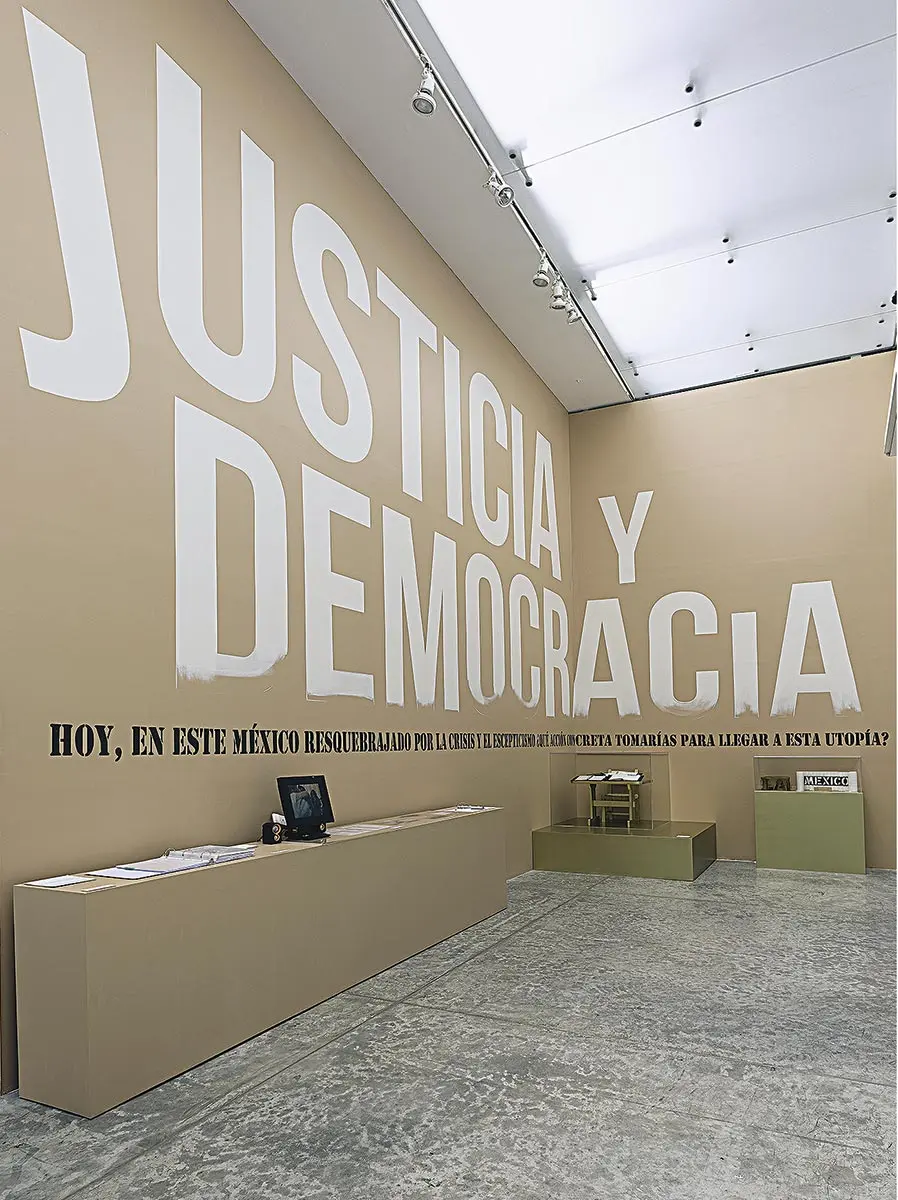
The exhibition consists of an introduction, titled Hanging out Networks, and three thematic centers: Feminism and Education; Towards another Eroticism: Art, Life, and Affection; and The Personal is Political, Performative, and Public.
The exhibition ends with an 8-hour long performance by Mayer. The exhibition was curated by Karen Cordero-Reiman.
RICARDO POHLENZ