
When Georges Didi-Huberman writes that “What we look at is only valuable—only alive—in our eyes because it looks back at us. Inside us, the cleavage between what we see and what sees us is inescapable,”1 we realize that the author’s conceptual effort lays the foundation of an interpretative immersion dealing with the dialectical vitality of the image and its unsettling persistence in our era.
Actuating connections between the dialectic of the image and the contemporary Brazilian scene, we situate here the visual thinking of Minas Gerais artist Niura Bellavinha in order to accompany some of her most recent sensorial and chromatic investigations.
In her exhibition at Millan Gallery, the artist presented a new series of inquiries that actualize studies and interests about the material status of her painting—between various pigments, formats, and supports—and activate a new analytical key, bringing it into contact with her more recent interpretations of light.
The exhibition, titled Ita Lítica Barroca, revisited a consciously programmatic aspect of the artist’s work, the decision to use uncommon materials as protagonists of her ephemeral paintings (for example, dust, an insistent authorial density in Bellavinha’s compositions).
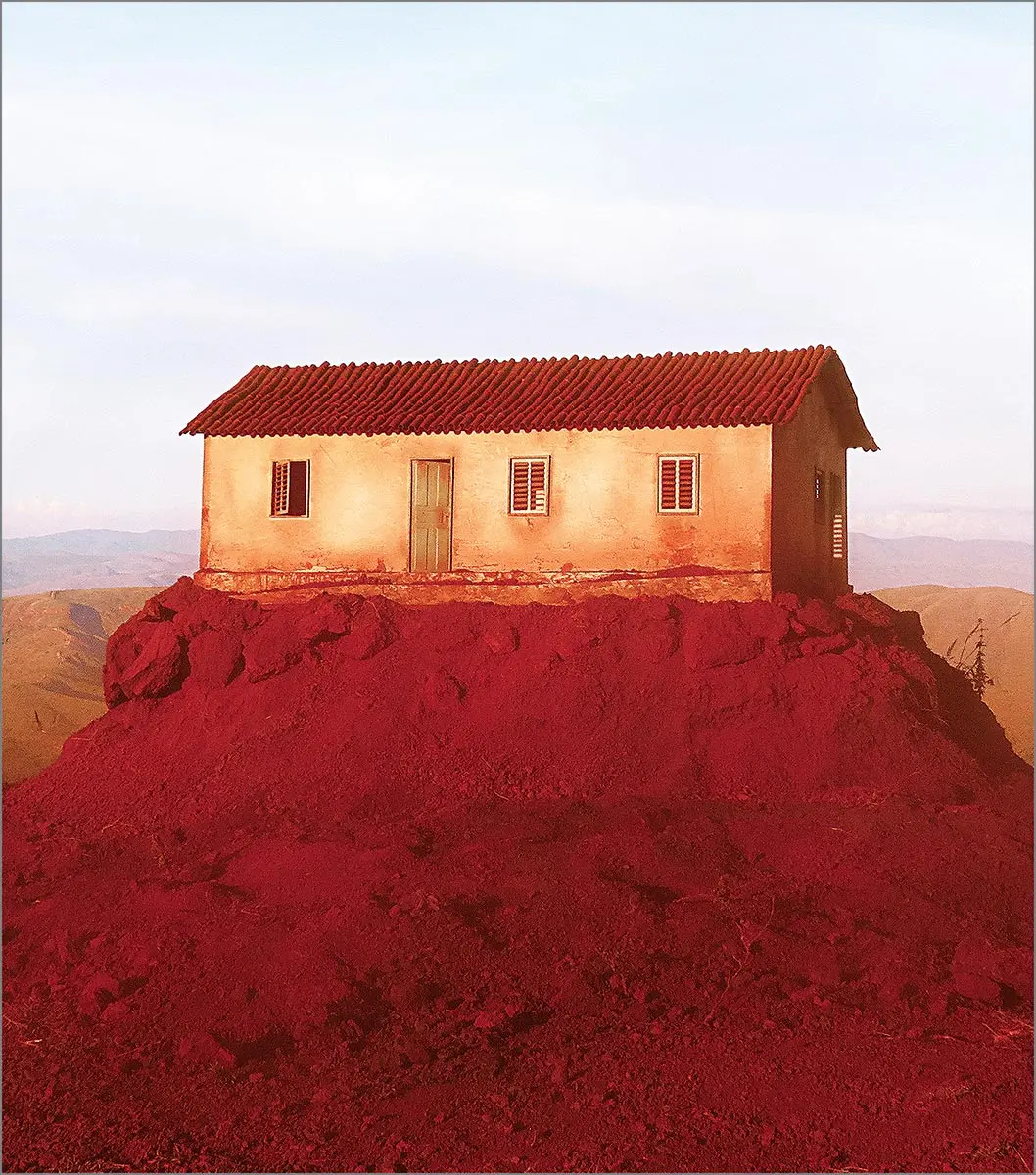
A central player in the exhibition was NháNhá, a medium-length film from 2014, proposed as the guiding thread for the exhibition project at Millan Gallery. Conceived and directed by the artist in collaboration with Alberto Saraiva, it silently narrated the presence of a visual field, like a painting on the landscape in earthen hues, dust, and projected shadows, inserted in a suspended temporality.
This work was centrally concerned with materiality as embodied in pictorial processes that the video image translated into a forceful narrative about the sources for the artist’s investigation, such as dry pigments, dust, various kinds of clay and minerals from cities like Ouro Preto and Mariana, in the state of Minas Gerais—cities that played a significant role in Brazil’s colonial past thanks to the exploitation of gold and precious stones.
Located at the center of the gallery space, the exhibition of NháNhá provided the outlines of a veritable epic tale of environmental loss, as the image of dust, which could almost be felt traversing the canvas, made its appearance in a red scattering amidst transparencies, enveloping in its dispersion the view of an isolated homestead in a neglected, desiccated landscape that time seems to have forgotten.
The video also brought forth, as a testament to the disastrous local situation, the tragedy that results from the chaotic activities of the extractive industries in Minas Gerais, the exhaustion of the region, and the dramatic state of areas lost to desertification and depletion.
Other works exhibited in Millan Gallery established a dialog with the video’s experiment, insisting on the dialectic of the image as a constant concern for the artist, especially with regards to her process painting.
Our course through the exhibition was completed by Articulado Guignard, from 2015, mineral ink print on cotton paper and paint with cosmic pigments on carbon and silk; the photograph Articulado Rodapé, from 2016, mineral ink print on cotton paper; and the painting NháNhá, from 2015, earthen pigments and minerals on canvas.
Process painting, which can be understood as a structural axis in Bellavinha’s oeuvre, has remained an important referent throughout her career, incorporating specific behaviors that, in a way, singularize her production in the context of Brazilian art. Be it in the use of blown dry pigments, water jets, or liquid drips that cover the entire body of her support, Bellavinha’s visual thinking produces recurrent practices already seen by São Paulo audiences.
In fact, Bellavinha’s oeuvre deals in conscious experimentations with diverse materials and supports, with drawing, painting, printmaking, photography, and video as areas of interest driving the artist’s entries into the contemporary scene.
Since her formative years as a painter, already when she frequented the Guignard school in Belo Horizonte and under the guidance of Amílcar de Castro, she discovered the potential of light and developed an interest in the light-related temperament of color in layers of pigment—like tranches opening one upon the other—and this has given direction to her practice.
The factors that have modulated Niura Bellavinha’s gaze are the pictorial phenomenon as such, its character, and its materiality—the dripping of paint on her supports.
In a direct reference to the context of the artist’s lived experiences, the title of the exhibition, Ita Lítica Barroca, brought to mind the mineral presence of precious and semi-precious stone quarries and veneers—a repeating sight in Minas Gerais—and the tradition of the state’s Baroque art, reinvented by slaves who created a different vision for sculptures sometimes even made in soapstone.
The exhibition key brought forth an outline of painting on landscape via the video register and the exercises with earthen pigments and minerals, and it reasserted the persistence of those processes that imbue Niura Bellavinha’s investigation of the dialectical image with authorial value.
NOTE
1. Didi-Huberman, Georges. Ce que nous voyons, ce qui nous regarde, 1992.
CLÁUDIA FAZZOLARI