
At a time when we are approaching an era of peace, when we speak of forgiveness, not forgetting is extremely important. And not forgetting means to confront the country’s memory, of this continent suffering from chronic amnesia, where forgetting has been a constant as if that famous epidemic of oblivion caused by insomnia sickness, masterfully narrated by Gabriel García Márquez in One Hundred Years of Solitude, were still ravaging the memory of these peoples. Prohibido olvidar (Forgetting is Forbidden) is the title of a group exhibition presented at the MAC (which, by the way, is celebrating its 50th anniversary) in February and March of 2016. In the words of its curator, Juan David Quintero, it is “an invitation to wake up, to keep our history alive and current, to not make the same mistakes of the past, to find equality in a society that has somehow lost its way, and, most importantly, to struggle for dignity and for the right to live freely.”1 From its very title, this exhibition posits a prohibition that in turn confronts a series of other prohibitions that, paradoxically, are intended to bring oblivion about. The show outlines a brief but forceful trajectory through the work of artists from Chile, Mexico, and Colombia, countries that in one way or another have shared a history of systematic human rights violation in the context of a dictatorship (Chile), the violence of the drug trade (Mexico), and political conflict in a civil war lasting for over fifty years (Colombia). These artists, judiciously selected by the curator, prompt us to reflect on the meaning of remembrance.
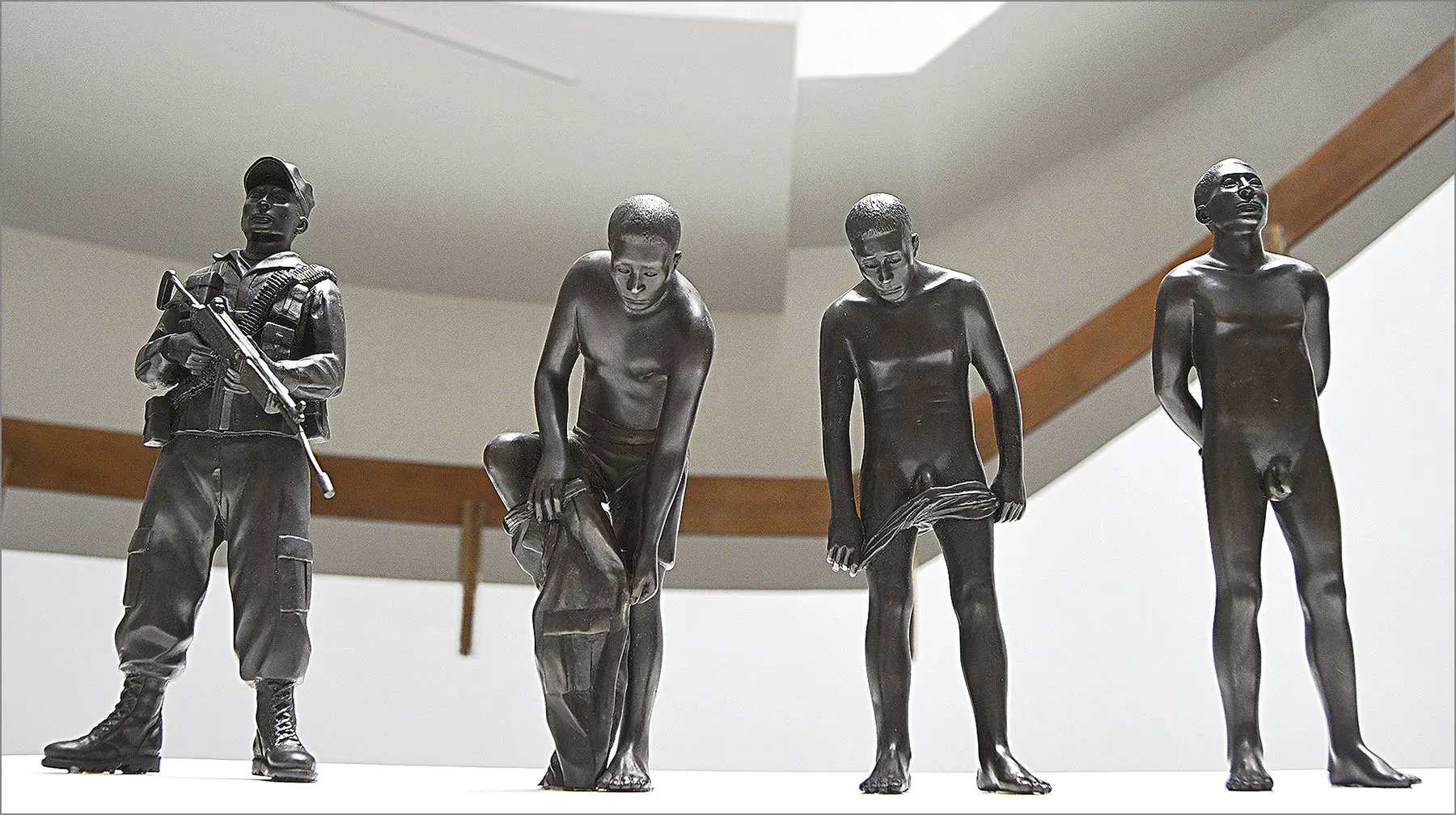
Let’s begin with the work of Fernando Arias, Humanos derechos (Right Humans, 2011); a series of four bronze figurines in variable sizes with a military character, fatigues-clad, and weapons at the ready, situated on the left side. Gradually, this character loses his garments in the other figures, appearing entirely nude in the last one, in an erect posture, with his hands to the back. This work generates a strange mirroring relationship where a heavily armed person ends up revealing an inherent fragility. Yet a different reading is also possible: the confrontation of an unarmed, naked individual with an armed one, the former even holding his hands back as if offering his chest to the bullets. This work insists on human rights violations on the part of military forces that in one way or another have been involved in such execrable events. Arias presents us with a work of art in a traditional technique, bronze sculpture, that points out a complex issue in today’s politics.
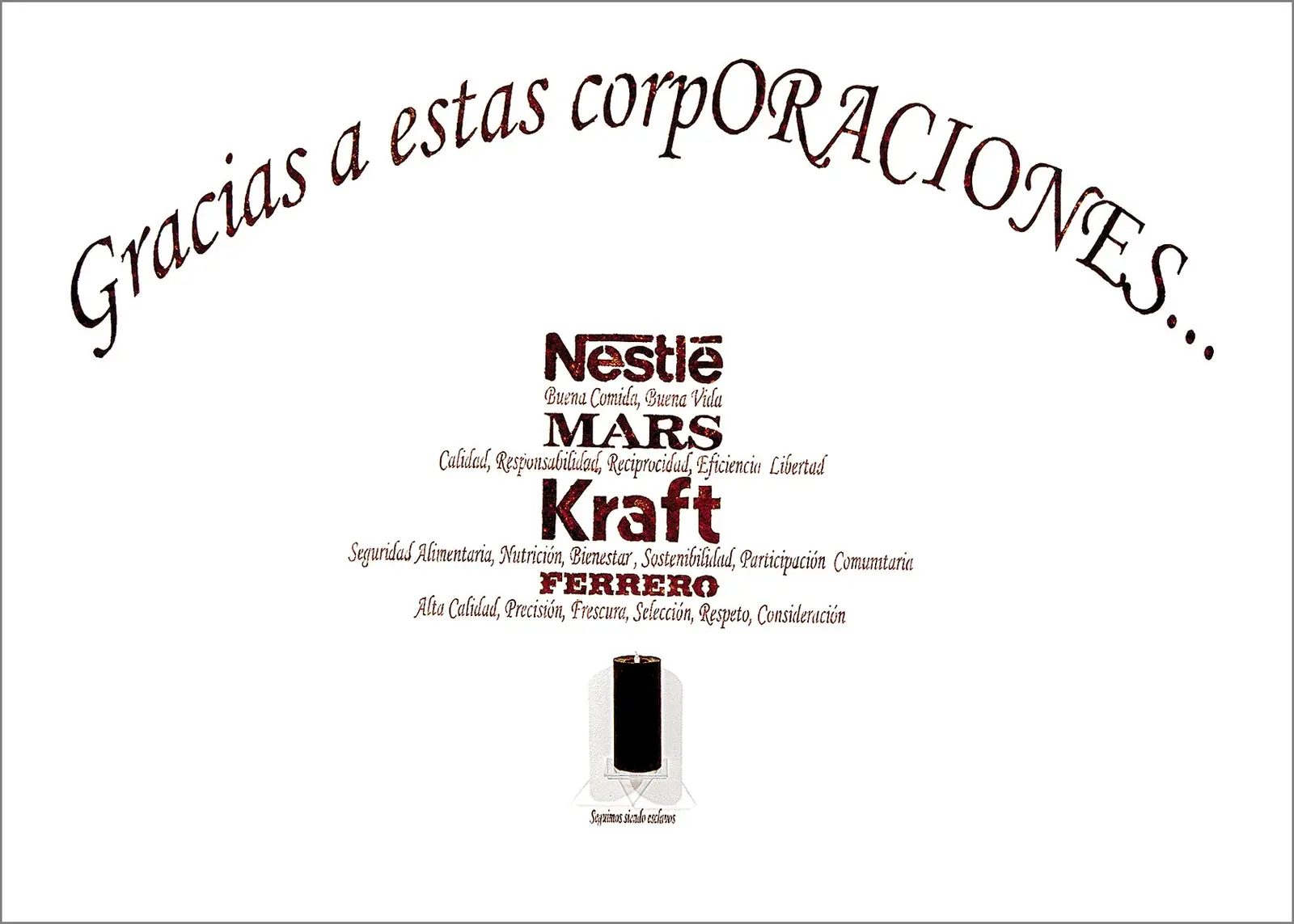
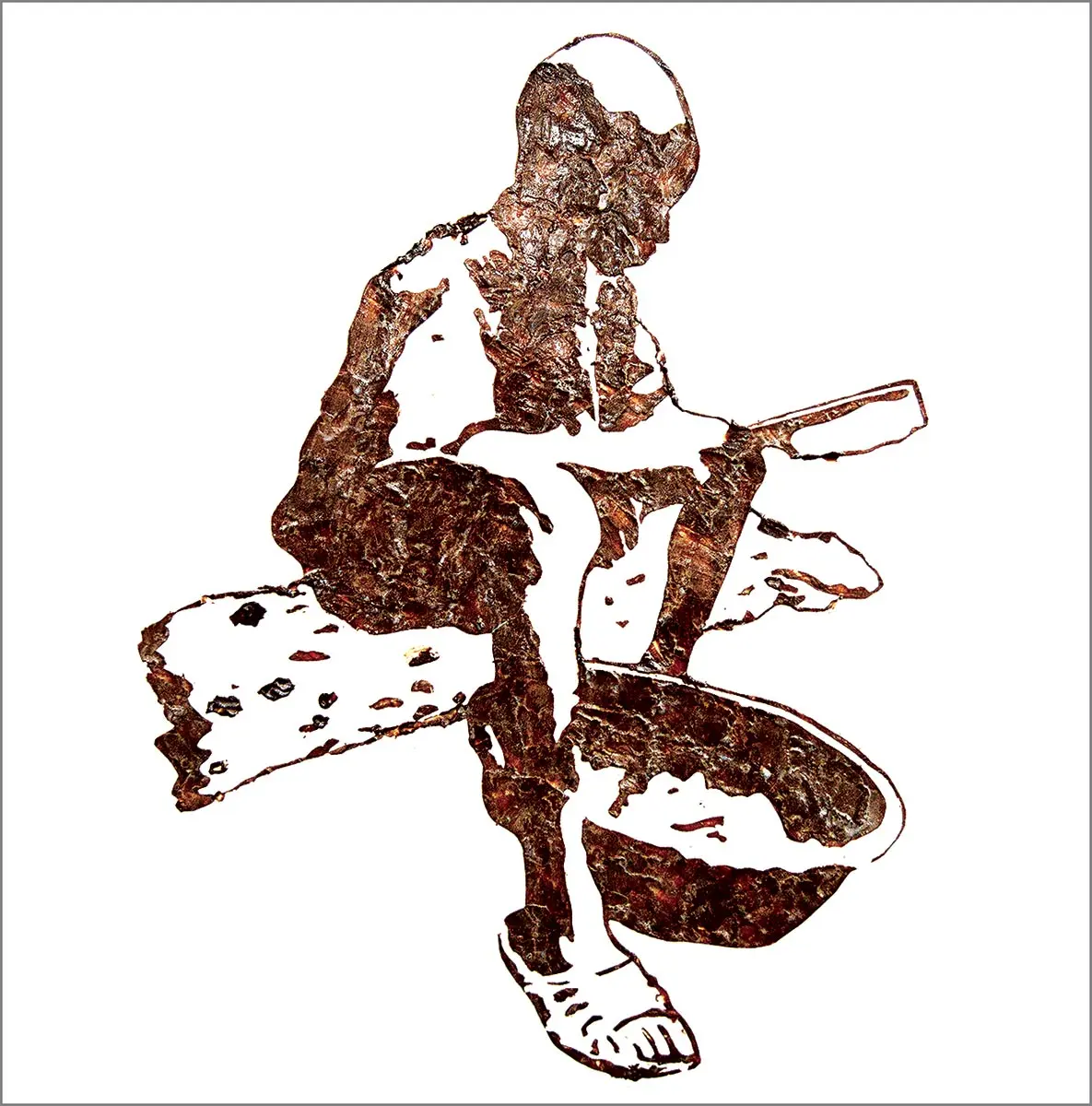
Responsabilidad social (Social Responsibility, 2016) is the title of Fernando Pertuz’s work on exhibit here; in my judgment, Pertuz is one of Colombia’s most significant artists of the last twenty-five years, because of his political commitments. His work is a critique of the perverse kind of altruism brandished by multinationals, which in reality paves over the centuries-old colonial exploitation of the region’s resources. The artist says in this connection: “Social Responsibility is an advertising strategy that many multinationals have deployed in order to cover up environmental disasters, the exploitation of workers, damaging uses of the land, and territorial controls that ultimately are controls over life.” This work occupies an entire wall, and it reproduces, in chocolate, the logo of one of the world’s four major chocolate producers. A thick candle, also in chocolate, waits to be lit up, like a death symbol, while in the lower section we find reproductions of chocolate drawings made by child workers in cocoa plantations. Printed by the artist in the upper section—also in chocolate—is the following phrase: Gracias a estas CorpORACIONES… (“Thanks to these corpORATIONS…”), in a play of words that fuses the concept of a multinational concern with religious prayer (oraciones in Spanish). This work is part of a project titled Oro de las colonias (Gold from the colonies), where “ingots” made from materials such as cocoa, coffee, soil, and others, emphasize the issue of what in the first half of the Twentieth Century José Carlos Mariátegui termed coloniality, which still afflicts us.
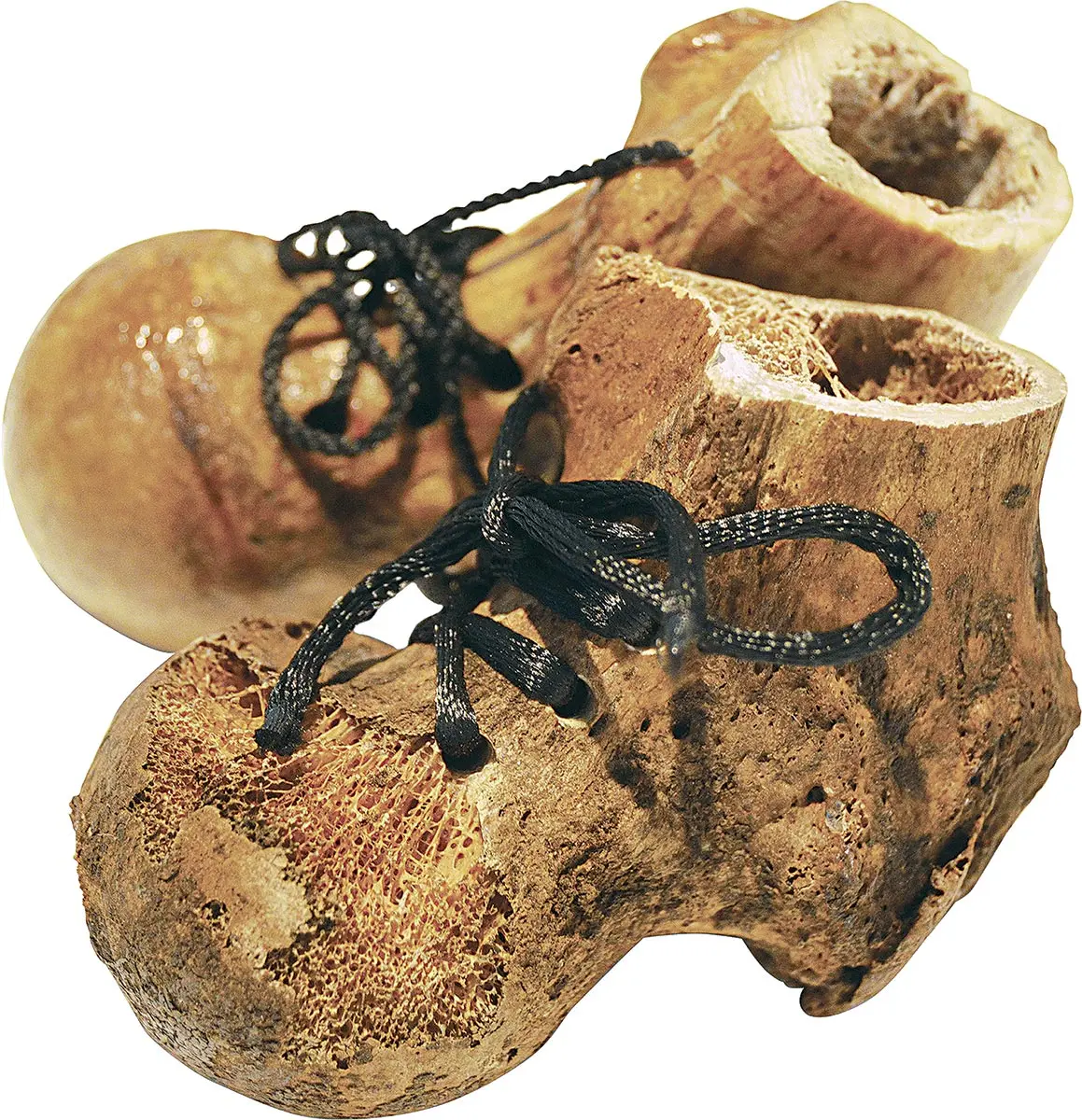
Edison Quiñones is another one of the artists featured in this exhibition, and with his Proyecto Falso O+ Relatos en hechos violentos (False Project O+ Narrative in Violent Events, 2015) and Zapato hecho con fémur humano y otras cositas (Shoe Made with A Human Femur and Other Little Things, 2015-2016) he is able to offer a critical reflection about a phenomenon that has devastated and continues to devastate our country: paramilitary action against civilian populations. In the former, the testimony of a demobilized paramilitary fighter hangs on the wall, detailing his criminal record for the prosecutor’s office in order to receive benefits stipulated in the government’s proposed Peace and Justice Law. It is truly frightening to see this individual, who was a fruit seller in a small town in the Antioquia department, was recruited into the paramilitary Autodefensas as a young boy, under threat of death, and by the age of 13 had already begun to be prepared for military command. Afterward, he traveled across the country, to wherever the presence of the guerrilla forces was strong. The narrative of these events ends a chill down one’s spine: war is truly a terrible thing. As if to countervail this, Quiñones’ second work on exhibit presents human remains that are used to manufacture a flute, a necklace with a rattle, and little baby shoes. A forceful lesson, especially now that the paramilitary organizations have staked a strong position with regards to a possible negotiated solution to the armed and political conflict between the State and the guerrillas. Undoubtedly, because of its rawness, one of the most striking works in this exhibition.
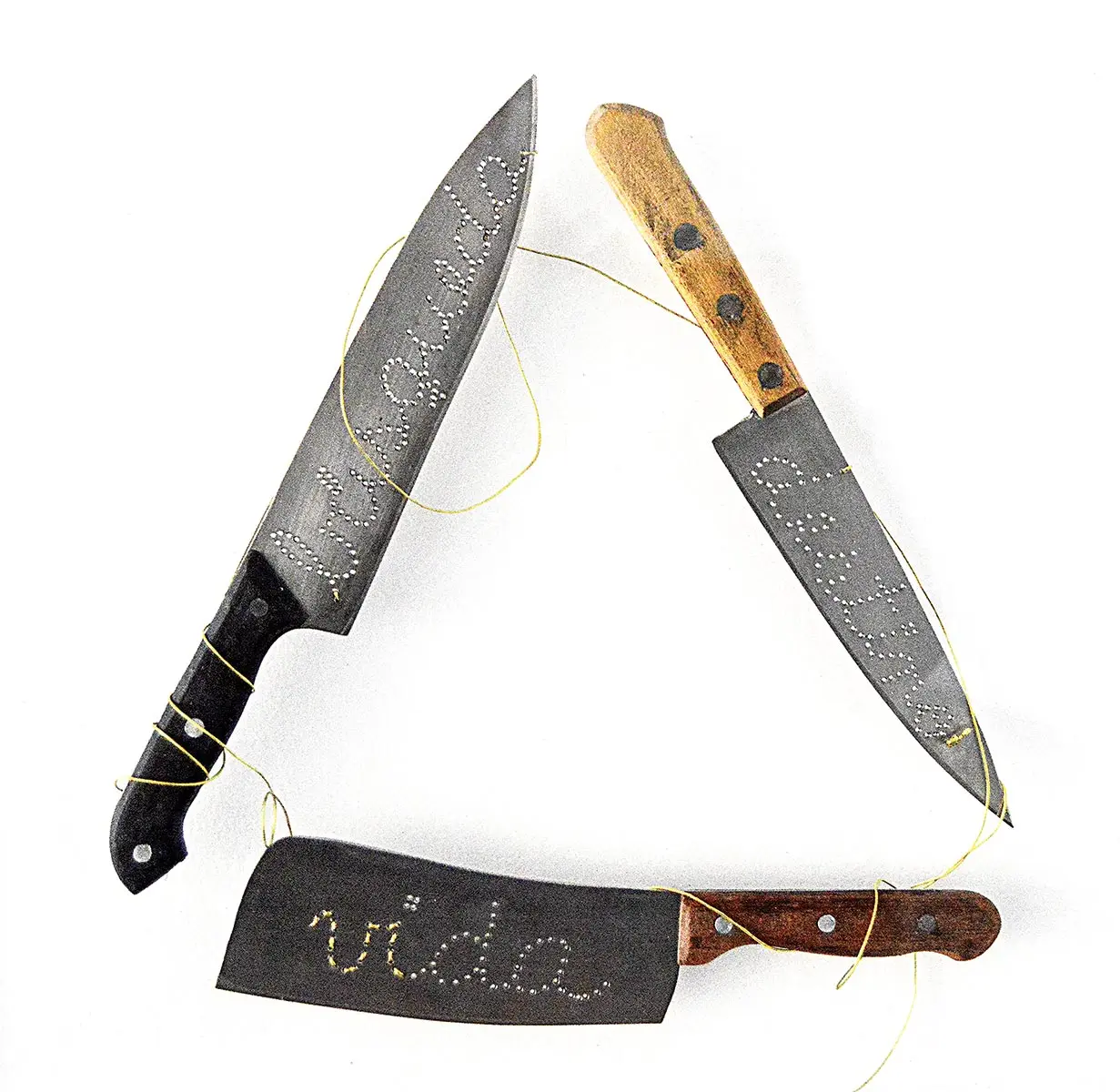
Trilogía (Trilogy, 2014) is the title of the work by Chilean artist Catalina Mena included in this exhibition. Three knives of the kind generally used by butchers are arranged here on the wall in a triangle shape. On each blade, the artist has perforated letters to form the words búsqueda, destino, vida (search, destiny, life). The allusion to the violent killing and forcible disappearance of people is strongly compelling here. A yellow thread connects the three knives and filters through the holes that form the letters v and i in the word vida. This work derives from Mena’s Léxico doméstico, which also features knives with words engraved into their blades, arranged on walls as decorative items or hanging from the ceiling like lamps to generate odd effects of beauty and horror. In these cases, words acquire new meanings and literally become lethal weapons.
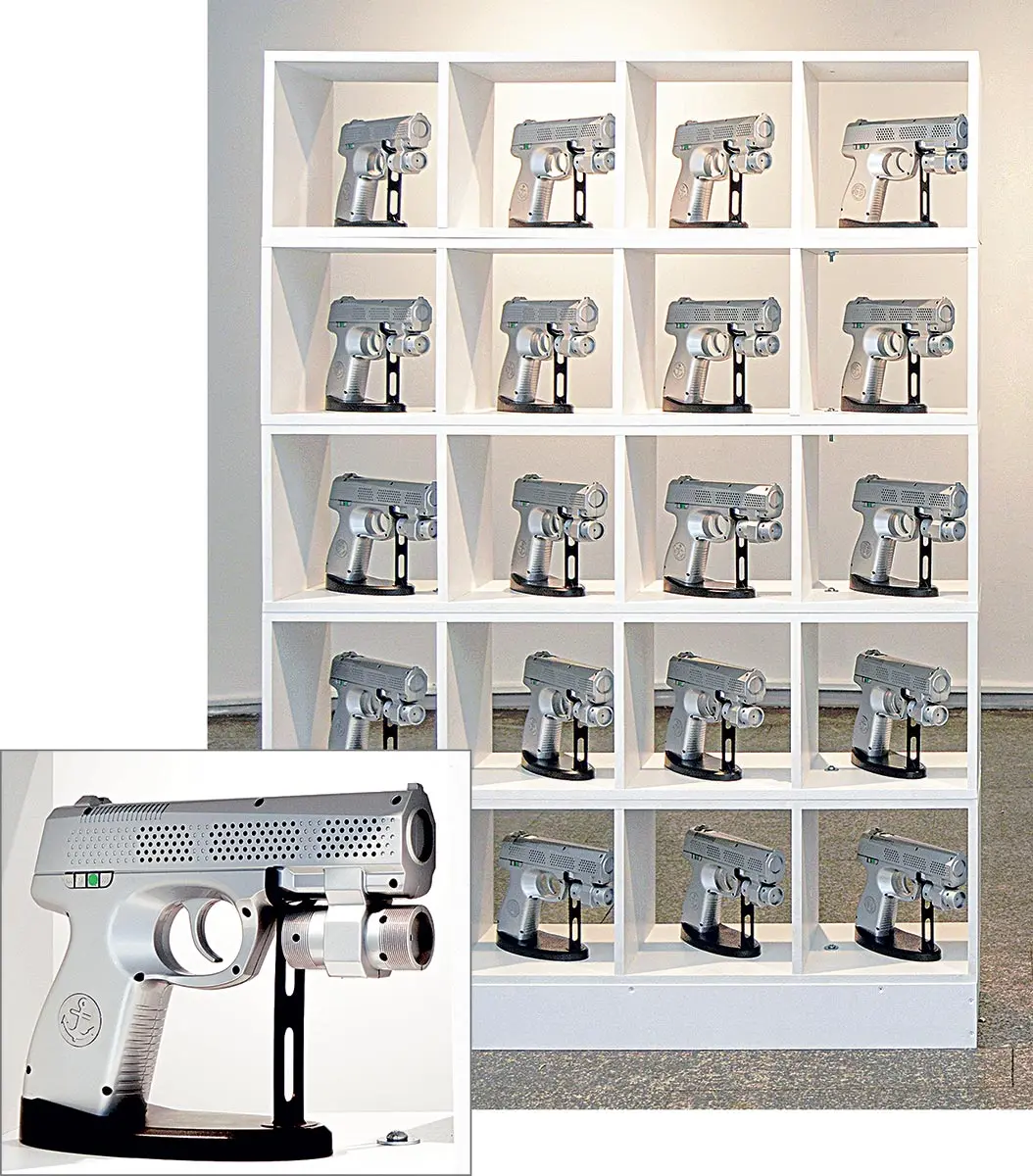
Luz María Sánchez, from Mexico, offers a visual reflection about the problem of organized crime that is ravaging her country. Her V.F(i)n* (2015-2016) is a visual and sound device that, weapon-like, reproduces a series of gun battles recorded by civilians using their camera phones. According to the artist, these unedited recordings are uploaded to the web and fly under the sensors of the criminal band’s own information or propaganda media. Twenty sound recordings are reproduced by twenty guns, with viewers “brandishing” the weapons in order to hear them. A strange relationship thereby evolves as viewers bring the hand to their ear. This sound sculpture opens a door to sensibility, since the sound of gunfire dominates everyday life for a good portion of the country’s population, immersed as Mexico is in a wave of raw violence through which the mafias continue to express their power. The artist tells us that these “gun battles recorded by citizens trapped in the combat between the police and organized crime across the entire territory of Mexico” are a way for her to raise those citizen’s voices, silenced even by the mass media because they are the true victims who find themselves under crossfire.”
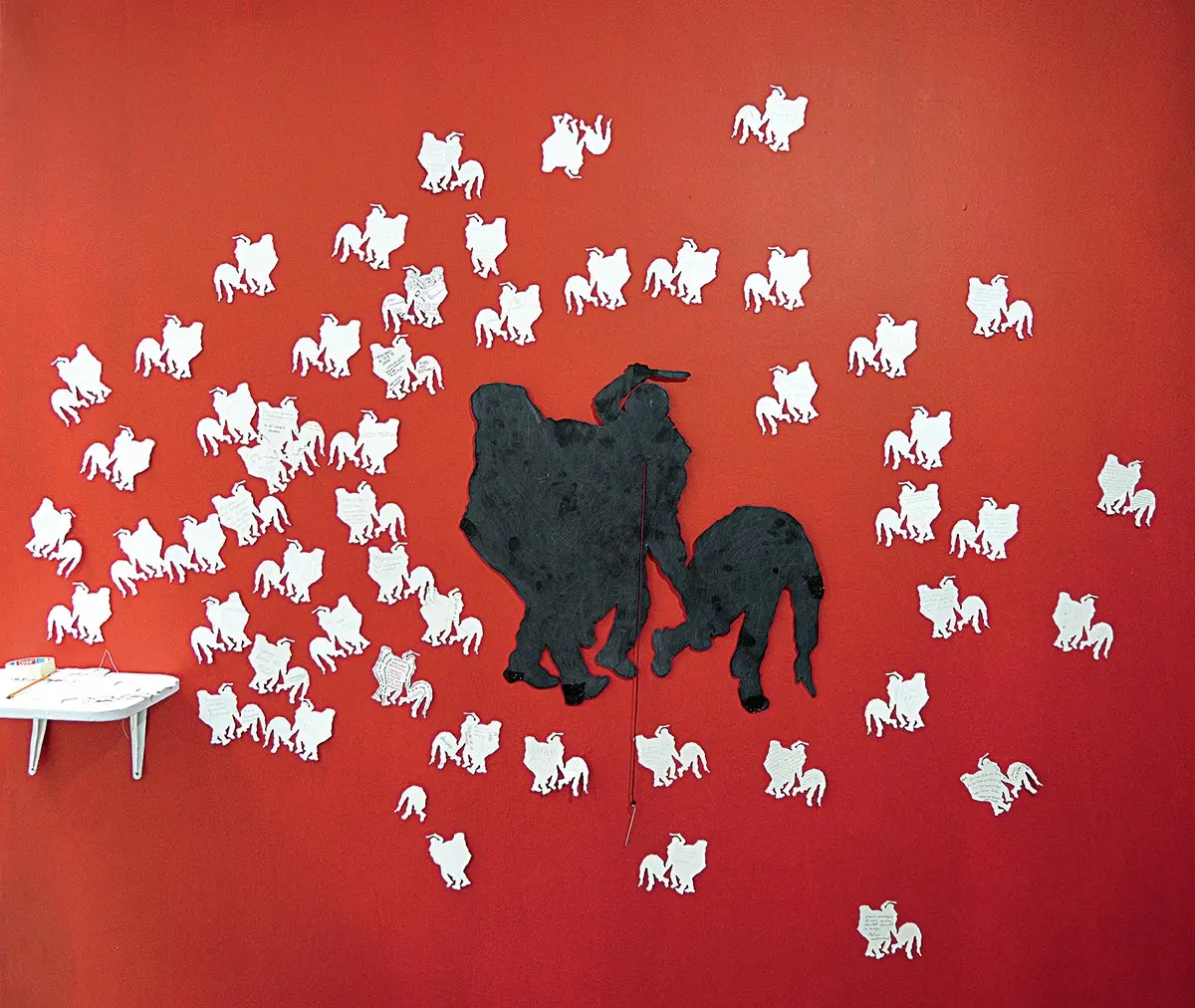
With Está escrito que… (It is written that…, 2015), Chile’s Francisco Peró brings up issues of police violence and repression by the State. A large black silhouette reveals a number of bodies: we can easily recognize the form of policemen hitting a defenseless citizenry with their shields and batons. This is an image we encounter often, and all can recognize it. Like butterflies, another set of paper silhouettes, this time white and much smaller, reproduces the same scene. The idea is for viewers to find the silhouettes on a little table and/or shelf on the red wall that gives support to the entire visual device, and to write on them narratives of violence related to the image. This participatory work is intended to be built gradually, installing a narrative of criticism and protest. It is a simple yet forceful work of art that gives the public a voice.
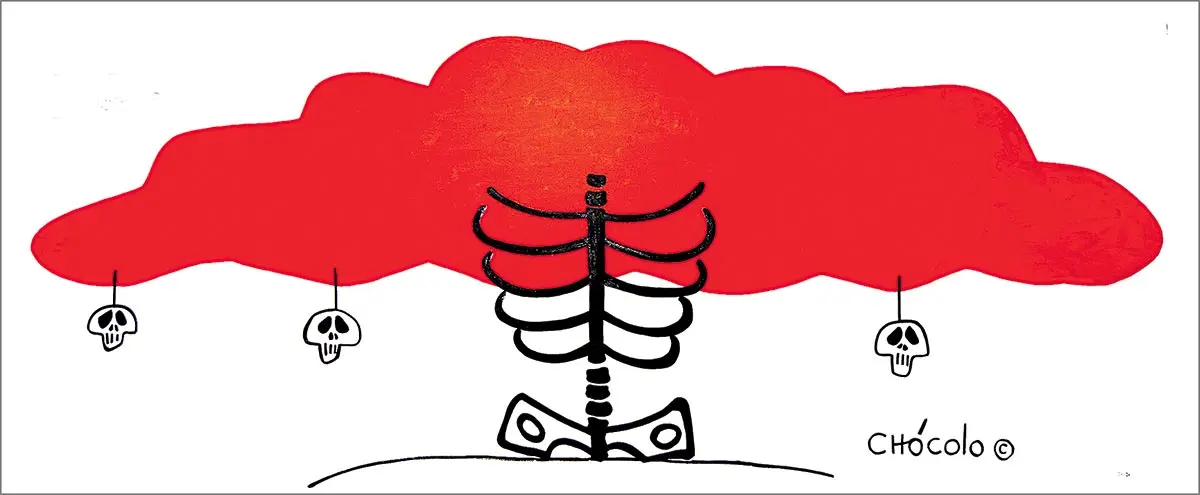
Finally, Chócolo and his wall drawing titled Árbol genealógico de la Violencia (Family Tree of Violence, 2016), features a human spine and its lumbar section as support for a red tree crown on which a number of skulls hang like fruits. In the style of a cartoon, the artist deploys humor and irony to point towards the problem of violence as a tragically genealogical matter. There is nothing to be done, he seems to be suggesting since the tree of wisdom has been exchanged for the tree of death.
In sum, this show accomplished its goal by insisting on non-oblivion, because forgetting is enormously dangerous.
NOTE
1. Juan David Quintero. Extracted from the exhibition flyer.
* Courtesy Museo de Arte Contemporáneo de Bogotá. Photographs: Alejandro Triana.
RICARDO ARCOS-PALMA