
We Shall Prevail has been heralded as the first major solo exhibition by Cuban artist René Francisco in Brazil. This exhibition follows his first two presentations for the Brazilian public, both in Rio de Janeiro. The first, in 2014, consisted of about twenty canvases presented at Casa Daros, a space dedicated to contemporary art. A year later, in that same institution, he participated in a group exhibition centered on an anthology of Cuban art titled Fictions. Now, in this current exhibition curated by Ella Cisneros, Francisco completes the cycle with an ambitious group of works presented at the Galeria Nara Roesler in São Paulo.
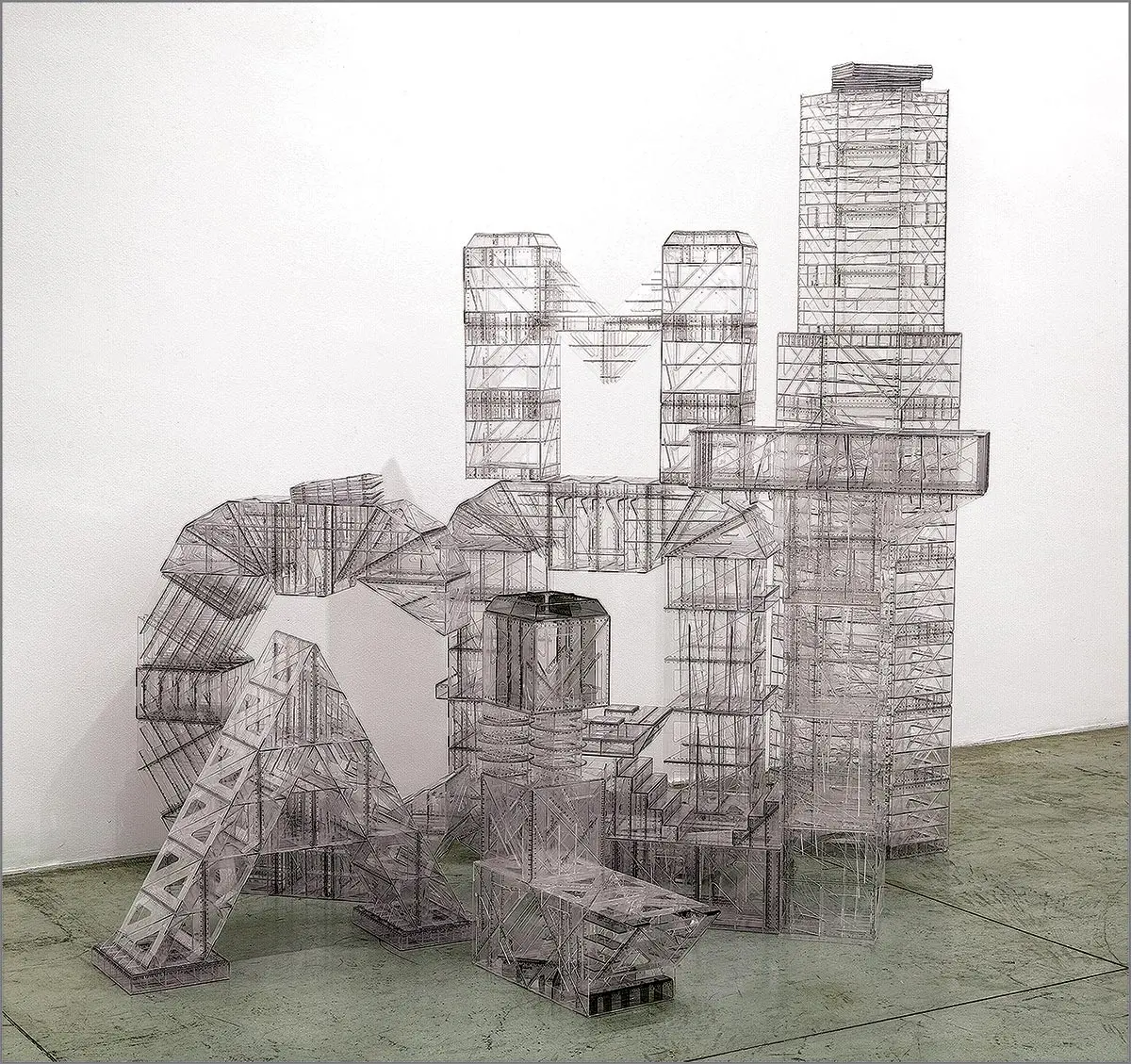
Conceived to include works with a very limited chromatic range of greys, the exhibition countered the predominant Neo-Baroque cultural legacy in Cuban art as a response to the contrasting urban reality in São Paulo, where René Francisco’s work would gradually be divested of the intertext that has flourished in other moments of his artistic career. In the process, he confronted the artistic currents in Brazil that he admittedly used to regard as clichés from afar and looked deep into them through the development of works that returned to the Russian influenced constructivism that he practiced during the 1990s.
At first glance, the exhibition results in a very elaborate, formalist, conceptualism that is nonetheless highly speculative when it comes to subjectivity. Without abandoning figuration, Francisco propagates the anthropomorphic element by individualizing the mob, as he embraces with clever seduction the aesthetic of constructivism and narrative. A scene turned into composition or vice versa, nothing should surprise us since his works in this exhibition are syntheses.
A variety of aesthetic sources and materials form the work of René Francisco. Two large tensioned bodies convey such plurality. They contrast each other and are also combined throughout the exhibition space. On the one hand, there is the series Figures and Backgrounds that depicts individuals as archetypes purposely rendered with tubes. It is important to remember that the first tubes that Francisco incorporated in his work were the containers of oil colors, a symbol that drove his personal trajectory. But then he began using the toothpaste tubes found in every Cuban home and turned them into a parody of that everyday act of pressing and handling them. The meaning of these pieces was heightened by the sexual positions that they staged, as well as by the title of the series Tubosutra (in a reference to Kamasutra). Because this pointed toothpaste tube is almost a national Cuban symbol, his work thus desacralizes art that is at the service of utopic and revolutionary ideas. On the other hand, in the current exhibition, these Figures are expressed through a more intimate vocabulary in which anthropomorphism flirts with Gestalt or with the provocations between abstraction and antithesis.
The other body represented in the exhibition centers on the metaphor of architecture, a theme present in a large part of Francisco’s work. Like in the performance of his pedagogical action titled La Casona (The Manor House, 1993), when he invited a group of students to reconstruct an old colonial building according to the demands of the people that inhabited it. A piece that foreshadowed the path of postmodern art and the molds envisioned by art critic Clement Greenberg: “The painter-sculptor of the future will have to be a carpenter.”1 But in the series The City of Names this metaphor is more a poetic/utopic option. It is important to mention that Cuba—an island that determined its destiny during a period of social uncertainty and where illusory situations are not limited to the art field but also abounds in political and economic situations—became fertile ground for proposals and imaginaries of constructivism.
In one of the installations that are part of The City of Names, oversized letters constructed with measuring instruments invoke a highly sophisticated and minimalist architecture eventually modified by a verb (logos). Another group is formed by pop pointillist paintings and characters in a mob that moves around matchboxes arranged like architectural agglomerates. Without major pretensions, what at first appeared to be a graphic rendition of a standard city is put into question by the flammable nature of the material. The last of these groups centered on the city consists of projects—rather than in architectures—of intertwined urban-like structures in which words-slogans act like support structures or powerful barriers. In this manner, Francisco invokes other solemn aspects found in the history of Cuba, in the same vein as the one that is included in the title of the exhibition We Shall Prevail.
Immersed in the art system like few artists are, René Francisco has become the paradoxical image of the social artist in constant confrontation with the precarious ethics of a failed utopia. His constant inquiries associated with performance and with what he called “From a Pragmatic Pedagogic,” applied at the Instituto Superior de Arte, are added to the fact that his authorship is the simile of a collective being. A collective that is eventually reflected in this artist’s archive as he brings together the possible revisions of knowledge.
NOTE
1. Clement Greenberg quoted by Sandu Darie in a letter from March 26, 1951, addressed to Gyula Kosice.
XENIA BERGMAN