
The anthological exhibition titled Buenos Aires-Paris-Buenos Aires by Roberto Plate (Buenos Aires, 1940) at the Museo Nacional de Bellas Artes (MNBA) surveyed 50 years of a prolific artistic trajectory-based in France since 1970. Curated by Raúl Santana, the exhibition included more than one hundred paintings of different sizes, pieces associated with his work as a scenographer, as well as the recreation of several emblematic conceptual installations from the 1960s.
Plate belongs to a generation of artists that emerged into the public eye from the Centro de Artes Visuales of the Instituto Di Tella (1963-1970) and then had to leave Argentina because of the increasingly repressive environment. Despite the 1966 military coup led by Juan Carlos Onganía and the ensuing intervention of the university, the 1960s decade was a period of important artistic, intellectual and political work. This exhibition “is to some degree a historic reparation. Like many other artists, Plate had to flee Argentina during the 1960s because of political unrest in the country. The same state that made him leave today welcomes him with open arms and recognizes the value of his work,” said Andrés Duprat, the new director of the MNBA, during the inauguration of the exhibition.
The trip from Paris to Buenos Aires begins almost upon entering the museum on the ground floor with the installation titled Los Ascensores (The Elevators), located far from the pavilion of temporal exhibitions in which the rest of the exhibition presented. Observers not familiar with the museum would be in line to go up or walk past the doors of the so-called elevators (which do not go anywhere), believing that these are a part of the architecture of the place and not an installation created by Plate. When first shown in 1967 at the Museo de Arte Moderno in Buenos Aires, it generated all sorts of comments.
Then, the prevalent presence of painting multiplies in the exhibition hall, which includes two sections that showcase an erotically charged series and documents that contextualize Plate’s itinerary and attest to his work in Europe and Argentina through short videos of interviews, records of previous exhibitions, installations, scenographies, and his work in his studio.
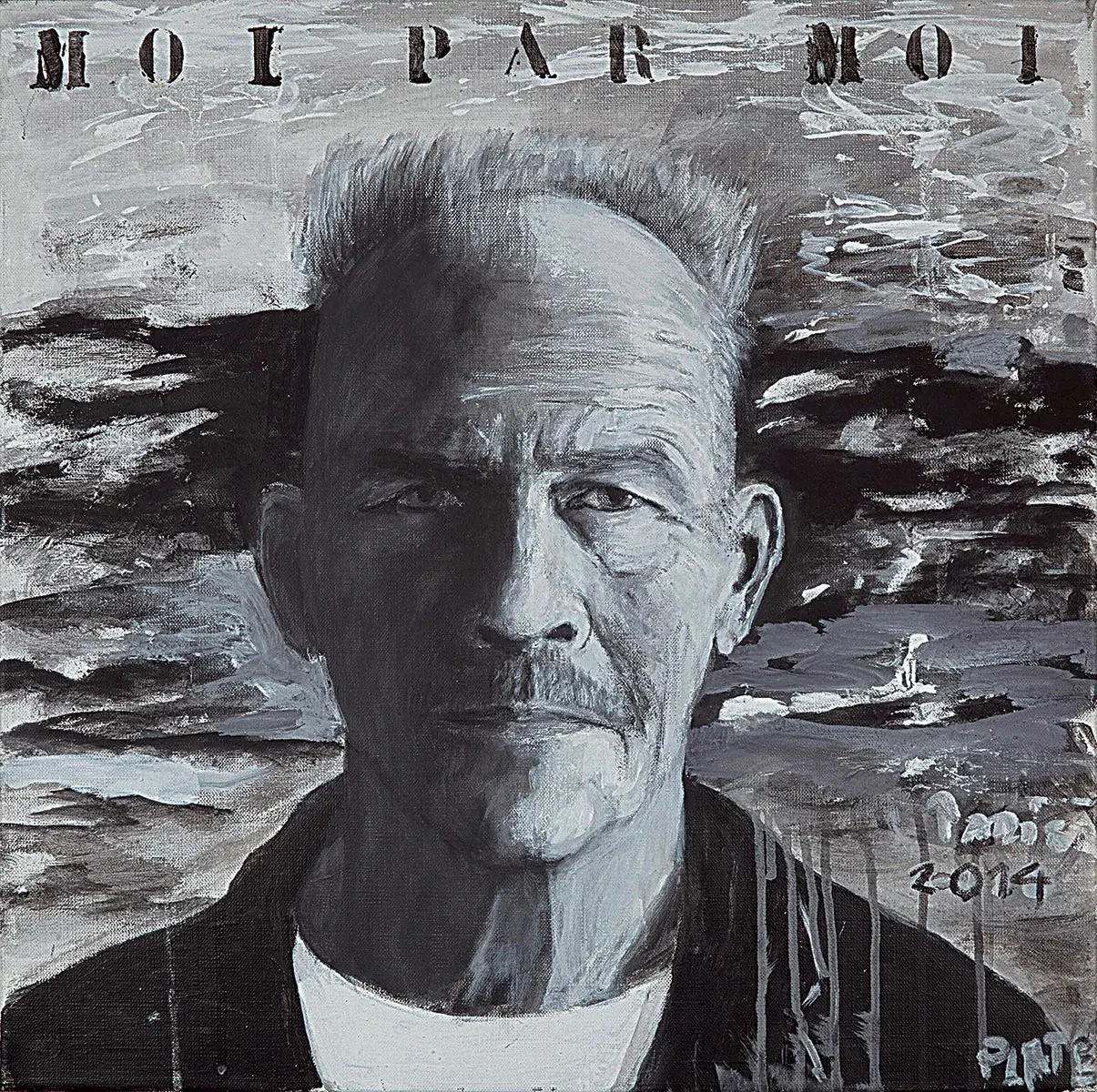
A prominent and persistent painter, as it is well documented in the generous amount of paintings of various sizes, Plate paints without preparatory sketches, and his proposals are self-referential for the most part. His countenance and figure, fragments of his presence, dominate and populate the canvases from different and unusual angles. Some canvases are full of colorful gestures, while others are inhabited by subtle forms. According to Santana, “The visible that surrounds Roberto Plate in his studio in Paris: easels, stretchers, paints, jars, and brushes—that olfactory and retinal world that is so dear to the artist—materials that while recurrent have nonetheless served him well throughout his life as a painter and scenographer to evoke the most different things in the world. They have been a constant point of departure to activate his body, that other grand protagonist that completes the miracle that is his painting.”
The installation titled Reflejos (Reflections) — a new version of the original work of the same name presented in Paris in the 1990s — closes and summarizes his love for the painting profession. It consists of twenty small and vibrant paintings hanging on the walls of an enclosed area that resembles the interior of a brush jar. The paintings are reflected on a pool of water with a dark tonal range that is reminiscent of the liquid left from washing the brushes. At the center, a large brush descends from the top. With this work, viewers get to complete their immersion into Plate’s painting.
However, there is one installation that is responsible for changing Plate’s life. The piece (was it called an installation back in the day?) titled Baños Públicos [Public Restrooms (Instituto Di Tella, 1968)] was banned by the dictatorship and Plate rose to fame as a result. Just as it occurred in Los Ascensores, the mimetic element is central in this piece. Baños Públicos consisted of construction that included doors with the silhouette of a man or a woman, respectively. The doors opened to space with white walls but no restrooms. It was designed so visitors could access it and write something on its interior walls. There were all kinds of phrases written on them, but the politically charged writings were what caused the censorship. Police taped notice of closure signs on the doors and a constant police presence impeded access to the original installation. In the current one, Plate displays a gigantography next to the doors that shows the moment the police closed down the installation. In response to the censorship, the other artists participating in the original exhibition removed their works and destroyed them in front of the Instituto Di Tella located on Florida street.
A multidisciplinary artist, Plate acted in risky happenings and theatre plays developed at the Instituto Di Tella by a group of artists. He was also friends with Alfredo (Rodríguez) Arias. After leaving Argentina, Plate entered the TSE theatre group and became a prominent scenographer. The exhibition is complemented with a profusely illustrated hardcover catalog that includes writings by curator Raúl Santana, Marguerite Duras, and Carlos Espartaco.
VICTORIA VERLICHAK