
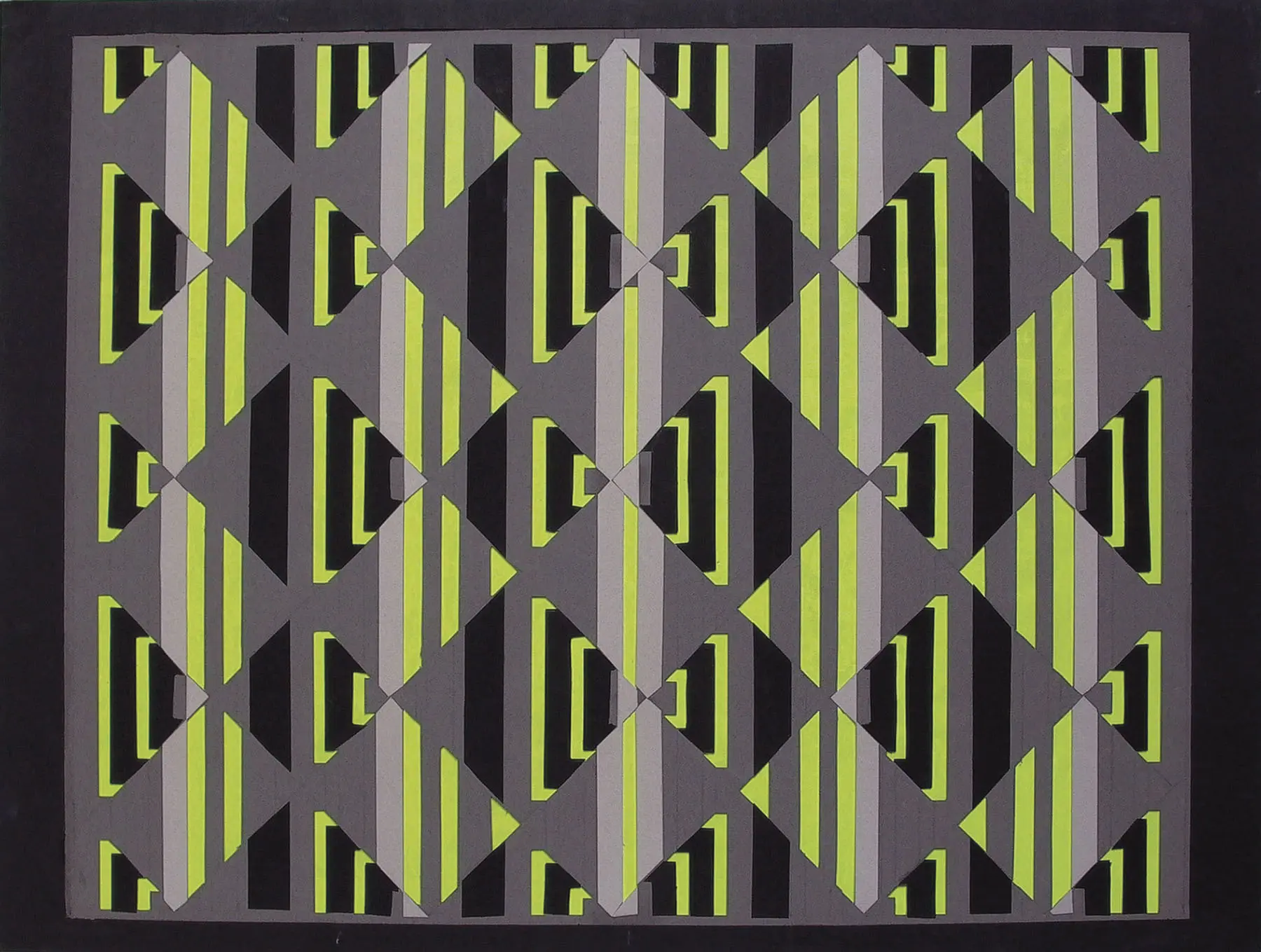
In the noisy silence of the hospital floor, resting in her room surrounded by electronic devices with their prophetic lights, small luminous signs announcing whether she is alive or nearing death. Before closing the door, the nurse turns the light off. Pérez, Matilde, falls into a deep sleep.
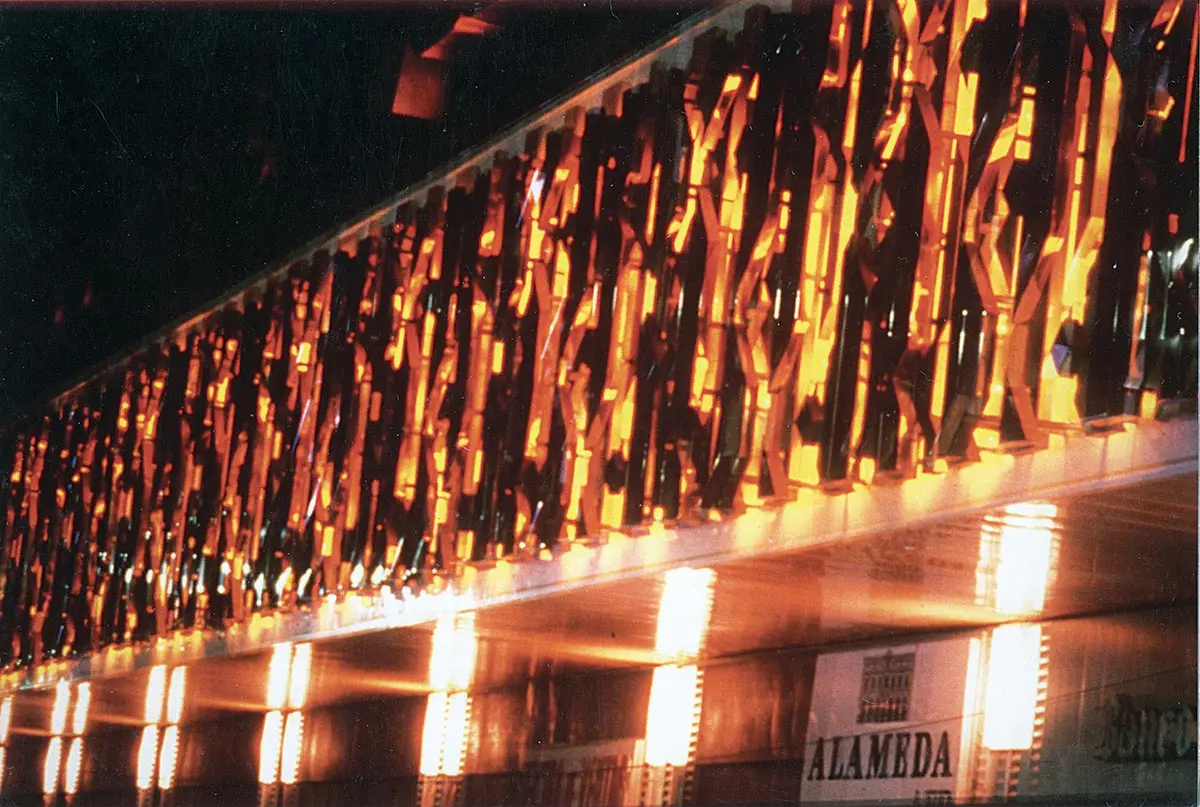
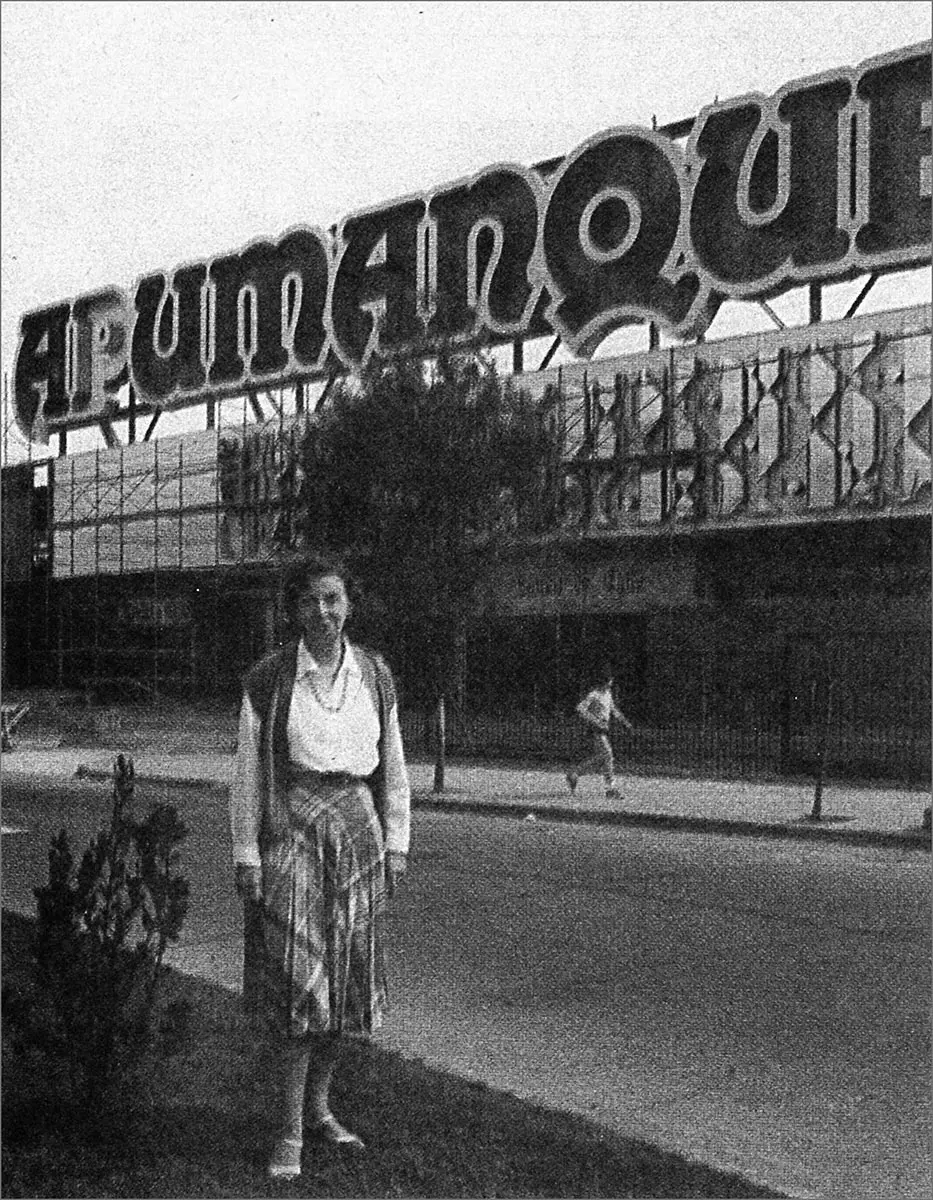
1982: the renowned, and by then veteran, artist Matilde Pérez, in front of her most ambitious work to date: the great frieze for Cosmocentro Apumanque. A mural composed of steel, a metallic band of schematic shapes, a geometric design that generates motion, a dynamic sensation, from its own stasis: it is kinetic art, of which she is a pioneer in her country, Chile. The Municipality of Las Condes, which managed the space, decided to charge for the use of Pérez’s work as an advertising billboard (for that reason, no light mechanism could be used in it, despite its having been conceived for the use of lights). The frieze in the commercial mall measures 350 x 70 centimeters, and a reduced number of viewers approaching from Manquehue Avenue remain doubtful behind Pérez, who forcefully closes her eyes and contracts her face in rage. Not again. The circuit won’t turn on. Just like in '61. Not again, not ‘61: Matilde Pérez returns to Chile after her stay in France with a government fellowship. Filled with energy, ideas, and sketches, she begins a solitary effort at Universidad de Chile. She presents, in the Fine Arts Salon, one work of art that synthesizes the knowledge acquired in Europe. It is a work of kinetic art with a light system… which, due to technical problems in the building, will not turn on.
Patient Matilde Pérez remains in the hospital, in the embrace of a sticky sleep, while a number of journalists in their metallic offices start with the mandatory copy & paste for such occasions. Pérez began her education as an artist in 1938, studying independently with Pedro Reszka. A year later she was admitted to the Escuela de Bellas Artes, where she had Pablo Burchard and Jorge Caballero among her professors. But her destiny was not connected to the traditional academic teachings of Chile’s schools. In 1944 she decided to study muralism with Laureano Guevara (who she assisted in the creation of murals in the La Cisterna commune in Santiago).
Since the late 1940s, Matilde Pérez began a dedicated and lifelong relationship with teaching. In 1948 she worked as a Drawing Teacher at the Dunalstair school, and in 1950 she established the Providencia Arts Academy. Her career in the politics-ridden Universidad de Chile was marked by the rejection of a large portion of the faculty, already since her beginnings as an assistant in the Painting and Drawing course at the Escuela de Bellas Artes (1951). This was due to her political opinions, which contrasted with the dominant leftism at Universidad de Chile, and to her artistic practice, which evolved into geometric abstraction against the informalism that dominated the scene.
The Rectángulo group (later Forma y Espacio) was formed in 1955 and included Gustavo Poblete, Ramón Vergara-Grez, Elsa Bolívar, and Uwe Grumann. Matilde Pérez joined the collective, which developed the main (better yet, sole) advances in geometric art in Chile, against the figurative tradition. They will be the country’s representatives in the early editions of the São Paulo Biennial. Matilde Pérez, however, was not to remain with them for long: she left the group because Ramón Vergara-Grez rejected anything that wasn’t oil painting, while she believed that “one can make paintings without paint.” Her works, using industrial materials such as metal, some accompanied by electronic systems and lights; her manipulation of color; her verticals and circles; all simulate motion and generate a dynamic sensation while taking into account the context in which they are displayed.
These premises motivated Pérez to seek sponsorship from the French government to complete her studies in Europe. In 1960 she traveled to Paris, where she met Hungarian artist Victor Vasarely. His teachings were not limited to the Yellow Manifest; this is to say they did not remain in the theoretical terrain but moved also to the creative arena: notions of form and color; innovations in kinetic art. Matilde Pérez wanted to extend her stay in Paris, and to that end, Vasarely commissioned her 20 works, which she finished in two days, on paper. But her husband, the academic draftsman and painter Gustavo Carrasco demanded her return to Chile, for him and their son. Upon her return to Chile, the artist intended to activate a collaboration agreement between the Art School and Vasarely but was unsuccessful.
Pérez was patient. She remained in Chile and sustained contacts with colleagues installed in countries more favorable for avant-garde initiatives in kinetic and optical art, like Julio Le Parc from Argentina and Carlos Cruz Diez in Venezuela. In Chile, not only were almost no funds for this type of art (so that any work that included any kind of technology, even a basic electric circuit, has little future) but any work of art that distance itself from informalism was seen as alien. Despite all that, Pérez continued to develop and expand her investigations in optics, connected to a precise mathematical rigor. Many failed to understand her proposal and thought it boring, unconnected to reality, and dehumanized; for Pérez, her work was “a mental relationship with nature.” Once again, political motivations were behind a new defenestration driven by the most political sectors of the art world, committed to the Allende government and to the opposition during the Pinochet dictatorship. Matilde Pérez remained in Chile, with the exception of another period in Paris between 1970 and 1972, when she was commissioned by Universidad de Chile to continue her investigations and studies in kinetic art.
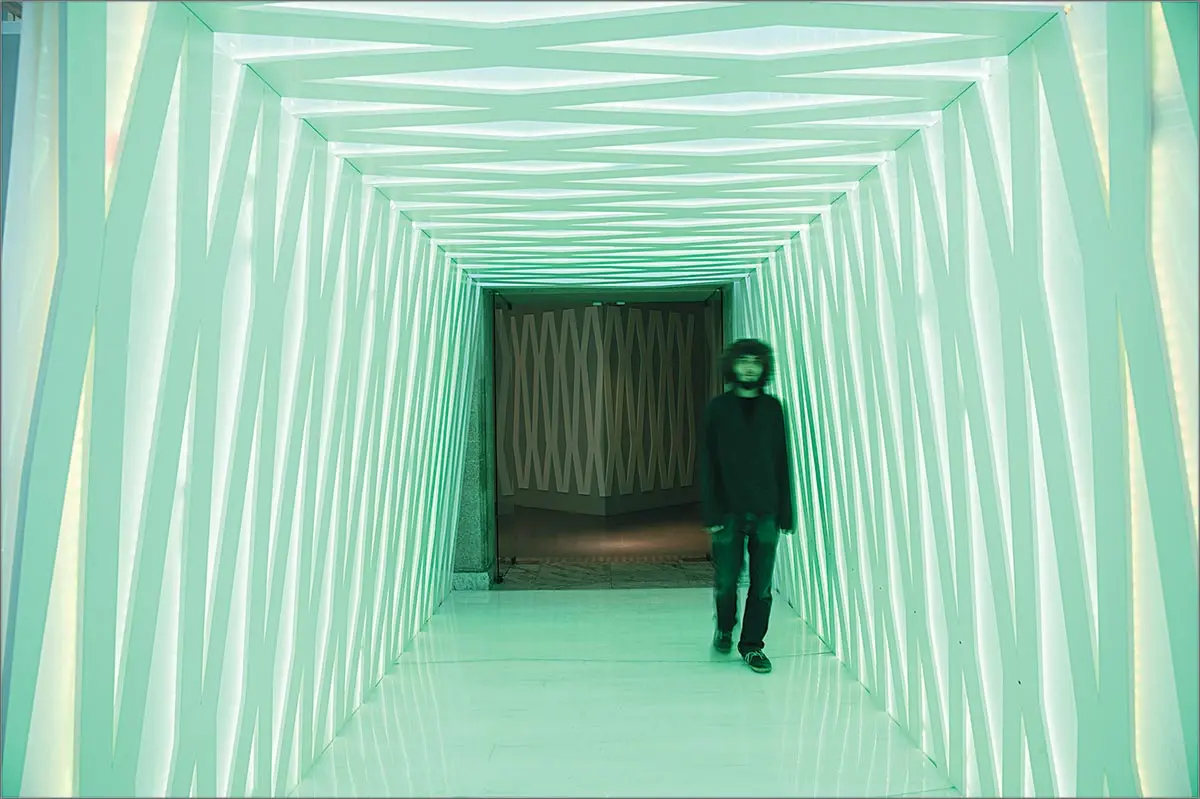
Another frustrated initiative was the creation of the Center for Kinetic Research at Universidad de Chile’s school of design (the year she produced another one of her emblematic works, Cruz del Sur, 1975). Soon after establishing the innovative department, Pérez was fired from the university. Already past 50 by then, the artist continued to produce works on commission and in a variety of formats: painting, printmaking, sculpture, metal installations, public art, etc. Public recognition, however, was slow in coming. It was not until 1999 that the first retrospective of her work took place, at the Museo de Bellas Artes (she was in her 80s by then). Outside Chile, however, her work was valued and recognized as pioneering in Latin American kinetic art, as exemplified in her inclusion in the Cinético(s) show at Museo Reina Sofía (Spain) in 2007. Pérez’s most complete career-spanning exhibition was held in 2013: Matilde x Matilde: Espacio Móvil. This is what the artist commented on the event: “Several years have passed and the idea of promoting my exhibitions has not been lost. That is nice and I am thankful. I made this work because I was not born to tell half stories. Today I think I have the obligation to respond to an audience who has been watching me and waiting. If it weren’t for them, I wouldn’t know what I have done.” Among the works exhibited in this retrospective, Pérez’s last, were her Túnel cinético and the frieze she made for the Apumanque center in 1982, which had been dismantled in 2007 and, after the show, moved to its final location at Universidad de Talca.
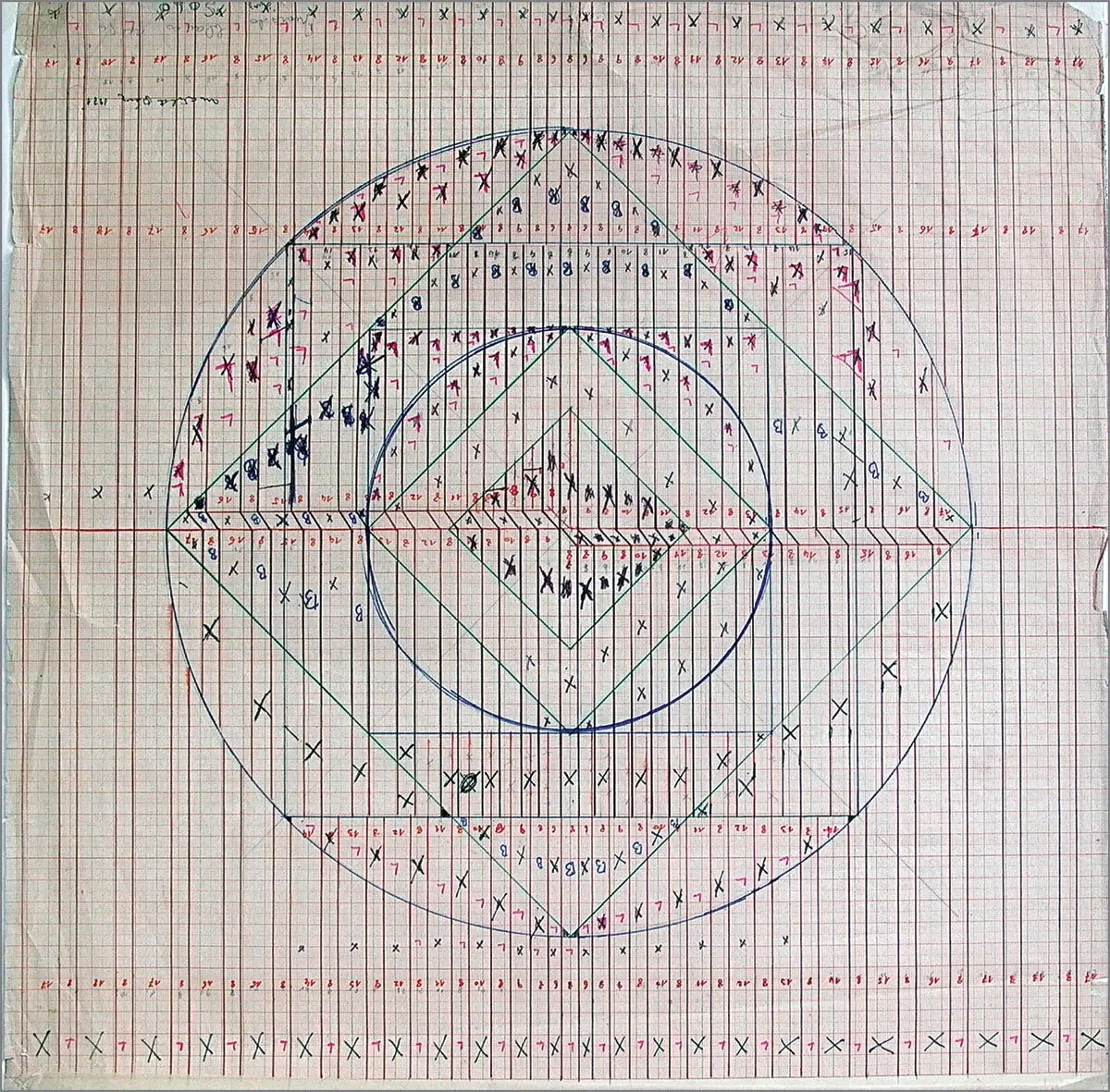
Ramón Castillo was the curator of Matilde x Matilde: Espacio Móvil. This is how he defines his collaboration with the nonagenarian but still active artist (among other things, the distribution plan and the trajectory were decided by Pérez herself): “It was a great opportunity to gain more information about emblematic works like Cruz del Sur (1975) and Túnel cinético (1970). In other words, Matilde was very concrete and made her ideas known inasmuch as one was in the same material and technical wavelength. Cruz del Sur and the Túnel were highly complex technical and required a long time for reflection, analysis, and electronic combinations. Pérez was well versed in electronics; there are several sketches where she works noting the negative or positive charge of the light circuit. She worked with sequencers and network circuits. In the exhibition, we saw that constructive and technical side, which Matilde never made explicit if it wasn’t necessary.” The exhibition served as a settling of accounts; it shed light on her great achievements, established her as an artist ahead of her time during the first half of the twentieth century, and associated her figure with initiatives like a competition for technological art by young artists.
There is still much work to be done regarding a controversial figure who was given scant recognition by her peers, except in that last exhibition. Her candidacy for the National Arts Award was presented up to six times, but she never got it. “I function for whoever wants to know me. Those who don’t, it’s fine. I have no responsibilities with anyone. I have never worried about being recognized in Chile,” the artist said, Curator Ramón Castillo explains this anomaly: “She was not valued in Chile, she wasn’t listened to, she was not studied or taken into account because the depth of the country’s intellectual life is very low. There were no collectors, no critics, no artists studying and promoting her uniqueness. Several people have told me, ‘Matilde should have remained in France’… and it is true. We talked about it more than once, but she trusted that things would change. Matilde chose well, but the country was mistaken about her, it did not rise up to the challenge. There was no policy to protect her oeuvre and it is not safeguarded in museums. Had she been in Venezuela, Colombia, Argentina, or Brazil, we would have buildings or public murals. In England, she would have been a Louise Bourgeois. Instead, the sole kinetic mural we had at Apumanque was violently torn down, which revealed the ignorance and shortsightedness of the proprietors, architects, and professionals involved, and the indifference of the citizenry. Matilde died without there being any documents or special reports… such are “the wages of Chile.” We were late, or she was too much ahead of us.”
Political factors were determinant in the scant consideration she received on the part of a broad sector of public opinion and art professionals in Chile. Despite the fact that, as curator Osbel Suárez notes, “the rigor and transcendence of her work is an exercise that should be made without contamination from any other realms.” She suffered rejection by leftist artists, like José Balmes, who in an interview told this story: “Pérez’s husband was an angel putting up with her and she was a dead soul. Suddenly she met Vasarely in Europe and went crazy. I find her a mediocre artist (…) totally overblown. It is false that she was a pioneer in kinetic art, Gustavo Poblete came first. She just peels cables now, no more.” For Osbel Suárez, “Matilde’s adventure, her conviction in being part of an artistic event of a new order, condemns her to incomprehension, reduces knowledge of her work to just a few people, encloses her excessively in her studio, but at the same time makes her an essential figure to understand Chile’s dislocated, slightly out-of-phase, yet deeply necessary modernity.” And according to Ramón Castillo, “her low profile and attitude of constant investigation and studio work, made her work a form of political resistance and a response to the bullying by Universidad de Chile artists who insisted on ‘a committed art for the masses.’” From Vergara-Grez to Balmes, she was resented and cast out, as though her creative independence or her “solitary militancy” for an aesthetic that was undervalued because it lacked literal or literary meanings, could not be tolerated.
However, and with the independence of political opinions in a tumultuous Chile, Matilde Pérez’s contributions in the arts cannot be denied. Curator and theorist Justo Pastor Mellado puts it this way: “Her figure is unique, anomalous, secret, and singular. This is why I think there was no critical attention to her work before now. She was a solitary, low profile artist. Yet she was able, without doing much, to focus critical attention. She was responsible for forcing us to read her, to try to understand her art.” The relevance of Matilde Pérez’s artistic practice connects her name to that of Carlos Cruz Diez, Jesús Soto, Julio Le Parc, and Morellet. The mutual influences are so striking that, for some, Pérez’s works are not so much unique, but a Latin American translation of a European style. To that respect, Ramón Castillo explains: “She remembered, for example, how they made, on commission, black squares measuring two centimeters by two centimeters, and then had to organize them on a white plane. Later one sees works by those artists from the 1960s and 1970s, and the identity is found in the variations on the same motif. The question was not to repeat a formula, but to develop a formula of her own, mathematically and technically. This is to say, Matilde was not a translator nor a reproducer of models; she developed her own meter and aesthetics.” Curator Osbel Suárez, who specializes in concrete and geometric art, says that “every artist ‘translates’ influences. Doing it is not optional. These ‘digestions’, if they are considered and respond to an in-depth study of the sources, suggest new avenues for exploration.”
Ignoring all these comments, premortem appraisals, and disputes, Matilde Pérez remained in her long sleep in her hospital bed. Asleep from which she never woke up. The artist died as a consequence of respiratory and cardiac arrest. The lights on the devices around her turned off on October 1, 2014.
JUAN JOSÉ SANTOS
Art critic and curator, professor at the Universidad Diego Portales and Uniacc.