
Túlio Pinto presents the exhibition titled Blue and Unicorn at the Galería Baró in São Paulo that consists of a selection of his most recent works, some specially created for the show. Pinto is known for harmonizing his sculptures through counterpoising tension and equilibrium, relying on materials apparently that are apparently very dissimilar in terms of weight, resistance, volume, and even origin. Pinto acts as a magician who challenges the laws of gravity and places the attraction between different bodies in apparently improbable situations in the foreground. Relying on glass balls, stainless steel, a blue cord, and the outlines rendered by their borders, he conveys the delicate interaction between different elements.
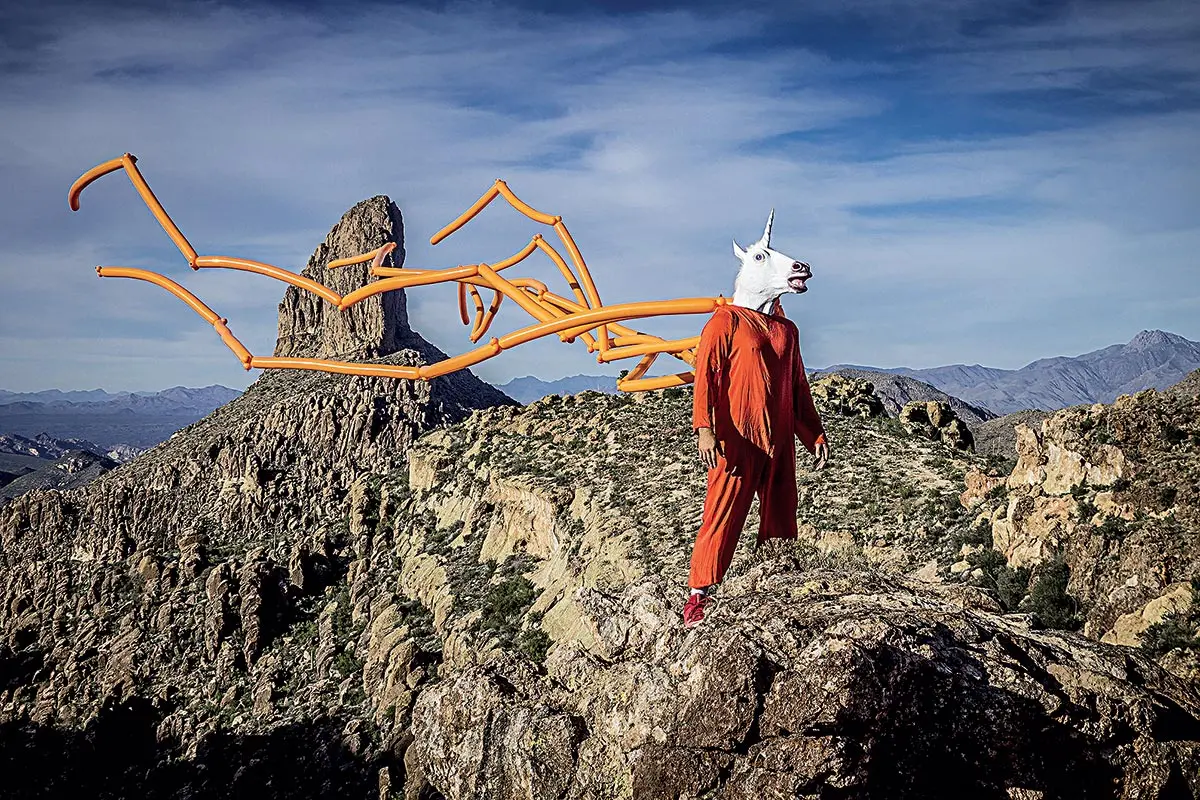
The video installation titled Unicornio (Unicorn) dialogs with the staged sculptures. The video was created by Pinto during the seven-week period of his artist residency in the grand desert metropolis of Phoenix (Arizona) in November and December of 2015. The video was conceived before he began the residency. In his luggage, he carried inflatable pumps and orange clothes. Once in Phoenix, he complimented the production by acquiring a unicorn mask and by seeking the collaboration of local artists in the creation of the video. The recording took place in the desert of the Superstition Mountains located to the east of Phoenix; with the unicorn anchored to the balloons, it offers an almost absurd, surrealist, visual juxtaposition. The video installation activates the same sensorial operation pursued by Pinto in other works (tension and harmony). The carnivalesque elements draw viewers into a walk through a fourth dimension in which mythology leads to the perception of an altered state, where the surreal becomes real, impossible encounters are established in a sort of interval, a bridge towards the imaginary space of immanence. Pinto materializes another reality from the character wearing a unicorn mask, amid an unwelcoming environment harmonized with the strong and contrasting tones of orange and blue.
The appropriation and carnavalization based on the mythological unicorn demonstrate Pinto’s immersion into a realm without rules or investments. According to Russian philosopher Mikhail Bakhtin, carnavalization is a performance without a stage, the element that separates the public from the actors, a new way of human interaction as opposed to any socio-hierarchical relationships. At a carnival, man becomes free from regulated behavior and moves towards emancipation. The character chosen by Pinto, the unicorn, is a symbol of purity, honesty, and freedom who nonetheless manages to preserve its wild and indomitable nature. The color blue embodies purity and protection from the ethereal. It is in this vein that Pinto creates a sensorial dialog that harmonizes with the notion of that which is different, breaks with hierarchies, subverts rules, and proposes a magical space in which the deepest and most emotional forces are imposed on nature and social relations.
More than merely subversion, the investment made by Pinto—who challenges reality, nature, and even the laws of gravity that pulls bodies towards the center of the Earth—searches for an instance of levitation, of movement that overcomes the laws of nature, conquers the inexorable, projects, flies and transcends; bring opposites together and generates dialogs among them.
The exhibition consists of six sculptures structured by minimalist precepts from the mid-twentieth century: using prefabricated materials not marked by the artist’s hand, and producing works that interact with space. Pinto maximizes the physical properties of the materials. Free from traditional supports, his work is projected onto the space of viewers and establishes an interactive relationship with them, allowing them to move freely around the object. Tensions and uneasiness usually ensue once viewers come to the realization of the piece’s potential collapse as a result of the combination of materials, some as strong as steel and others as fragile as blown glass. Unlike the minimalists and post-minimalists, Túlio Pinto addresses contemporary art themes relating to tension and harmony, and the power of the human mind, its choices, and movements, whether these are physical, mental, or emotional. His construct serves an order in which anything is possible, where it is possible to dialog and coexist without impediments. Pinto offers powerful works that overcome intolerance in search of a utopia.
HÉLCIO MAGALHÃES