
Despite being the result of inquiries into everyday themes, eccentricity dominates the artistic production of Ecuadorian Wilson Paccha. He completed a degree from the Art Department of the Universidad Central in Quito, his hometown and where he has developed a great part of his work. Paccha is one of those artists that can “hook” us once we enter the psychedelic universe that emanates from his paintings, artifacts, assemblages, sculptural objects, and installations. The subjectivity that they elicit comes from the diaphanous and marginal creole humor that inhabits them. Anyone who stops to observe his works is susceptible to break into laughter, even involuntarily. Lately, he has been very present in the artistic scene of Ecuador and his last exhibition titled Wild Caprices, presented at the DPM Gallery in Guayaquil focuses on the themes that interest him.
He makes fun of the educational world in the Ecuadorian artist field and of certain models self-defined as exceptional. Likewise, Paccha also takes on soccer fans or the paroxysmal anxiousness of young people in the social networks.
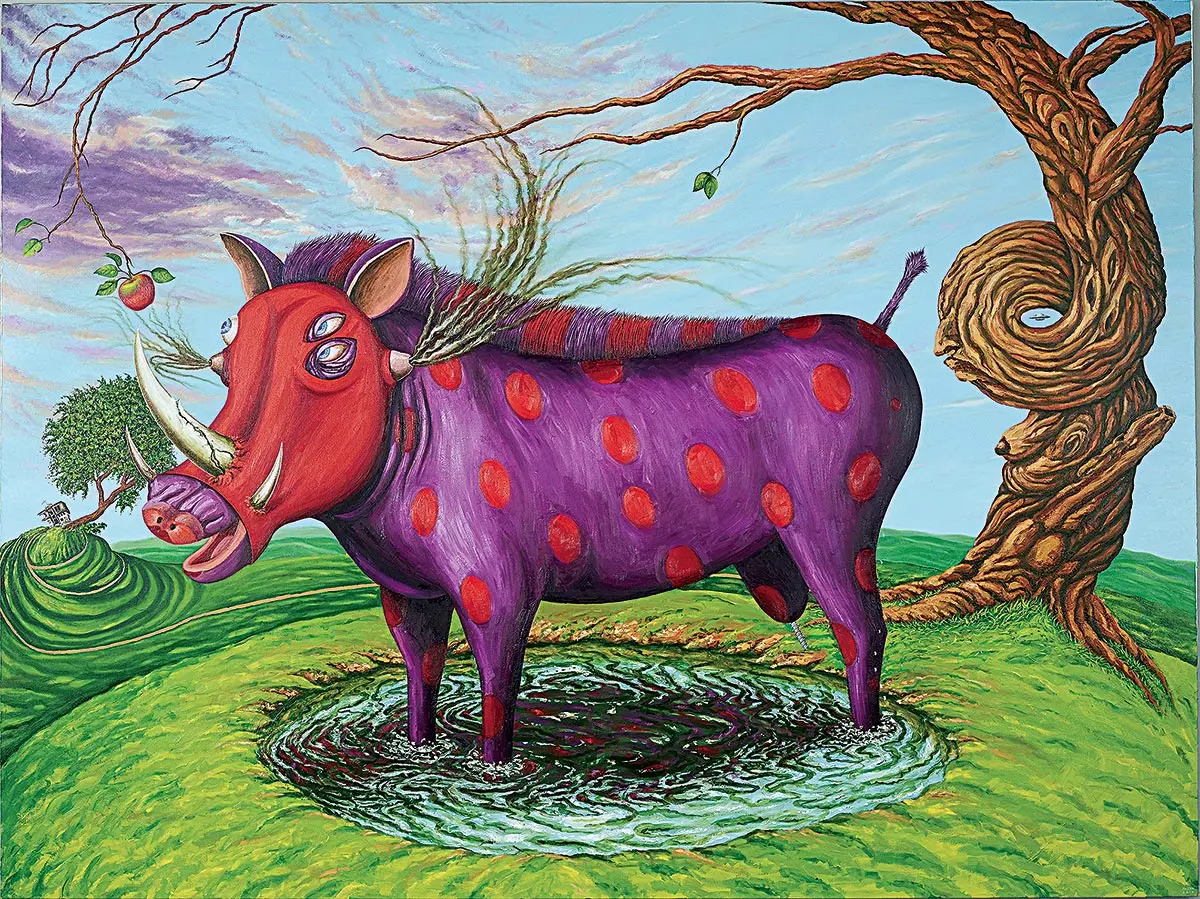
In his production, which has occasionally been performative in nature, he takes advantage of any material or event to build a game, to construct a metaphor, a critical inquiry framed by a sharp gaze. In the piece titled Eva y la Casa del Chapo (Eva and the House of Chapo), Paccha uses a pig to allude to a character—represented with four eyes, strident colors, and ovals—placed in the middle of a garish landscape. In this work, we delve into an endless number of questions about the type of story that this artist is interested in constructing about that iconic character. Strange and caustic vegetation appears as a catalyst element, as an exit from a symbolic literature book; a UFO, an apple, an animal penis turned into a bottle opener. Despite its flashy flexibility, the boar is shown as heir to its own habitat. Located in the middle of a puddle, it appears impassible, sovereign, but most importantly prey to its own uncertainty. Here Paccha offers us a festive version of Joaquín Archivaldo Guzmán, the feared “Chapo” Guzmán, head of the international drug trafficking organization known as the Sinaloa Cartel, and a character with an extensive criminal record.
El Chapo’s ability to escape on more than one occasion, to elude the law, and to deal with movie and television stars, has generated a wave of confusion, especially for the naïve spectator. On the lookout for any scandalous episode, especially when it involves the participation of the media, Paccha subjects us to the examination of a situation that is both ambiguous and laughable. Is this character as smart as he is painted to be that he can escape from high security prisons without inside help? Whose heads would roll if a thorough investigation about Guzmán’s constant transgressions were to be conducted? The way in which he is covered in the media makes Guzmán a character that enjoys the sympathy of many. This is particularly clear in social networks, where people constantly joke and comment about the abilities of the famous fugitive.
There are some works that play with the voluptuous condition of searching and gathering of sexual content in social networks. Young women in provocative and sensual poses are also the target of this artist’s discourse. Wilson Paccha becomes at once a tolerant, attentive, and critical user. Once a space to express sociocultural opinions, a place for dialogue, for the promotion of a diverse number of events, or for interaction between family members, Facebook, for instance, has become a global site in which many women, or young people, offer cheap and reproachable negotiations that also happen to be dangerous.
The exhibition offers constant quotes by other artists and personalities from the entertainment world like Giuseppe Arcimboldo, Damien Hirst, and Lionel Messi; a series of declarations that demolish any sacred or lasting notions associated with their legacies. Excessive, deprave and disturbing manifestations are at the core of Pacha's focus. According to him, he has always wanted to attack attention because that has been part of his extroverted personality since he was a child. Now as an artist, he is able to poke fun at himself just like any other person that has reached maturity.
I recall one occasion when, while visiting one of the editions of the July Salon of Painting, I saw one of his works confined to a corner as if the curatorship had not considered it very important. When I asked one of the organizers why had that work not received any award, I was told that the jury had decided not to include it. After some time, I understood the reason for the shunning: Paccha makes fun of any group, trend, or distinction associated with artistic notions. It is a sort of Ecuadorian alter ego because it dismantles any cliché about the creole and tropical imaginary and, at the same time, exerts through such dismantling the seductive power centered on accomplishments through one’s own means, without regard for the appearances or complexities surrounding the “white cube” or any technological props. Generally speaking, Paccha’s work causes a contagious, spontaneous, and fresh enjoyment that does not detract from its commitment.
I applaud his ability to recycle any object and/or language. He can teach a few things to younger artists about the possibility of creating with economy or resources and a critical approach. For several years Wilson Paccha remained away from the public eye, salons, and galleries because he felt that the art world was consumed by its own pretentiousness. Today, he belongs to a group of artists that are widely covered by the media and followed by the public. There is something that I find to be very interesting: it has been said many times in the media that Ecuadorians are among the happiest people in the world; however, while this is something that certainly does not ring true in the Ecuadorian art world in general—as discourses are often very solemn—it is certainly true in the work by this incorrigible satirist.
AMALINA BOMNIN