
Adán Vallecillo’s inaugural exhibition at El Lobi, a space directed by artists Vanessa Hernández Gracia, Tony Aponte, and Melissa Sarthou, led viewers to consider what needs other than functional ones do objects answer? 32 with 8; the limits of the machine and the movement investigates how practical items undergo a continual mutation and expansion from a technological system towards a cultural system. Vallecillo salvaged obsolete articles from Puerto Rico’s defunct Imprenta Nacional or National Press and he re-presented the industrial objects as aesthetic objects that signify the indices of time. From 1971 to 2014, the National Press printed leftist newspapers like Claridad, and materials for the Puerto Rican Socialist Party, that argued for the island’s independence. Thirty-two black and white pages and eight color pages were the press’s maximum capacity. Vallecillo, who studied art and sociology, used the term abstracciones implicadas or “implied abstractions” to describe his artistic practice, whereby abstraction is linked with the social, political, and economic factors related to objects, before his intervention in their selection, formation, and presentation.
32 with 8 resonated with Puerto Rico’s critical juncture by making the invisible visible to improve society and sharing the voices of those who have lost agency. Vallecillo’s exhibition came together during his participation in The Harbor, a residency program at Beta-Local, a non-profit organization dedicated to supporting and promoting critical thought and contemporary artistic practices in Puerto Rico. His project happened rather serendipitously through the connections of Sofía Gallisá Muriente, co-director of Beta-Local, and the interests of poet and editor Nicole Delgado, a participant of Beta-Local’s research and production program La Práctica. Gallisá Muriente contacted Carlos Jiménez who had worked for decades at the National Press to see if there were some materials at the abandoned facility that Delgado could use for her center for graphic experimentation in Santurce called La Impresora or The Press. Jiménez agreed to meet Gallisá Muriente and Delgado at the former plant and the women invited Vallecillo to join them. Upon entering the workshop, he was deeply struck by the loss of a forty-three-year-old political struggle.
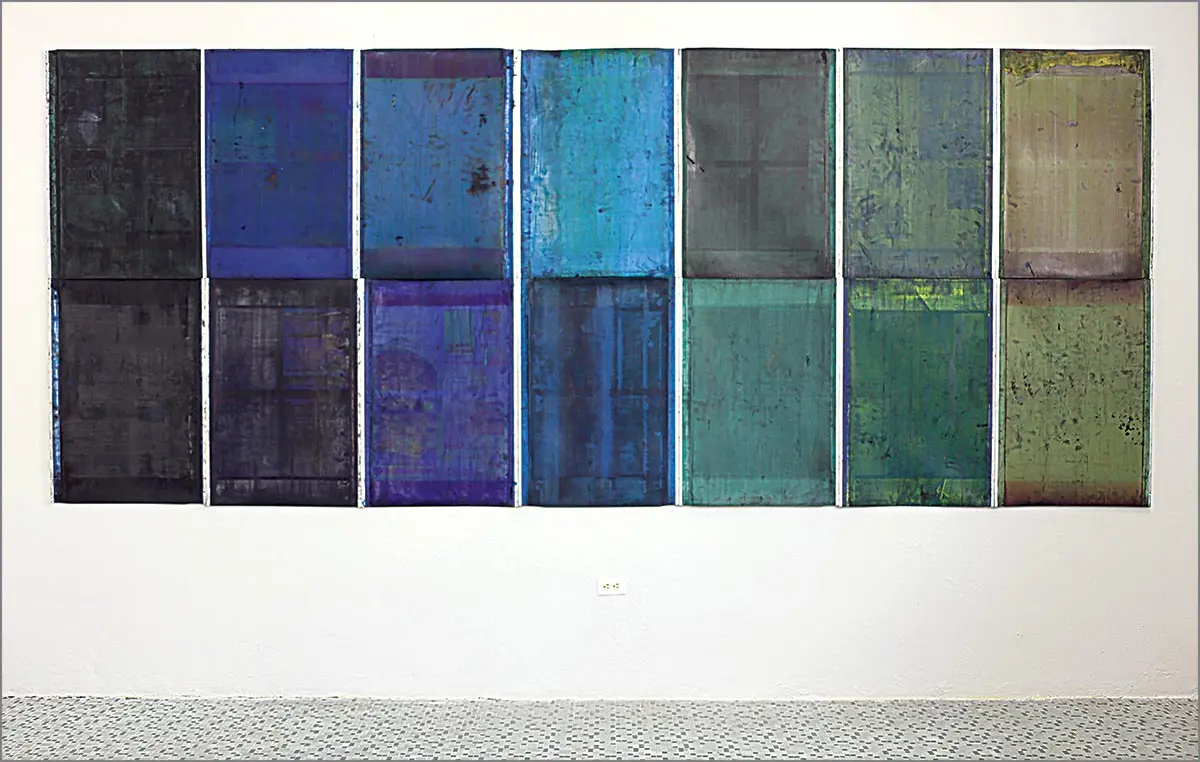
Vallecillo’s brief scavenge for objects at the National Press for an exhibition had striking and seductive results. 32 with 8 was a thrilling example of how he brings to his discipline a sense of the poetry and vulnerable beauty of materials and an acute feeling for the color, form, and texture of commonplace industrial objects. La Rotativa featured two rows of seven offset printing blankets in shades of grease, indigo, cerulean, seaweed, olive, and chartreuse. La Rotativa suggested a core sample from the depths of the sea and moments in the history of abstract painting. What was hard to believe was that people took bullets for those blankets. In Otro PR, Vallecillo, like the workers at the National Press, took a negative and made a positive. A grid of thirty-six pages of the black film on a bright yellow matrix for a printed booklet detailed the deplorable conditions of health and education in Puerto Rico.
Pueblo Trabajador suggested a resting figure. Vallecillo curved two black rubber bands with teeth (bandas dentadas) and placed one inside the other to form a ninety-degree angle running along the floor and up the gallery wall. Vertebral, another allusion to the body, was a forty-eight-inch-long broken line of small shaped wood and carbon blocks. This simple gesture showed Vallecillo’s remarkable aesthetic alertness to the forgotten, useless, and commonplace in everyday life. Flora Tropical, a grid of twenty-four tomato red ink prints on celery-colored paper, was made at Delgado’s The Press. Vallecillo used her Risograph, a digital duplicator, to print detail of the ubiquitous Puerto Rican office decoration--an image of a Flamboyán or Royal Poinciana tree--left hanging on the wall at the National Press.
32 with 8’s keystone piece was an audio recording of a conversation between three former National Press employees--Carlos Jiménez, Jorge Rodríguez Escribano, and Víctor Sánchez. They reflected on their experiences with Diego de la Cruz, a family friend and former La Práctica participant who works next to The Press, and Vallecillo and Delgado. Artist Omar Obdulio Peña-Forty assisted with the sound recording and Gallisá Muriente included short excerpts of the recollections in her thorough article on Vallecillo’s project published in El Rojo, Claridad’s online newspaper. The co-workers’ conversation was an illuminating remembrance of solidarity. Together they grew an independent political, industrial, and commercial enterprise that generated the need to acquire the tools to be free, and they applied their collective values to their personal, familial, and communal lives. The audio recording reminded viewers of what one cannot do without, though we lack it. A future transcription of the conversation would transcend the limits of 32 with 8.
CHERYL HARTUP