
Over the years, the formal and conceptual axis on which the body of work developed by Alfredo Ramírez (Caracas, 1957) since the mid-1980s turns, has acquired greater consistency and depth. This axis is what gives cohesion to his oeuvre as a whole, since, besides being the structure on which the individual work is formally supported, it connects the various themes to which the artist makes reference. Ramírez achieves such a degree of purity in his formal and conceptual logic that in his current work, the structure becomes an end in itself.
This renders all considerations of the media used by the artist at various points (painting, sculpture, electro-mechanic art), as well as stylistic observations such as his passage from a figurative to an abstract phase, while important, secondary. This is so because the fundamental issue in the entirety of Ramírez’s creative process is the achievement of a harmonious and proportionate relationship between the parts that comprise a body or an object, and an idea that remains in a different semantic level throughout his work. Physics, biology geometry, psychology, literature, music, art history, among others, are present in his investigations, driving, structuring, or making visible in some way phenomena that take place in nature and the human experience.
Initial Bodies
The education received from his teacher Angel Foong, an Uruguayan painter with a Chinese background residing in Caracas, and through his formal studies in Venice and Milan with Emilio Vedova, were decisive for Ramírez’s understanding of the Divine Proportion, or, as it is also known, the Golden Ratio. Assimilating the notion that the parts forming an object in nature display a harmonious and proportionate measurement has been important to the artist. This relationship is precise, logical, and responds to a mathematical formula that artists of the Renaissance intended to make known. Starting from this principle, it is possible to understand the meaning of series as heterogeneous as those created by Ramírez over the course of three decades: drawings, radiographs, electro-mechanical sculptures, translucent sculptures, among others, as they all feature underlying structures revealed through a golden-proportion formula.
At the same time, copying referential works by Mantegna, Titian, Rembrandt, Piranesi, Velázquez, Ingres, Delacroix, and Van Gogh, among others, also influenced Ramírez’s study of the relationship between the different parts of the human body. This is one of his recurrent themes, handled through different approaches to the mode of representation from his beginnings to the present time. In the mid-1980s, living in Mérida after his return from Italy, Ramírez was interested in the effects of Kirlian waves, and for this reason, his paintings of that era featured short, vibrating brushstrokes that alluded to female bodies integrated into a current of fluids, an effect expressed by means of an alternation of color hues (Twin Peaks, 1988). These figures are undoubtedly enveloped in life energy (or spiritual aura), which irradiates from it. They are transparent fluids. They are subtle bodies.

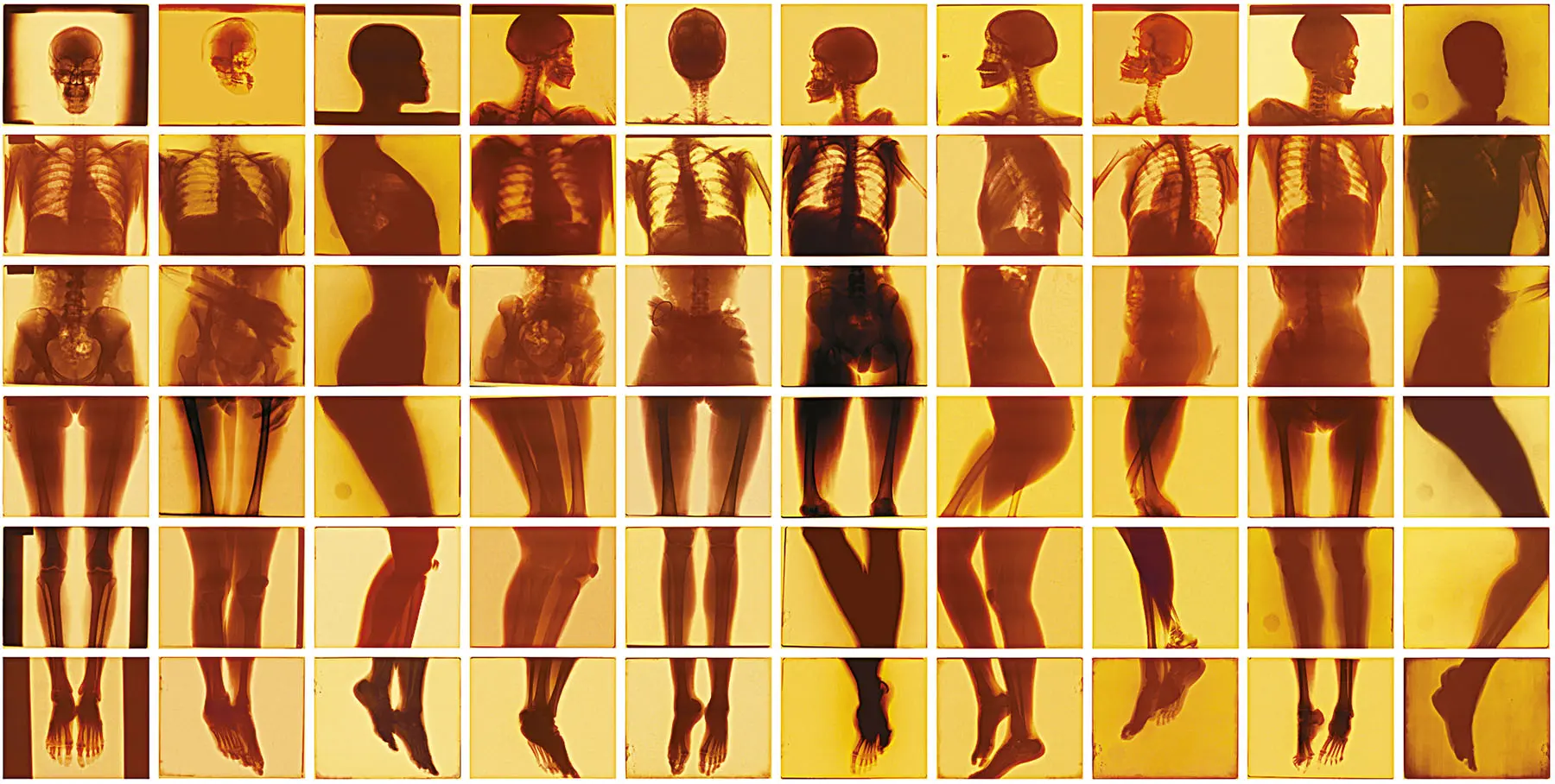
The latter quality, transparency, drove him to experiment with a previously unexplored medium: radiography. Ten female friends (accomplices) were x-rayed at an outpatient clinic at Universidad de Los Andes; the result is a photo-mural (Luz química, 1989-1990) comprised of 60 copies of radiographs of various parts of their bodies. The arrangement of the figures is of great importance: each one signals a counter-clockwise turn. Our reading of the work from left to right is reversible. In this way, it marks a Spatio-temporal cycle moving from West to East and, which the cycle restarting in reverse at the end. Ramírez has not only created a work about femaleness the nature of which differs from masculinity but has also made time relative in his proposal.
His experience of recording the bodies of his friend without the use of photographic cameras or chemicals continued between 1994 and 1997 with works titled Registros. The characters left a bodily imprint on plastic surfaces that had been previously prepared with dust, and the images resemble, in the words of Félix Suazo (MUAC, 2006), funeral shrouds.
Dissected Bodies
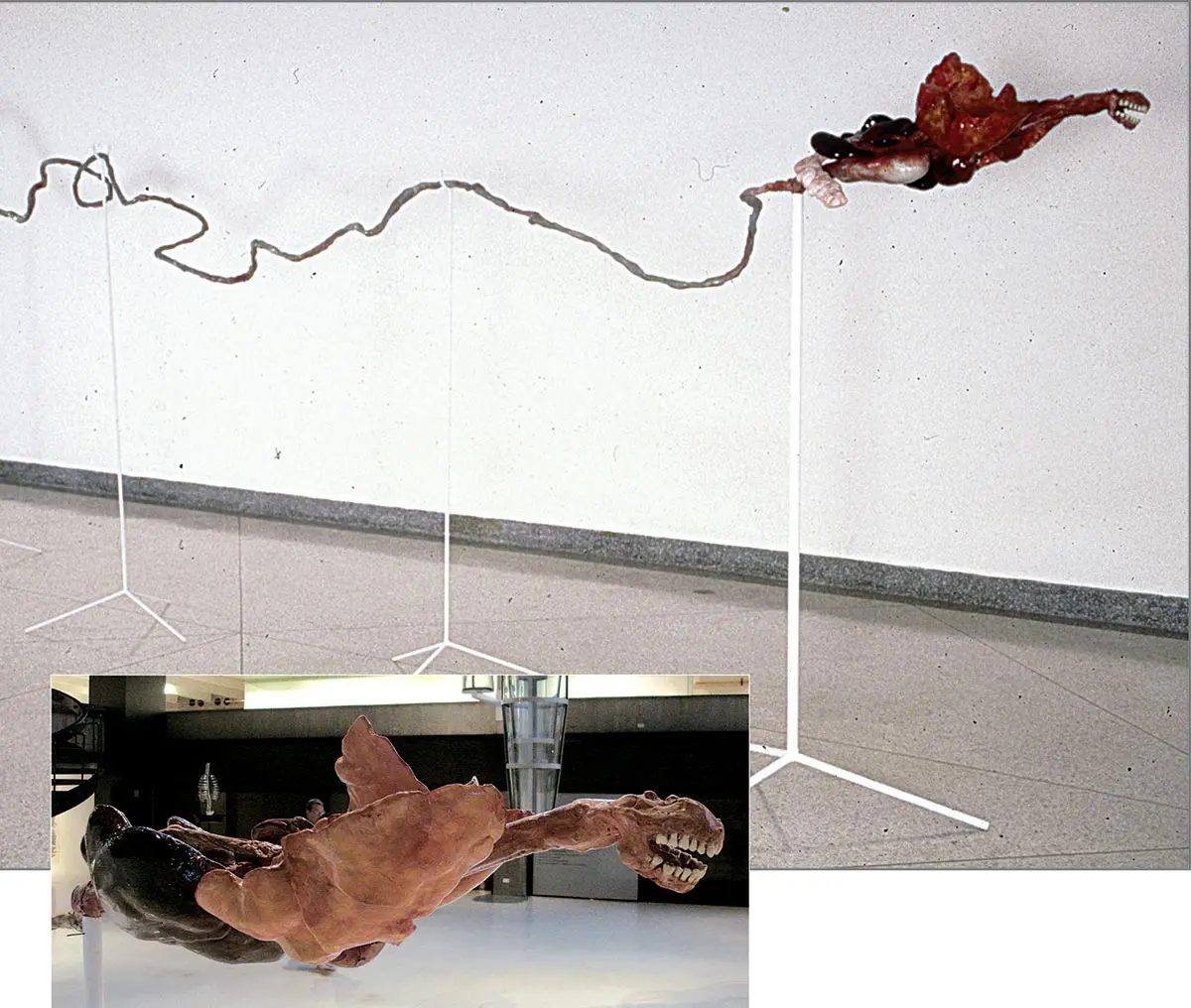
Luz química opened a door: he will traverse the body, to visualize it as light (radiograph) and understand, in anatomical terms, its bone structure. At the same time, there was an integration of scientific knowledge and a mythical reinterpretation of these characters: these are Venusian figures, entirely translucent. Once again, we are dealing with subtle bodies. Yet, since his childhood, Ramírez was interested in the interior of bodies, something that was reinforced after a serious lung operation made with a heavily invasive technique. One consequence is his Modelos tridimensionales, works with which Ramírez brought into view the opaque, visceral, loathsome aspects that our bodies hide. Using resin and color, it extended in a realistic way all the components of the endogenous system: mouth, trachea, lungs, heart, liver, stomach, spleen, duodenum, large intestine, small intestine, all as a single fleshly tube: Tubo de carne (1996), rising in the attitude of flight. As Ramírez notes, “This system is unknown, it is the horror. It is synonymous with pain. It is in a situation of flight because the totality of functions of the endogenous system is independent of consciousness and of will, which does not decide anything about the workings of the organs. So, it is a free flight”. The organic and the hidden become a volatile element and, paradoxically, light. That year, 1996, Ramírez exhibited La Novia de Corinto at Sala Mendoza, where seven representations of the endogenous system traversed space as "monstrous birds of thirsty vampires".1
On the other hand, since the early 1990s, Alfredo Ramírez worked on a different kind of experimental art, which he continued to develop throughout the decade: spinal cords and electro-mechanical sculptures.
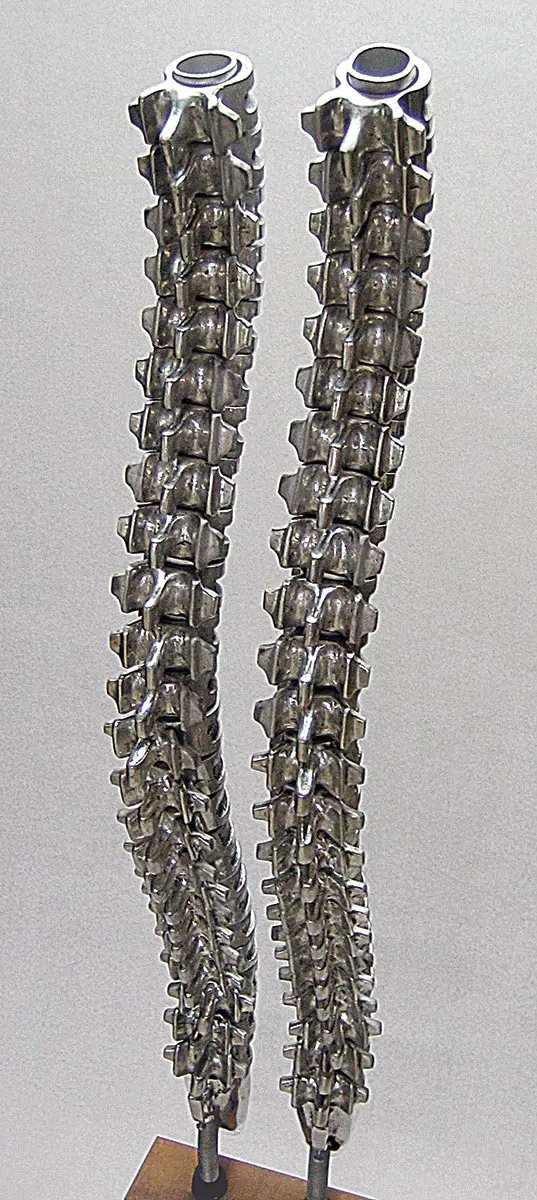
The spinal cord is the body’s (and the artwork’s) structural axis. These chords, or columns, possess in turn a variety of meanings according to their anatomical representation. Laboratorio de sueños (1991) was the first in the series. In it, a refrigerant gas compressor freezes the chord. The intention: to slow downtime in order to stop cellular transformation ad its connection with thoughts and dreams (the brain). Every neuronal branch goes through the spinal cord. With the chord frozen, all bodily transformations are stopped. Birth Right Column (1997) represents the anomalous morphology of two conjoined-twin girls with a single, but the bifurcated spinal cord. Another example is Transfiguración (2000), which refers, contrary to the previous instances, to Christ’s transfiguration on the third day after His Resurrection. These are parallel columns that, reproduced twice, represent the same person: Jesus. Ascending intermittently between them is an electric current, metaphorically equivalent to a life impulse: the element that balances the boundary between life and death.
A Mechanics of Affection
Marcel Duchamp created, graphically, a seduction machine in The Bride Stripped Bare by Her Bachelors, Even (The Large Glass), 1913-1925. Octavio Paz writes in Apariencia desnuda about the way in which the bachelor’s in the Large Glass become aroused as they sense the emanations from the bride in the higher plane. Automatically, the gears of this marvelous love machine are activated. Decades later, Ramírez decided to materialize and bring into practice a way to visualize the physiology of love: through his electro-mechanical sculptures. These works, described by Costanza De Rogatis as a "fascinating artificiality",2 are machines in motion that allude to the topic without romanticism and with the coldness of a scientific approach to the workings of the inner body. The components of Ramírez’s installation El beso automático, from 1992, have Bauhaus-inspired ovoid shapes. They are arranged according to the parameters of the Golden Ratio. The fan irradiates a "divine wind, a heat that comes from the universe" as it inflates the blue fabric, a tongue that in turn penetrates the ovule (vagina or female head). It is kiss and coitus at the same time. The automatic kiss is activated as the chord is moved by the air-filled tongue. This capital work gave rise to the Beso automático from 1998: a structure comprising a central axis and two silicone-covered heads. It is the explicit representation of a kiss that two conjoined girls share repeatedly. The two heads turn on their axis and, as they meet face to face, an electrical charge is emitted. As in the hidden faces of Magritte’s lovers, a feeling of asepsis is produced that also expresses a certain degree of coldness.
Translucent Sculptures: Linternas
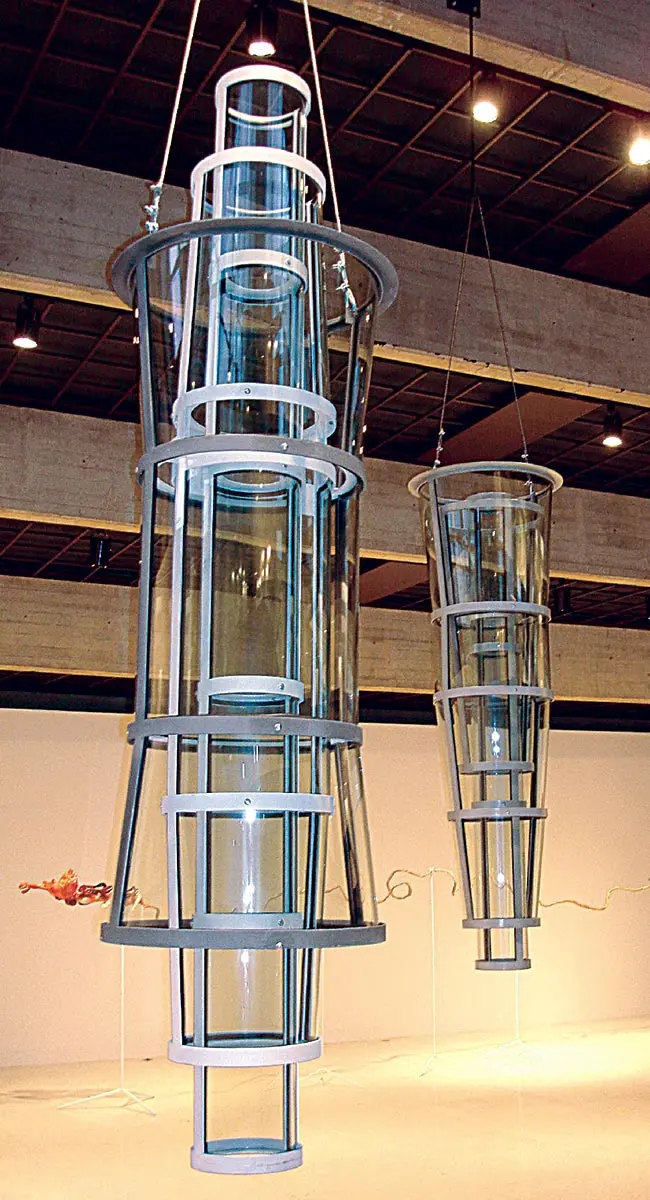
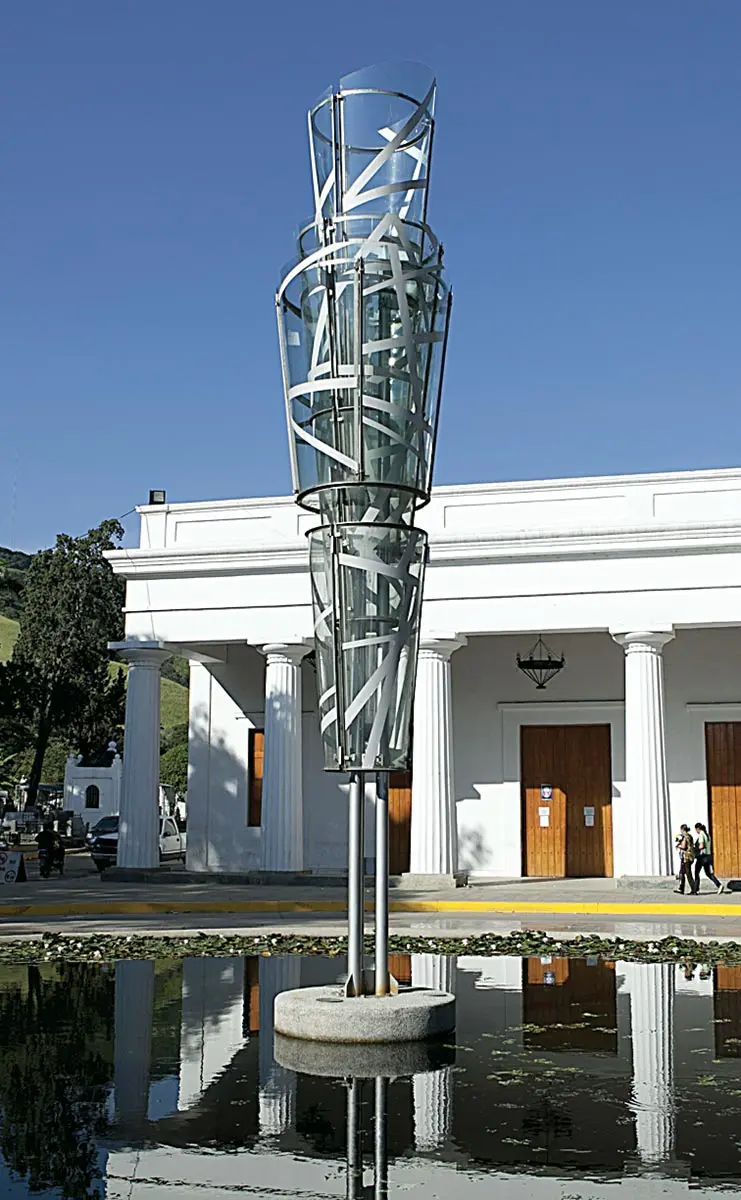
In meditation, Ramírez explains, one perceives a light. His Linternas are translucent works that seek to materialize such a vision. They are comprised of three sections, each corresponding to one Golden-Ration number. A progression is established. In these vertical bodies (axis), one cone is inside the other. "As with the organs, which are encased by the rib cage, the body is divided into strata: first are the ribs, then the muscles, finally the skin." Ramírez’s Linternas, then, refer also to the human body and are built on the basis of a pre-established proportional pattern. Light, in this case, is the golden number, as the starting point is that human beings are luminous.
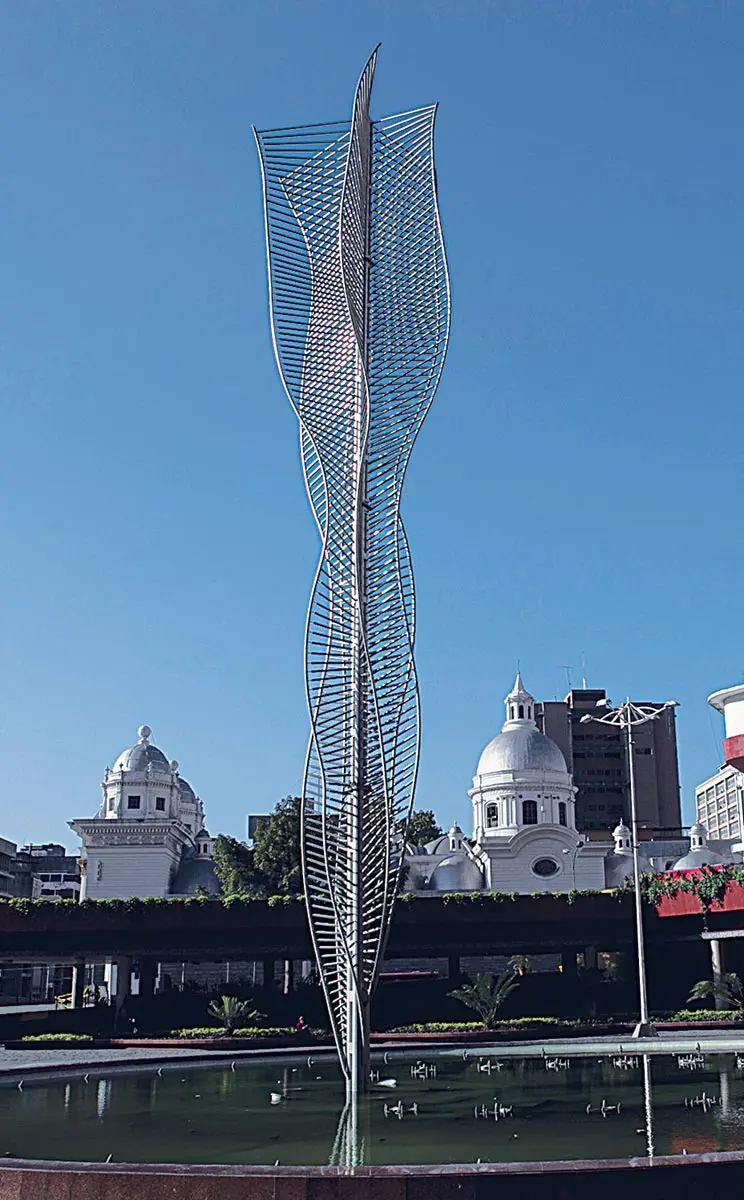
These translucent sculptures (or structures) have made it possible for the artist, during the decade of 2000, to explore in greater depth two aspects that are also interconnected: proportionality and scale. During this period, Ramírez was worked on structures that are free of anecdote and figuration. Three important and recent urban-scale works are worth mentioning: Hug (2006), Biosílice (2011), and Aguja de Caracas (2011). The latter work, conceived under the same notion of transparency, retains a harmonious and proportionate relationship in front of the two towers at El Silencio, emblematic constructions of Caracas’s late-1940s modernity.
Drawings and Dragons
The study of the Divine Proportion in connection with natural phenomena has involved for Ramírez the adoption, in his work of the 2000s, some basic concepts from the field of physics. Concepts like singularity and space-time—a line of reflection that persists from the 1990s—are embodied in his works. "It is very beautiful," the artist says "because in the singularity you capture space and time as a single entity. In physics, one no longer speaks of space and time as separate. One speaks of the cone of space-time. Then, what is the singularity? It is a phenomenon that, because of gravity, produces a compression of time into infinitely small spaces." This phenomenon is expressed in a drawing titled Linterna (2009). This work, in an intentionally outsize format (somewhat larger than the gallery where it was exhibited), shows the implosion process (from outside into inside) of particles liberated from a star whose growth has ended. Because of the compression caused by gravity, it collapses towards its own center. What is left is a black hole, the singularity, which is precise with the totality of the star’s matter is comprised into an infinitely small point.
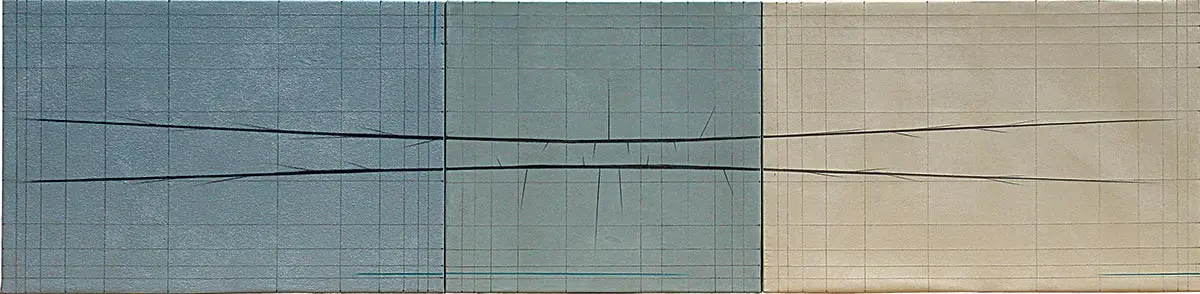
The study of physics and the study of cellular growth are themes found in Ramírez’s recent works. In his series Caja de niebla (2006 and 2008), the artist shows the “graphic” results of experiences in the electro-magnetic field using fog cameras. On the other hand, 1274-27.5 (2009) is a giant polyurethane mural with heat-carved groves representing the anomalous growth of cancer cells. Given their condition, these cells grow in a counterclockwise direction, a rhythm that is expressed in the somewhat chaotic directionality of the grooves.
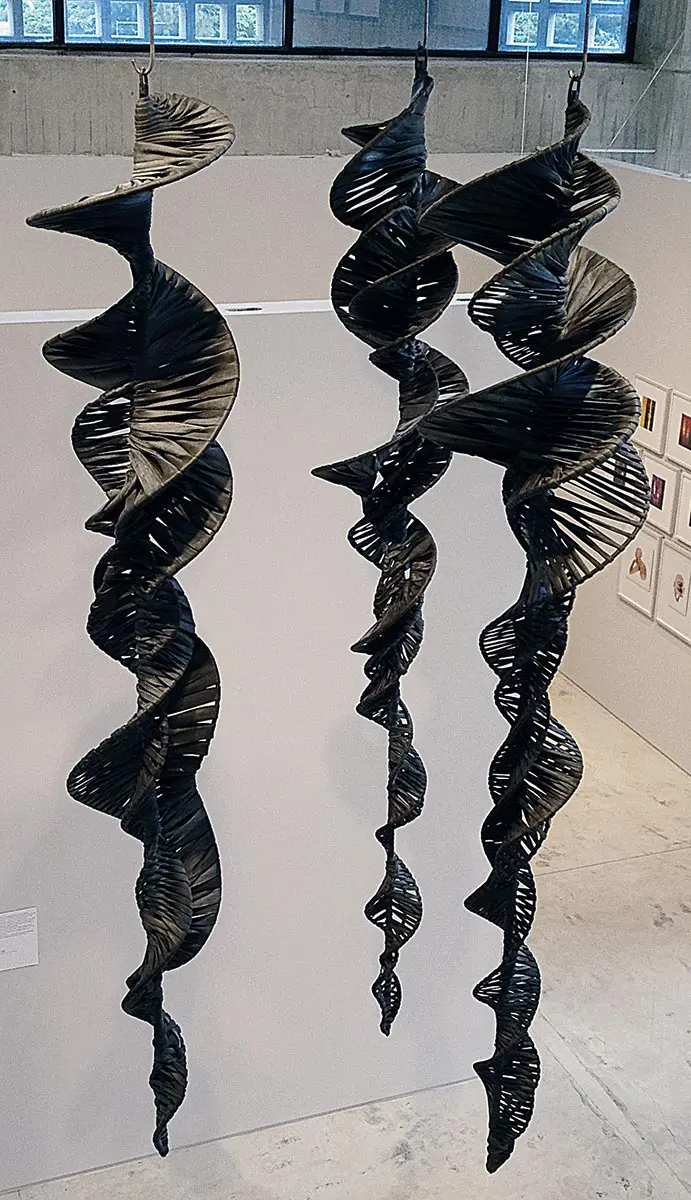
The return of biology presents today a metaphorical and abstract meaning. The idea of the dragon—already present in a 1990 work titled La sangre del dragon—has to do with the concept of what the dragon represents: the presence of all animals, which is to say, the understanding of a totality conceived geometrically through proportional relationships. A vertical axis (which supports for instance works like Preludio and Dragones, both from 2012), conceived as a totality, is divided symmetrically on the basis of a “greater/smaller than” relationship according to the Golden Ratio. With this, the artist creates progressions to infinity that are materialized in the helical shape of the works. As in Luz química, these dragons are arranged vertically. They are presences that are imposed by their force and their degree of absolute purity, as they are devoid of all content. They are pure geometry.
NOTES
1. Félix Suazo. Panorama catalog. Caracas: Museo de Arte Contemporáneo, 2006.
2. Alfredo Ramírez. Arte Venezolano Collection. Caracas: IARTES, 2008.
SUSANA BENKO