
The exhibition titled A Place to Live When We Get Old at the Museo de Arte Moderno in Buenos Aires (MAMBA) is comprised of a comprehensive selection of works created in the last ten years by Argentine artist Ana Gallardo (1958). The conception of these works is based on a persistent idea: the passage of time and the inexorability of death. The artistic object takes shape solely as part of a program born from intimate stories that belong to Gallardo and others. In this manner, the meaning is given to objects-relics, the practice of dance and song, films, and even to charcoal drawings. Nonetheless, writing—and, most importantly, the way the artist’s voice is conveyed—is perhaps the constant basis for the entire group of works. Even the epigraphs reject technicalities and disaffected descriptions in favor of writing that accompanies the soul of each action.
Mi tío Eduardo (My Uncle Eduardo, 2006) and Mi Padre (My Father, 2007) are film records that show emotions, stemming from past experiences, of two of Gallardo’s dear relatives. Through Gallardo’s gaze, uncle Eduardo sees the landscapes of Granada that he would have wanted to see again after fifty years. Her poet father reads with emotion a note found by chance in an old periodical from Rosario: a reporter chronicles the arrival of Gallardo’s parents to Argentina after leaving Spain, their homeland.
Gallardo lives in each work. She is like a sensitive host that opens her home to visitors, invites them to seat and shares with the family photographs and also her deepest and most unsettling feelings. For a year, Gallardo and her daughter were homeless and had to move often from one borrowed house to another. She lost most of the furniture that they had to leave in storage. The few things that Gallardo was able to recover were used in the piece Casa Rodante (Trailer Home, 2006), a utopic home that she even paraded through the streets of Buenos Aires.
Extracto de un Fracasado Proyecto (Extract From a Failed Project, 2011-2015) is based on an unfinished project developed in a retirement home for former prostitutes in Mexico City. For a time Ana Gallardo cared for Estela, a person with complete paralysis who eventually died. That experience established the groundwork for possible work. But, how could a narrative be developed when the material, because of its raw nature, can hardly be expressed through the usual forms of writing? Thus, the entire body must be put into action. A museum wall is perforated from end to end, word by word. Only then can the story acquire the required spatial-temporal dimension. There will be no choice but to slow down and take the time to go over the writing and become the flesh of a grim and intimate confession. A while back, Gallardo addressed in the following manner how she would suggest viewers read her work: “[…] I wish to encourage thought that is sensitive, emotional, and cathartic; thought that above all else is generated by the emotion.” And this statement continues to ring true in her work today.
In Currículum Laboral (Work Curriculum, 2009) Gallardo tells with her own voice the type of jobs that she has and had to do in order to make a living and support her family. It is striking the variety of jobs that she has performed and how she still managed to never deviate from her goal of becoming an artist.
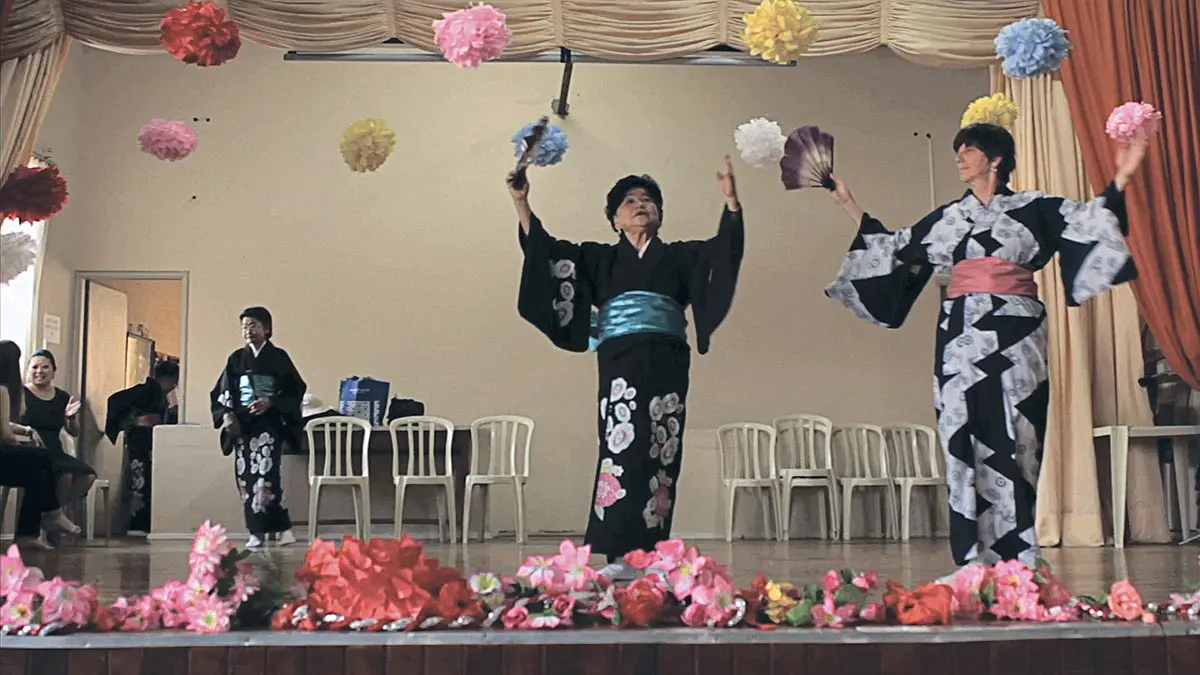
In the series Primary Actions, she delves into the activities performed by persons over the age of 70, immerses herself in their spaces, and takes over their vital rhythm. A group of Korean women practice Karaoke; another group gathers to perform typical Japanese dances. Like a feminine version of Zelig—the character created by Woody Allen that adopted the characteristics of the persons that he got near to—Gallardo dresses, dances, sings, and behaves like her subjects of study, as she once again involves her entire body. But her goal is not just being like them in order to be accepted by the group—as Zelig did—or merely to perform an empty role, but rather to get as close as possible to the experience of being old, within a happy context in which art can still survive and, most importantly, appease the shadow of death.
The installation titled Boceto para la Construcción de un Paisaje: La Laguna Zempoala (Sketch for the Construction of a Landscape: The Zempoala Lagoon) spread across the large exhibition room located in the 2nd basement level and marked the end of the exhibition. A large group of charcoal drawings produced between 2001 and today completely covers the walls. Located in Mexico, the Zempoala Lagoon in Mexico becomes the place that Gallardo selected to spread her mother's ashes across the landscape. Her mother died when Gallardo and her sister were still very young children. There once again writing appears as an introduction to the work: an emotional text written from the heart, and not subjected to revisions, corrections, or additions, precedes the exhibition room. The tone established by the texts continues on the lines of the charcoal drawings. It is as if the series has taken a life of its own and expands ad infinitum, finally achieving the ultimate goal of transcending death.
VIVIANA SAAVEDRA