
In a world conditioned by the standardization of compartments and the mechanization of everyday life, the interaction between the sociological and artistic fields reveals that connections between art and life continue to be part of contemporary aesthetic debates.
This notion has been the leitmotiv in the work of Brazilian artist Ana Maria Tavares and is reflected in Forgotten Mantras, her second solo exhibition at the Silvia Cintra Galeria de Arte in Rio de Janeiro. In addition to four works from the series of the same name (two-dimensional polished stainless-steel plaques with words engraved on them), the exhibition also includes an installation with small works that form “mantras” based on words like desire, delight, stilnox, lexotan, and sex that can be mounted in different ways.
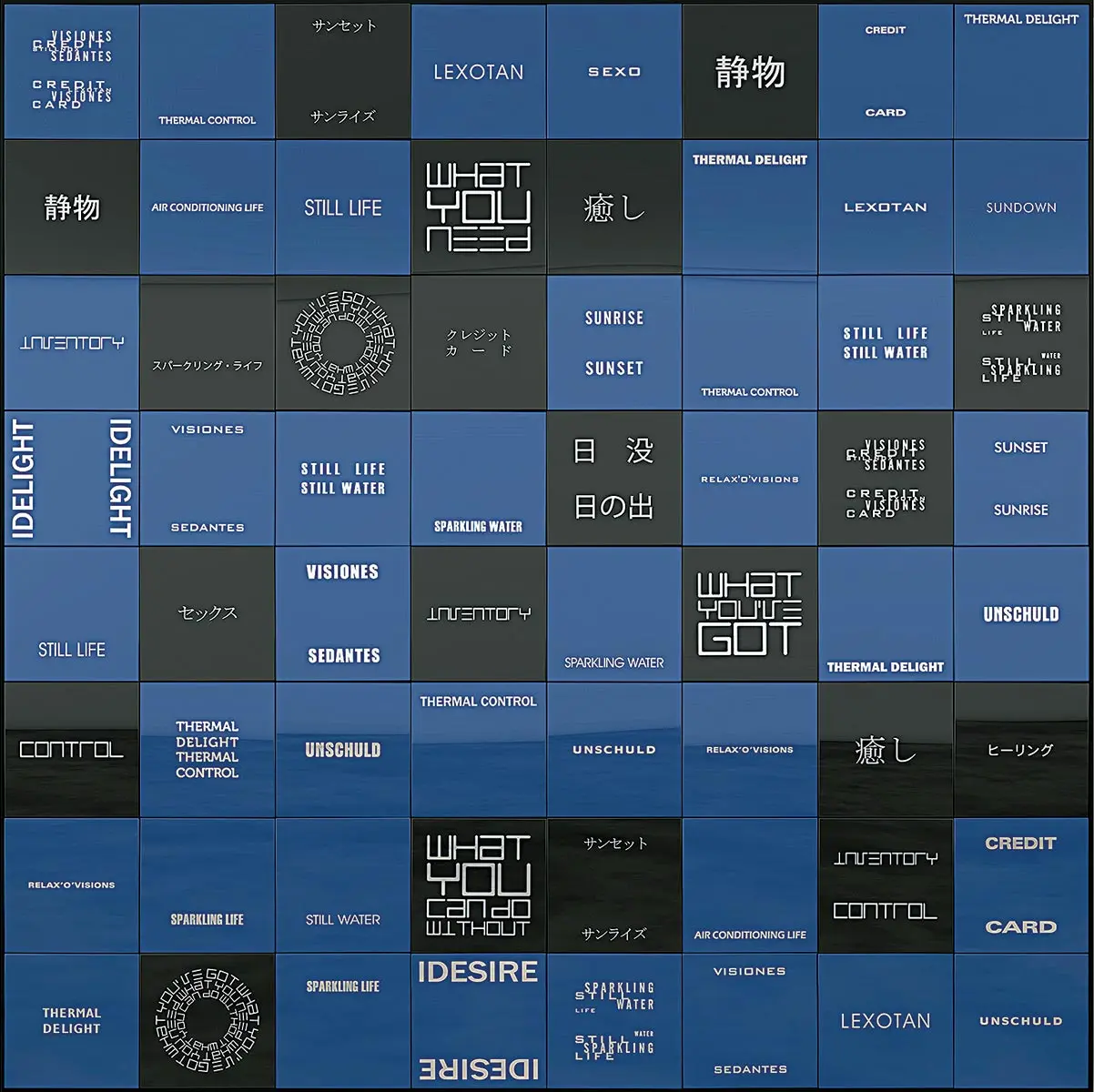
According to Tavares, “mantras are like a synthesis of the present and work lke signs to navigate the contemporary world.” It is precisely for this reason that mantras have increasingly become more complex and are conceived in several languages, encouraging homogenization and repetition from one culture to another, all contaminated by copying.
Tavares began to incorporate words in her work in 1997, but it was in the series Cityscape, specially created for the 50th anniversary of the São Paulo Biennial in 2001 when mantras began to play a bigger role in her proposals. In that series, Tavares used eight words and expressions printed on polished stainless steel, which together formed a large panel that reflected the image of Ibirapuera Park.
At the beginning of her career, Tavares created paintings that worked as sculptures or objects for installations. Then, she began to create objects that combined the concept of sculpture with that of design. In recent years, she developed works that consciously appeared uncertain about the reality of art and the reality of life. This is the case of the installations that she exhibited in large institutional spaces in Brazil and abroad.
Tavares worked to promote an aesthetic that reached beyond the physical and intellectual spaces of museums and galleries. She was recognized for her highly fluid public works, like those exhibited in airports, in which she presented recurrent themes that symbolized a sort of exile from everyday life through places suspended between the real and the virtual. One of her most prevalent concepts was the idea of the “non-place” developed by philosopher Marc Augé, particularly in projects for places in which notions of identity and history are not present, namely places that are not memory friendly.
For this exhibition, Tavares appears to have returned his work to the artistic space, also showing that, as art critic Tadeu Chiarelli once declared, Tavares has “created a niche between poetry and the visual arts.” About her use of words: it is an element punctuated throughout the entire survey of the history of art during moments with peculiar characteristics. As scholar Simon Morley pointed out in the book titled Writing on the Wall, we can follow that “symbolic quality of words” from the Renaissance to the posters by Henri de Toulouse-Lautrec, the vanguards (cubist collages, paintings by René Magritte and Fernand Léger) in the postwar—like, for instance, the 1959 painting Trophy 1 by Robert Rauschenberg—or even the 1970 conceptual works by Lawrence Weiner, like Earth to Earth Ashes to Ashes Dust to Dust, among others.
By saying that images can be read in the same manner in which we read words, Morley is affirming that this operation represents an offensive against all forms of fundamentalist thinking, given that the relationship between images and words promote ambiguity and a stance against pattern codes, eliciting a semiotic whirlwind that exerts pressure on the calm surface of language. Thus, Tavares returns to the institutionalized space through aesthetic and political insubordination. This very “rebelliousness” appears in the paradox between the spirituality of mantras and their relationship with words that are part of the capitalist repertoire, particularly with respect to hedonistic pleasures and the so-called “Prozac Generation.”
ALESSANDRA SIMÕES