
Titled In Advance of a Stupid Glandule, the nearly thirty works by multifaceted Mexican artist Cisco Jiménez (Cuernavaca, Mexico, 1969) shown at the Farside Gallery synthesize about 20 years of a prolific artistic career and are a perfect example of Jiménez’s versatility when it comes to exploring different media: paintings, sculptures, drawings, found objects, assemblages, and collage that showcase the cultural-geographic palimpsest of several referents that Jiménez, an industrial designer turned artist, has been accumulating from early on in his career.
The group of pieces exhibited pay tribute to the late art critic Joel Weinstein and are part of the art collection of Arturo and Liza Mosquera. The curator, Cheryl Hartup, suggests a disordered arrangement process pertaining to the evolution of Jiménez’s creative thought. Through the incorporation of sculptures, paintings, assemblages, and installations the boundaries between art, illustration, collage, and comics are erased, questioning issues surrounding “high” and “low” art.
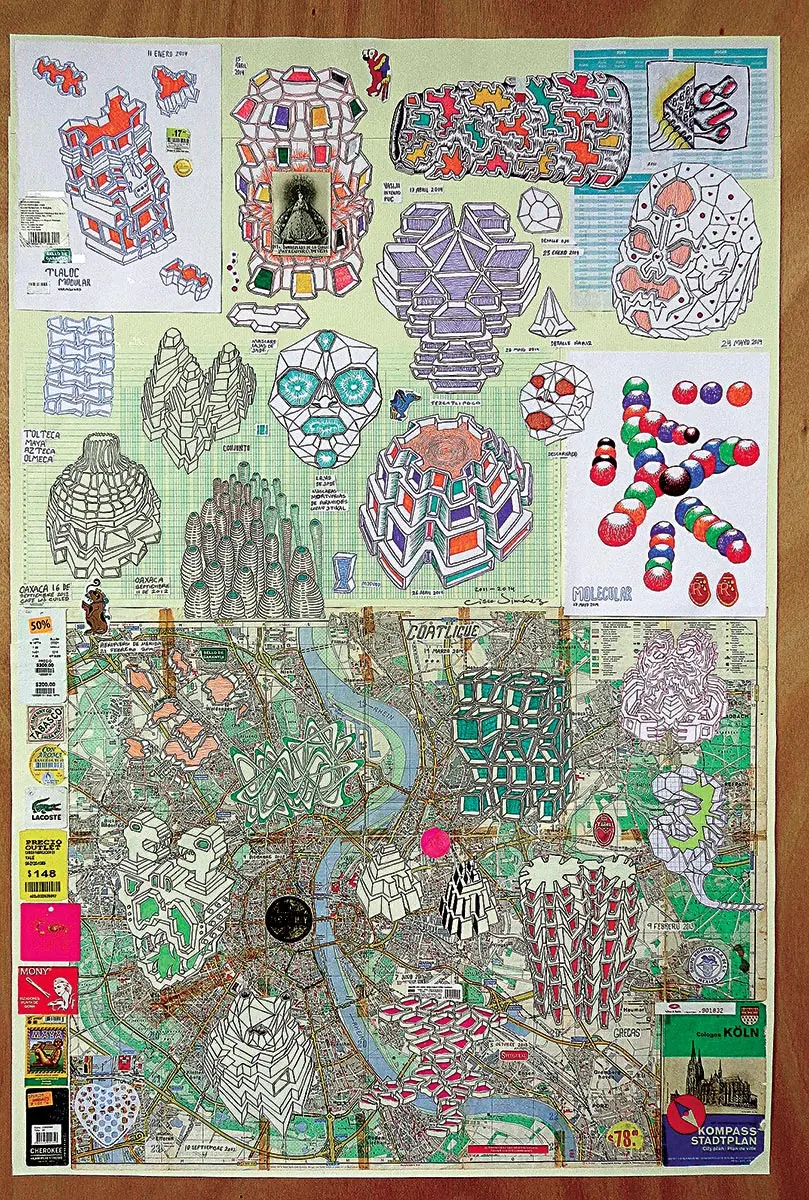
Jiménez’s work ranges from the cunning nature of double meaning and representation to the denunciation of social and cultural issues. His works reflect the idiosyncratic subversive alliance of his multiple creative interests: personal narratives, counterculture, the history and prehistory of Mexico, found and intervened objects, votive offerings, popular proverbs and sayings, activist gestures, and the use of maps of technological or corporal circuits. These are combined in planes or sculptures to build a sort of conceptual and surrealist neurosis in which valves, communicating vessels, organs, and words are responsible for establishing the connections.
Jiménez is pleasantly and constantly influenced by the humoristic vignettes from the tradition of José Guadalupe Posada, pre-Columbian cosmogonies, found objects, popular sayings and proverbs, autobiographical elements, humor, important moments in Mexican history and politics, and the influence of Robert Crumb’s underground comics, among others. Likewise, he is interested in the human body as a container of communicating vessels and organs; anatomical sheets and medical jargon are the perfect support for combining pictorial and linguistic signs.
From early on in his life, Jiménez has been fascinated by the explanatory diagrams of circuits and connections, as well as by electronic devices that had disappeared and reappeared, such as boom boxes and record players that today are regarded as “vintage” and have become very valuable. With them, Jiménez clearly alludes to all social and consumerist ailments—through direct references to technology, the massification of culture, and planned obsolescence—in connection to media culture, social activism, and political commentary.
In several of his paintings, such as in The Newest of the New, Bossa Nova Painting, and Molleja Fractal, there is a large and central element that occupies almost the entire space with abstract backgrounds on which Jiménez wrote words that refer to the subject. In this manner, each canvas attests to that speed of thought, to a sort of narrative thread of the unconscious, to the desire to record a collection of experiences, legacies, and ideas that appear in the brain; implications of words as metaphors.
In drawing-collages like Olmeca Sound Stones and Molecular Coatlique, Jiménez divided the pictorial plane into undefined spaces or vignettes on collected memorabilia to stridently illustrate his fascination for body organs, blood systems, communicating vessels, epidermal maps, utopic societies, and futuristic spaces, robots, and anatomical illustrations, as well as cartoons of Aztec goddesses on which he once again incorporated words, proverbs, and neologisms from the popular lexicon. His drawings are precise, delimited, and the point. They pay attention to detail and rely on the verbal satirical elements that accompany the rest of his body of work.
In Advance of a Stupid Glandule brings together Jiménez’s voracity for popular consumption and Mexican tradition; in this manner, a green wall at the end of the exhibition presents, like oversized vote offerings, about fifteen small assemblages and paintings created with found objects: rims, flip-flops, superimposed leather shoe soles, wood carvings with hair and intervened adverting posters, among others. Next, viewers find the sculpture titled Campesino (Peasant), a wood carving portraying a man intervened with tequila bottles, rifles, and the word culero (asshole) in reference to a sort of traitor—a commentary on the social unrest experienced by that sector of the population in Mexican society.
A critical observer of our time through a lens that is both nostalgic and forward-thinking, Jiménez underscores the popular culture in which he grew up, the pre-Columbian mythologies that gave him his history, and the media culture in which we leave today. His work is hybrid, irreverent, syncretic, critical, and sagacious; his humor is caustic and his imagination infinite.
AMALIA CAPUTO