
Corina Briceño stands out for her extraordinary ability to visually explore the natural and urban environments and integrate mediums (graphic arts, painting, collage, drawing, photography, and video). Her creation is geared toward the discourses that express the processes of construction-destruction of the figure and the landscape in field explorations, with a refined power of synthesis of the image.
In recent years, Briceño radicalized the core of her concepts towards the fragility of memory, the accumulation-disappearance of recollections, and the manner in which those processes are permeated by everyday life, her relationship with nature, and the manner in which memory can alter the perception of that which we observe, feel and are able to accomplish. The exhibition titled 123 Flowers offers that same reflection, but this time memory has more to do with the out-of-control violence that has permeated everyday life in Venezuela. Briceño constructs a poetic iconography and documental archive that takes the violent act to a deep existential expression.
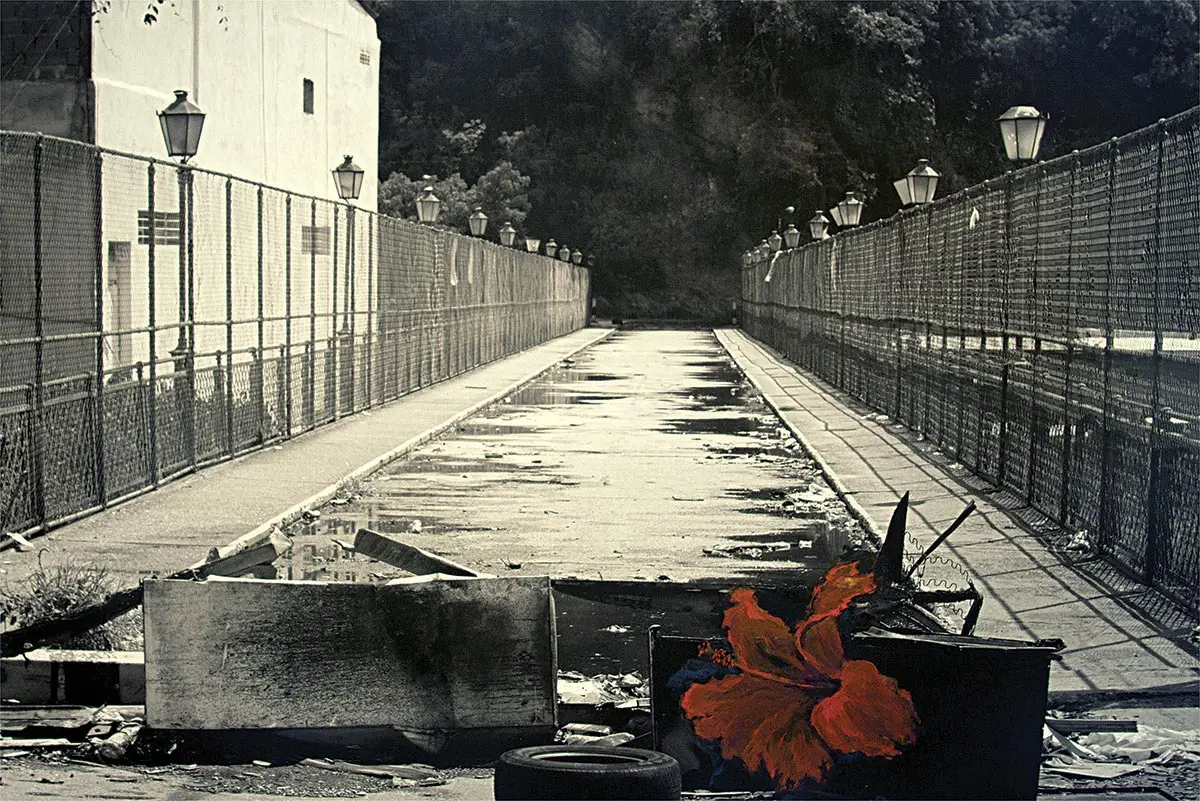
Two central elements permit the structure of the project’s conceptual basis: the first, processual in nature, is the notion of movement; and the second, existential in nature, a reaction to the out-of-control violence that has disrupted the lives of Venezuelans and transformed Caracas into one of the most dangerous cities in the world. Around 2005, Corina Briceño began visual documentation of sites and situations that generated reflection—intervened walls by the disenfranchised, for instance—and, later, she began to identify emblematic places at different times of the day from her car, during her commute from home to work at the Instituto Armando Reverón. The collection of images represents a record of the passing of time and the changes undergone by the city, its streets, buildings, and monuments. At a time when the country is falling apart, this record becomes powerful as a memory. The movement, which stayed pretty consistent for several years, was then joined by the second structural key that comes from life experience. The sign of violence has marked every inhabitant of this land, and this did not go unnoticed by Briceño. So when in 2014 she observed the dramatic increase of victims fallen, she did not hesitate to incorporate the events into the iconography of everyday life. And these works, with their precise style and piercing poetry, are the result of that. Carefully selected, the photographs from several periods were intervened with very subtle flowers and painted with acrylic and watercolor.
The 125 flowers refer to the victims of a genocide originally perpetrated by common criminals. But as years have passed other types of violence have appeared in the form of shortages of food, medicine, and basic services. These elements in the exhibition become symbolically representative of a fraction of the 390 murders that occurred the month when Briceño decided to approach the problem: cayenas, lilies, and roses—whether the complete plants or fragmented petals—appear to delicately populate like spectrums the usual itinerary among the streets of Caracas. The grey tones on a background with buildings and monuments flooded by sunlight or diffused through rain, strengthen the rather subdued palette. Some journeys fade among the drops and fog. In this manner, the icon of María Lionza on the Autopista del Este (a cultural reference in Venezuela) raises her voice between the fog and a cloud of white flowers. In 12 Azules y Gotas (12 Blues and Drops), the car window and the rain dilute the Estadio Universitario and serve as background for 12 blue flowers that could very well be marks left by bullet impacts. In other pieces like Cayenas y Bolivar, the Torres de El Silencio and the Asamblea Nacional building stand out clearly to give way to a rain of yellow cayenas. The city changes rapidly, and this work could be a visual-aesthetic record of such changes, given that between the moment of the topographic take and the present, the shameful eyes of the dictator, who had appeared to be contemplating the fall of the city, have already been erased.
But perhaps the most emblematic piece is Rojo en el Puente (Red in the Bridge), where a broken sewer, a tire, and a red cayena have severed the connection between the church La Pagüita and the El Calvario Park, accentuating the perceived absence of escape exits.
These images lead us to an intangible plane, blurred and barely perceptible, which we are sometimes unwilling to recognize in order to avoid pain. But they are also redeeming images and their authentic poetry does not distract from the screams that emerge from them as warning not to forget the truncated lives. There, in that clamoring for justice that hurts, is where this proposal by Corina Briceño becomes compelling and powerful.
MARÍA LUZ CÁRDENAS