
It all begins with a brief essay by Gabriela Mistral: “In the condor and the deer of our national emblem, Chileans have an uncommonly expressive symbol, one that touches on two different aspects of the spirit: strength and grace.” Using the two local species that are Chile’s national symbols, Mistral was subtly giving us her view of Chilean identity. Fernando Prats appropriates this strategy. The Andes mountains, condors, and the stars are the co-authors of this solo exhibition. And the vehicle for it is poetry.
Prats’ video Carnaza de la poesía (Poetry’s Carrion) is highly suggestive. A group of condors feeds on animal carcasses. Among them, strewn on the ground, are poem verses that refer to local landscapes, written by Chilean authors—most of them dead, including Mistral. The metaphor “poetry’s carrion” is rendered literal. A metaphor for those who, in the present, take advantage of the legacy of artists from the past? In her essay, Mistral described herself as more deer-like than condor-like. Had she seen this exhibition, she would have eagerly confirmed this self-assessment. The video is in good company: large drawings—if they can be called that—created by the actions of the birds’ flapping wings, air, and smoke. What remains are gestures, traces of the passage of nature that reveal motion and lost vitality. A kind of radiography hanging on the gallery wall placed like clothing in a store. Saliva, blood, and dust are among the elements with which Fernando Prats collaborates. His intervention is limited to placing the supports on which nature is to have an impact, or to adjusting the frame in order to record the exercise. And we move from a “from below” to a “from above”.
In the series Mapa mudo de los Andes (Mute Map of the Andes), the artist rolls up his sleeves. The traces left behind by smoke and air reappear, yes, but here Prats uses oil on the photographs and the paper. The result is a series of images that resemble defective smartphone or computer screens. Equivocal and suggestive visions. Prats carries this maximal economy of means into another video, Poema invisible (Invisible Poem): via digital manipulation, he transforms the Andes by playing with their symmetrical reflection in a fluctuating figure, a slash in the sky. Chile, land of poets. Poetry of the land. And from its highest elevation, the Andes, we move toward an endless ceiling: the sky. A gigantic portrait of the night sky above the mountain chain.
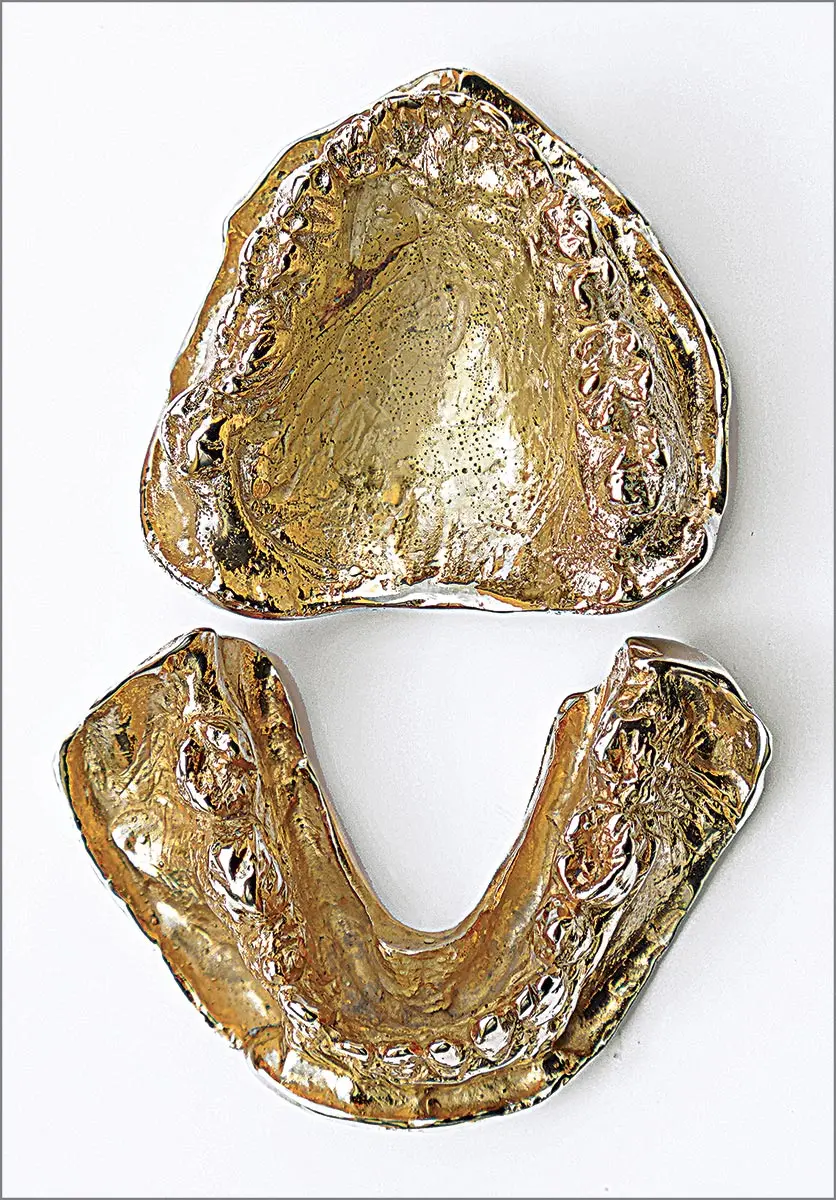
Not everything here is large-scale. There are also small objects that help us find the point of coherence for this “poetry carrion”. Cordillera dentada (Serrated Cordillera) is a model, in bronze and gold, of an open set of jaws. An artifact (in the manner of Nicanor Parra) that connects the human and the natural.
Fernando Prats returns to Chile bringing with him a series of works that move back towards the essential. In his career, we can identify a logical trajectory—if exploring such extreme regions implies anything as evident as that—and an evolution that begins with the primacy of texts over images. In this body of work, the letter is ahead, be it in those feasting condors (guided by the stench of poetry) or in the poetic object with the golden teeth. This is the Word made into art. The smoke and oil that sketch on paper the repeating shape of an “H” gives us a possible key: more deer (hemul in the local terminology), less condor.
JUAN JOSÉ SANTOS