
French curator Philippe Cyroulnik, who is more than a sporadic visitor to the local contemporary scene, proposes a dialog between “two Grand Dames of Argentine pictorial abstraction” and two historic works by Raúl Lozza and Manuel Espinosa as transgenerational guardians of the scene. This exhibition, which opened during the Buenos Aires summer season, attracted large audiences and prompted fittingly poetic readings on the part of critics, thus confirming that certain moments and places remain tacitly in waiting for a given event that, when it comes to pass, focuses the attention of all concerned. This was a necessary exhibition.
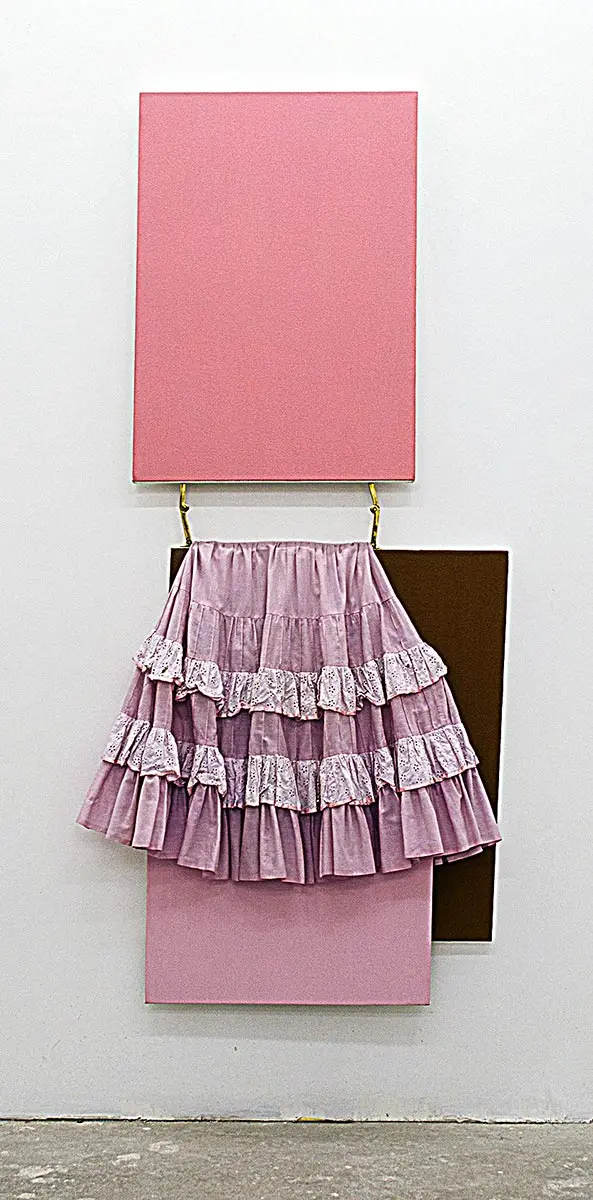
Given the uniqueness of Graciela Hasper’s and Mariela Scafati’s work, so decidedly assumed by the artists themselves, their participation in an experience that does not eschew an element of playfulness strengthened the force of their individual/personal artistic proposals. With significant careers already behind them, both Hasper and Scafati engage the subject of color via a classic medium such as painting, in dialog with the discipline itself, with the history of international art, and with elements of everyday reality. Yet, the paths they have followed have been divergent, almost contrasting: vivid, saturated colors in the case of Hasper; an atypical palette, obtained by mixing, in the case of Scafati. Not all the works featured are recent; rather, each selection functions as a concentrated anthology. The curator crafted a forceful presentation that can be seen as a thesis about the continuity of painting as a discipline across centuries and the genre’s resulting dynamism, after new paths opened up from orthodoxy some seventy years ago, at the dawn of the contemporary era. These two artists take up the gauntlet deftly and daringly.
Scafati’s works make many references to works from different periods, among them Robert Rauschenberg’s famous Bed (1955), one of his earliest Combine Paintings and also one of the most emblematic. It is a genuine and long-standing instance of the origin of a new genre, a lineage to which the Argentine artist’s paintings could perhaps belong. When Barbara Rose asked Rauschenberg about the special relationship he had with his materials, the celebrated American artist replied that every material has a history of its own, a history whose foundations may even lie within the material itself and that there is no such thing as an “optimal” material for the creation of a work of art. To this, he added that all artists select their material on the basis of their own existence, their familiarity, or their confidence. Meanwhile, among us, Kenneth Kemble was among the first historical figures to feel the need to integrate other objects and materials into his painting.
Hasper has always worked in the terrain of geometric abstraction with great skill and deep knowledge. In her work, colors vibrate in their saturation as they traverse interconnecting lines or circles, squares, rectangles, and other geometric shapes. Almost everything is always in motion in her work: color, form, or both. Her strategy subtly implies a kind of sublimated reality that nevertheless includes the whole of life’s energy.
Circling back to that dialog between the Grand Dames, Hasper unfurls an instantaneous presence in the glitter of the modern city and its environs. We must remember that she hasn’t lacked in reflections about the geographic identity of her abstract art. She has paid close attention to Helio Oiticica, Lygia Clark, and Lygia Pape. Scafati, in turn, makes allowances for a certain languor, for evocativeness and reminiscence. The real-world objects she incorporates into her work are chosen with attention both to reason and emotion. Clothing items—sweaters, a skirt with ruffles, a small modern-style piece of furniture used as support for a wholly abstract work—fuse into her paintings. These perfect combinations express that which painting doesn’t: the warmth of wool, the flight of a skirt in dance. A baroque Hasper; an essential, stripped-down Scafati; and a counterpoint that could continue just like their celebration could endure in time.
MERCEDES CASANEGRA